
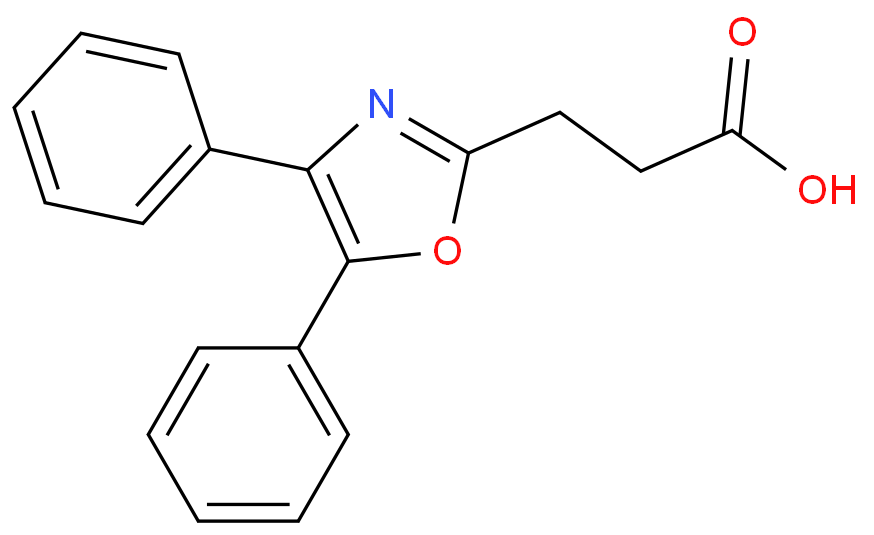
Oxaprozin, chemically known as 4, 5-diphenyl-1, 2-oxazole-3-propionic acid, also known as phenylacetic acid and oxaprozin, is a propionic acid class NSAID. It is an effective inhibitor of cyclooxygenase, thus inhibiting the biosynthesis of prostaglandins, which leads to its anti-inflammatory, analgesic, and antipyretic effects. Oxaprozin effectively treats ankylosing spondylitis, rheumatoid arthritis, osteoarthritis, degenerative arthritis, pericapsulitis of the shoulder, and gout attacks, as well as providing anti-inflammatory and analgesic effects for injuries and post-surgical conditions. It features rapid and complete oral absorption, prolonged action, and minimal gastrointestinal side effects. Currently, Oxaprozin is approved in our country only in tablet and enteric-coated capsule forms. It has significant anti-inflammatory and analgesic effects similar to ibuprofen and aspirin but is used at lower doses compared to ibuprofen and aspirin. Its strength is higher than indomethacin, and its side effects are less compared to other NSAIDs. Oxaprozin, when taken orally, reaches peak plasma concentrations within 3 to 4 hours, with a half-life of approximately 50 hours.
Meloxicam, sold under brands like Mobic, is an NSAID used to treat pain and inflammation associated with rheumatic diseases and osteoarthritis. It can be administered orally or via intravenous injection. It is recommended to use the lowest effective dose for the shortest duration possible. Common side effects include abdominal pain, dizziness, swelling, headache, and rash. Severe side effects may include heart disease, stroke, kidney problems, and gastric ulcers. It is not recommended for use in late pregnancy. It selectively inhibits cyclooxygenase-2 (COX-2) more than cyclooxygenase-1 (COX-1). It belongs to the oxicam chemical family and is closely related to Piroxicam.
Meloxicam was patented in 1977 and approved for medical use in the US in 2000. It was developed by Boehringer Ingelheim, but is also available as a generic drug. In 2022, it was the 29th most commonly prescribed drug in the US, with over 18 million prescriptions. The intravenous version of Meloxicam (Anjeso) was approved for medical use in the US in February 2020.
Oxaprozin: Oxaprozin is used for treating rheumatoid arthritis, osteoarthritis, ankylosing spondylitis, cervical spondylosis, shoulder periarthritis, gout, as well as providing anti-inflammatory and analgesic effects for injuries and post-surgical conditions.
Meloxicam: Meloxicam is used for symptomatic relief of pain, swelling, and soft tissue inflammation related to rheumatoid arthritis, osteoarthritis, traumatic pain, and post-surgical pain.
Common side effects of Oxaprozin: Gastrointestinal reactions, dizziness, drowsiness, and rash. Contraindicated in patients with gastrointestinal ulcers, severe liver or kidney dysfunction, allergies to the drug, and asthma. Recent reports suggest it may increase liver cancer incidence in mice.
Common side effects of Meloxicam: Gastrointestinal reactions (e.g., dyspepsia, nausea, abdominal pain, or diarrhea; rare cases of ulcers, bleeding, or perforation), anemia, leukopenia or thrombocytopenia, itching, rash, stomatitis, mild dizziness, headache, edema, and elevated blood pressure. Liver enzyme elevation (10%) and rare renal damage (0.4%) may occur, mostly resolving after discontinuation.

Oxaprozin: The peak concentration of Oxaprozin is reached within 3–4 hours, with a half-life of 40–60 hours. It is administered once daily, at 0.4g per dose, with a maximum daily dose of 0.6g.
Meloxicam: The plasma half-life of Meloxicam is approximately 20 hours, allowing for once-daily administration.

Drug interactions with Oxaprozin:
Drug interactions with Meloxicam:
Meloxicam is considered a more potent NSAID. On Drugs.com, Meloxicam has an average rating of 6.3 out of 10, with 593 ratings. 54% of reviewers report positive effects, while 34% report negative effects.
On Drugs.com, Oxaprozin has an average rating of 6.4 out of 10, with 8 ratings. 38% of reviewers report positive effects, while 13% report negative effects.
When comparing the strength of Oxaprozin and Meloxicam, consider their distinct characteristics and indications for pain and inflammation relief. Since each drug's efficacy and side effects may vary based on individual health conditions, consulting a healthcare professional for personalized advice is recommended to choose the most appropriate treatment plan.
[1]https://pubmed.ncbi.nlm.nih.gov/16197363/
[2]Li Gongchun, Wang Liye, Niu Liangfeng, et al. Synthesis of Oxaprozin[J]. Chemical Engineer, 2015, 29(10): 9-10+28. DOI: 10.16247/j.cnki.23-1171/tq.20151009.
[3]https://en.wikipedia.org/wiki/Meloxicam
[4]https://baike.baidu.com/item/%E5%A5%A5%E6%B2%99%E6%99%AE%E7%A7%A6
[5]https://baike.baidu.com/item/%E7%BE%8E%E6%B4%9B%E6%98%94%E5%BA%B7
[6]https://www.ncbi.nlm.nih.gov/books/NBK65641/
[7]Chou R, McDonagh M S, Nakamoto E, et al. Analgesics for osteoarthritis: an update of the 2006 comparative effectiveness review[J]. 2011.
[8]https://www.drugs.com/compare/meloxicam-vs-oxaprozin
[9]https://www.sciencedirect.com/topics/pharmacology-toxicology-and-pharmaceutical-science/oxaprozin
|
 |
 |



 3YRS
3YRS


