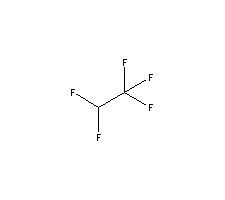
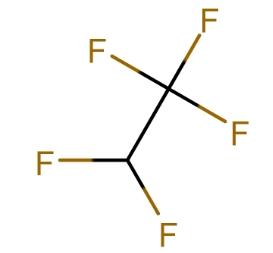
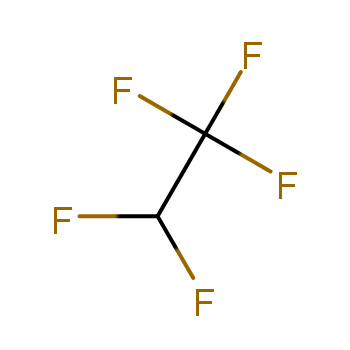
Pentafluoroethane is a fluorocarbon compound with the molecular formula CF3CHF2. It is currently used as a refrigerant (known as R-125) and as a fire extinguishing agent in fire systems. Pentafluoroethane does not deplete ozone, which has led to it replacing earlier fluorinated chemicals. However, while its ozone depletion potential is zero, it has a high global warming potential, with the U.S. Environmental Protection Agency (EPA) reporting that it is 3450 times that of carbon dioxide.
Pentafluoroethane (HFC-125) is chemically stable, non-toxic, non-flammable, has a relatively low freezing point, and suitable critical and boiling points, making it an excellent performer among hydrofluorocarbons. Its low viscosity, low surface tension, and high thermal conductivity give it high-efficiency energy-saving performance. It is a key component in mixed refrigerants like R-404A, R-407C, R-410A, R-502, and R507, widely used in refrigerators, air conditioners, refrigeration, and industrial refrigeration, replacing transitional refrigerant HCFC-22. Among many refrigerant alternatives, pentafluoroethane has good prospects and rapid development, being a new green and efficient refrigerant. HFC-125 can also replace Halon fire extinguishers, substituting Halon 1211 and Halon 1301, making it a mainstream product as an ODS alternative due to its excellent physical and chemical properties.
HFC-125 mixed with R-404A, R-407C, and R-410A can replace widely used refrigerants like HCFC-22 and R-502, demonstrating HFC-125's large market potential. For example, in R-404A, the mass ratio of HFC-125, HFC-134a, and HFC-143a is 44:52:4, while in R-407C, the mass ratio of HFC-32, HFC-125, and HFC-134a is 23:52:32, and in R-410A, the mass ratio of HFC-125 and HFC-32 is 50:50.

Halon extinguishers, containing carbon, fluorine, chlorine, and bromine atoms, were widely used due to their low concentration, high efficiency, non-conductive, low toxicity, and residue-free properties, particularly in planes, ships, electronic equipment, and communication rooms. However, due to their ozone-depleting effects, they were among the first substances banned. From January 1, 1994, production and consumption were completely stopped, except for essential uses. NAFS 125, consisting of HFC-125 and d-limonene, is a safe alternative for atmospheric ozone, with an ODP value of zero. D-limonene's main role is to reduce hydrofluoric acid produced by HFC-125 during fire suppression.
Pentafluoroethane has also been successfully applied as a foaming agent, according to reports. This foaming agent composition includes carbon dioxide, air, hydrofluoroalkanes, hydrofluoroolefins, alkanes, and hydrofluoroethers, with HFCs such as HFC-134a, HFC-152a, HFC-143a, and HFC-125 used as co-blowing agents. These foaming agents can replace those with high ozone depletion potential (ODP) and high global warming potential (GWP). They produce low-density, closed-cell foam with excellent k-factor memory (useful for thermal insulation foams) and low-density closed-cell foam with controlled, expanded cell sizes.
Pentafluoroethane is a non-flammable gas at room temperature and environmentally friendly. It can be mixed with ethylene oxide to form a gas sterilizer, which is compatible with plastics and polymers used in medical devices, forming an effective protective film on the surface of sterilized items.
A mixture of pentafluoroethane, oxygen, and decomposable gases (like CF4) has been introduced as a cleaning agent. It is primarily used in plasma film formation systems, especially in cleaning processes after silicon-based film deposition. This cleaning agent effectively suppresses arc discharge, protecting various components inside the chamber and preventing abnormal film formation.
Pentafluoroethane can also be used as a flame retardant for magnesium and its alloys at high temperatures due to its non-flammable nature. The gas mixture contains HFC-125 and carrier dilution gases, with volume percentages of HFC-125 (0.02%-1.15%) and carrier dilution gases (98.85%-99.98%). Magnesium, due to its chemical activity and strong affinity for oxygen, forms a loose oxide film upon oxidation, leading to sustained oxidation and even combustion at high temperatures. Therefore, magnesium and its alloys need effective flame retardant protection during high-temperature cleaning processes. HFC-125 gas mixtures, containing the fluorine element required for magnesium and its alloys, provide excellent high-temperature flame retardant performance. Additionally, HFC-125's toxicity is low, and its ozone depletion potential (ODP) is zero, making it an effective substitute for traditional SF6 flame retardants.
[1] Cheng Yongxiang. Research on the Performance of Gas Phase Fluorinated Tetrachloroethylene to Synthesize Pentafluoroethane on Cr-based Catalysts [D]. Zhejiang: Zhejiang Normal University, 2013. DOI: 10.7666/d. Y2414225.
[2] Wang Junxiang, Liu Jianpeng, Yuan Jian. Research Status of Pentafluoroethane Applications [J]. Zhejiang Chemical Industry, 2011, 42 (07): 1-4.
[3] Wang Junxiang, Liu Jianpeng, Yuan Jian. Research Progress on the Preparation Process of Pentafluoroethane [J]. Chemical Production and Technology, 2011, 18 (01): 10-12+7.
[4] https://en.wikipedia.org/wiki/Pentafluoroethane
[5] https://baike.baidu.com/item/Pentafluoroethane
 |
|
 |


 6YRS
6YRS