-
We detected your language preference as English. Would you like to switch to the English version for a better experience?
Switch to English
Stay here


What is Formoterol fumarate? Formoterol fumarate is a long-acting β2-adrenergic receptor agonist widely used in the treatment of chronic obstructive pulmonary disease (COPD) and respiratory diseases such as asthma. As a bronchodilator, Formoterol fumarate works by relaxing the smooth muscles of the airways, improving airway patency, and thereby relieving respiratory difficulties and asthma symptoms. This article will provide a detailed overview of the pharmacological action, indications, and clinical applications of Formoterol fumarate, offering readers a comprehensive understanding.
Formoterol fumarate is a third-generation β2 adrenergic receptor agonist developed by the Central Research Institute of Sumitomo Pharmaceuticals, Ltd., Japan. It was first marketed in Japan in March 1986 under the brand name Atock. Compared to other asthma medications, Formoterol fumarate has features such as high selectivity, rapid onset of action, and good safety and tolerability. The main clinical use is with the racemic form of formoterol fumarate hydrate. Since its introduction to the market, Formoterol fumarate has achieved significant social benefits and sales performance, being considered one of the main drugs for controlling and treating asthma.
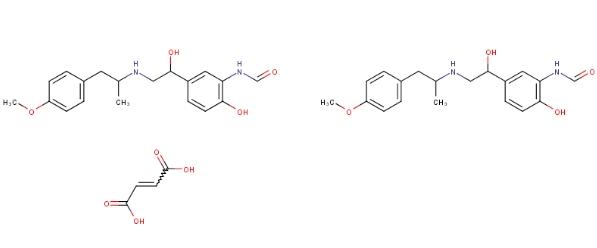
Formoterol is a relatively selective long-acting β2-adrenergic receptor agonist, although it also has some activity on β1 and β3 receptors. β2 receptors are primarily found in bronchial smooth muscle (with relatively fewer quantities found in cardiac tissue), while β1 receptors are the main adrenergic receptors found in the heart. Therefore, selectivity for β2 receptors is ideal in the treatment of pulmonary diseases such as COPD and asthma. Formoterol demonstrates approximately 200 times higher activity on β2 receptors compared to β1 receptors.
At the molecular level, activation of β receptors by Formoterol stimulates adenylate cyclase within the cells, which is responsible for converting ATP to cyclic adenosine monophosphate (cAMP). The increase in cAMP levels in bronchial smooth muscle tissues leads to muscle relaxation, subsequent airway dilation, while inhibiting culprit cells (especially mast cells) from releasing hypersensitive mediators (such as histamine, leukotrienes).
Formoterol fumarate inhalation solution is a long-acting β2 adrenergic agonist (β2 agonist) indicated for:
Maintenance treatment of bronchoconstriction in patients with chronic obstructive pulmonary disease (COPD), including chronic bronchitis and emphysema, administered twice daily (morning and evening).
(1) Formoterol fumarate inhalation solution is not indicated for the treatment of acute episodes of bronchospasm associated with chronic obstructive pulmonary disease.
(2) Formoterol fumarate inhalation solution is not indicated for the treatment of asthma.
(1) Potent and sustained bronchodilator action.
(2) Long duration of action - The effect lasts up to 10 hours after oral administration, with at least equivalent efficacy of twice-daily dosing compared to thrice-daily dosing of salbutamol.
(3) Higher selectivity for the bronchi - Animal studies demonstrate a more pronounced effect on respiratory β receptors compared to cardiac receptors. Formoterol exhibits higher selectivity for the respiratory tract compared to similar drugs.
(4) Good drug distribution and metabolism - After oral administration, peak plasma concentrations are reached within 0.5 to 1 hour, with rapid distribution to affected sites; almost completely excreted within 24 hours without accumulation.
(5) High safety profile - Similar to other β receptor agonists, Formoterol fumarate exhibits only general side effects such as palpitations, tremors, and most symptoms diminish or reduce with continued medication, with no reports of more severe symptoms.
(1) Patients with asthma should not use LABA, including Formoterol fumarate, without inhaled corticosteroids.
(1) LABA used as monotherapy for asthma (without inhaled corticosteroids) increases the risk of serious asthma-related events.
(2) Do not initiate Formoterol fumarate inhalation solution in patients during acute deterioration of COPD.
(3) Not for use in acute symptoms relief. Short-acting β2-agonists should be used as needed for acute relief.
(4) Do not exceed the recommended dose. Overuse of Formoterol fumarate inhalation solution or its concomitant use with other long-acting β2-agonists can lead to clinically significant cardiovascular effects and may be fatal.
(5) Paradoxical bronchospasm may occur. Discontinue Formoterol fumarate inhalation solution immediately.
(6) Use with caution in patients with cardiovascular or seizure disorders, thyrotoxicosis, or sensitivity to sympathomimetic drugs.
The most common adverse reactions (>2%, more common than placebo) include diarrhea, nausea, nasopharyngitis, dry mouth, vomiting, dizziness, and insomnia.
(1) Other adrenergic drugs may enhance effects. Use with caution.
(2) Xanthine derivatives, steroids, diuretics, or non-potassium-sparing diuretics may exacerbate hypokalemia or electrocardiographic changes. Use with caution.
(3) MAO inhibitors, tricyclic antidepressants, and drugs prolonging the QTc interval may enhance effects on the cardiovascular system. Use with extreme caution.
(4) β-blockers may decrease efficacy. Use with caution, only when medically necessary.
Formoterol fumarate is not indicated for immediate relief of acute asthma attacks. It is a long-acting medication used for the long-term prevention and management of asthma symptoms. If you experience acute asthma attacks, you should use a quick-relief inhaler prescribed by your doctor.
Store Formoterol fumarate in a cool, dry place away from direct sunlight. Keep it out of reach of children and pets. Follow specific instructions provided with the medication for proper handling and use. This may include regular cleaning of the inhaler mouthpiece and monitoring of remaining doses.
Formoterol fumarate is a long-acting β2-adrenergic receptor agonist primarily used to relieve respiratory symptoms in patients with chronic obstructive pulmonary disease (COPD) and asthma. By relaxing bronchial smooth muscles, it effectively improves airway patency, helping patients breathe more easily. However, each patient's condition and treatment needs are different, so be sure to consult your doctor before using Formoterol fumarate. Your doctor will provide personalized medication recommendations based on your specific situation, ensuring the safety and effectiveness of treatment.
[1] Lü Haijun, Jin Gengen, Liu Lei, et al. Study on the synthesis process of formoterol fumarate [J]. Chemical Bulletin, 2019, 82 (02): 133-137. DOI:10.14159/j.cnki.0441-3776.2019.02.006.
[2] Dai Yu. Study on the prescription and preparation process of formoterol fumarate patch [D]. Dalian University of Technology, 2017.
[3] https://www.drugs.com/pro/formoterol-inhalation-solution.html
[4] https://pubmed.ncbi.nlm.nih.gov/1972599/
[5] https://go.drugbank.com/drugs/DB00983
 |
 |
|
 |
|
 |
 EN
EN
 Agricultural News
 Food News
 Industrial News
 Cosmetic News
 Pharmaceutical News
 Science News

 6YRS
6YRS

