-
We detected your language preference as English. Would you like to switch to the English version for a better experience?
Switch to English
Stay here


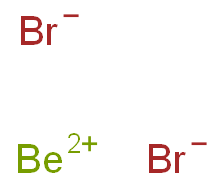
Beryllium dibromide (BeBr₂) is a compound consisting of one beryllium (Be) atom bonded to two bromine (Br) atoms. The Lewis structure of BeBr₂ visually represents the arrangement of electrons in this molecule, adhering to the octet rule for both beryllium and bromine atoms. The beryllium atom, with its two valence electrons, forms single covalent bonds with each bromine atom, which each have seven valence electrons. The structure clearly depicts these bonds and the lone pairs of electrons on the bromine atoms, illustrating the molecular geometry and bond angles.
Beryllium dibromide (BeBr₂) is an inorganic compound composed of one beryllium atom and two bromine atoms. It is a colorless solid that can be found in various applications, including the production of other chemical compounds and as a reagent in chemical reactions. Due to its high reactivity, it often reacts with water to produce hydrobromic acid (HBr).

Drawing the Lewis structure for beryllium dibromide (BeBr₂) involves understanding the valence electrons and the bonding principles between beryllium and bromine atoms. Here’s a step-by-step guide:
Step 1: Identify the Central Atom: Beryllium (Be) is the central atom, since it has fewer valence electrons compared to bromine.
Step 2: Calculate Total Valence Electrons: Beryllium contributes 2 valence electrons, while each bromine atom contributes 7 valence electrons, resulting in a total of 2 + (2 × 7) = 16 valence electrons.
Step 3: Distribute Electrons Around Atoms: Connect each bromine atom to the central beryllium atom with a single bond, using up 6 of the 16 valence electrons. The remaining 10 electrons will be distributed as lone pairs on the bromine atoms.
Step 4: Fulfill the Octet Rule: Each bromine atom should have 8 electrons (2 lone pairs and 1 bonding pair), while beryllium will have 4 electrons (2 bonding pairs).
Step 5: Check Formal Charges: With the octet rule satisfied, formal charges are not necessary for this structure.

The Lewis structure of beryllium dibromide (BeBr₂) indicates a Linear molecular geometry. The central beryllium atom is surrounded by two bromine atoms, with each bromine atom occupying one of the six positions in an octahedron. This arrangement allows for the maximum electron repulsion and results in a stable structure.
Molecular orbital theory explains the bonding and electronic structure of BeBr₂. The bonding in BeBr₂ involves the overlap of beryllium's 2s and 2p orbitals with bromine's 4s and 4p orbitals. The resulting molecular orbitals include bonding and antibonding orbitals, contributing to the stability of the compound. The specific details of the molecular orbitals would require quantum mechanical calculations to determine accurately.
The Linear molecular geometry of beryllium dibromide (BeBr₂) is evident from its Lewis structure. The central beryllium atom is at the center, surrounded by two bromine atoms in each of the six positions of an octahedron. This geometry ensures optimal electron repulsion and stability for the compound.
In beryllium dibromide (BeBr₂), the beryllium atom undergoes sp³d² hybridization. This involves the mixing of its 1s, 2s, and 2p orbitals with the 3d orbitals to create a set of six hybrid orbitals. These hybrid orbitals then participate in bonding with the two bromine atoms, forming two single bonds and accommodating the octet rule for all atoms.
The bond angles in beryllium dibromide (BeBr₂) are approximately 180 degrees, reflecting the Linear molecular geometry. This geometry ensures that the two bromine atoms are equidistant from the central beryllium atom, minimizing electron repulsion. The bond length between the beryllium and bromine atoms is typically around 0.866nm.
| Beryllium Dibromide (BeBr₂) Cas 7787-46-4 | |
| Molecular formula | BeBr₂ |
| Molecular shape | Linear |
| Polarity | Nonpolar |
| Hybridization | sp³d² hybridization |
| Bond Angle | 180 degrees |
| Bond Length | 0.866nm |
|
 |
 |
 |
|
|
 EN
EN
 Agricultural News
 Food News
 Industrial News
 Cosmetic News
 Pharmaceutical News
 Science News

 15YRS
15YRS

