-
We detected your language preference as English. Would you like to switch to the English version for a better experience?
Switch to English
Stay here


The Lewis structure of bromine oxide (BrO) is a representation of how electrons are distributed among the atoms in the molecule. It was devised by Gilbert N. Lewis and provides insight into the bonding and electron arrangement within the molecule. According to the octet rule, atoms tend to gain, lose, or share electrons to achieve a stable electron configuration similar to that of noble gases. In the case of BrO, bromine (Br) serves as the central atom bonded to oxygen (O) with a single bond. This structure helps predict the molecule's chemical behavior, such as its reactivity and physical properties.
Bromine oxide (BrO) is a chemical compound consisting of a bromine atom bonded to an oxygen atom. It is a highly reactive species found in various environments, including the atmosphere, water, and soil. This compound plays a role in atmospheric chemistry and can contribute to the formation of ozone depletion and other environmental issues. Its structure and properties are influenced by factors such as temperature and solvent interactions.
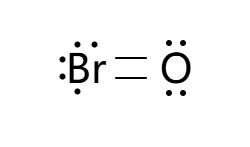
Let’s explore the steps to draw the Lewis structure for bromine oxide (BrO):
Step 1: Identify the Central Atom: Bromine (Br) is the central atom in BrO because it has a higher electronegativity compared to oxygen.
Step 2: Calculate Total Valence Electrons: Bromine contributes 7 valence electrons, and oxygen contributes 6, giving a total of 13 valence electrons.
Step 3: Arrange Electrons Around Atoms: Connect bromine to oxygen with a single bond, and distribute the remaining electrons as lone pairs around both atoms.
Step 4: Fulfill the Octet Rule: Ensure that both bromine and oxygen have a complete octet of electrons. This involves placing 6 electrons around oxygen and 8 around bromine.
Step 5: Check for Formal Charges: Formal charges may not be necessary, as both atoms have achieved the octet rule.
The Lewis structure of bromine oxide (BrO) suggests that the molecule has a linear geometry. With one bromine atom and one oxygen atom, there are no lone pairs on either atom, leading to a simple linear arrangement where the two atoms are directly connected by a single covalent bond.
According to molecular orbital theory, the bonding in BrO can be understood through the interaction of atomic orbitals. Bromine and oxygen have different sets of atomic orbitals, and when they bond, these overlap to create molecular orbitals. The resulting molecular orbital diagram for BrO includes bonding and antibonding orbitals for the Br-O bond, with the antibonding orbitals being more populated than the bonding ones, indicating the presence of some instability in the molecule due to the high electron density between the two atoms.
In bromine oxide (BrO), the central bromine atom undergoes sp hybridization to accommodate the linear geometry of the molecule. This hybridization results in the formation of two sp hybrid orbitals, which then overlap with the 2p orbital of oxygen to form a single bond. This sp hybridization is crucial for achieving the linear molecular geometry and maintaining the stability of the molecule.
| Bromine Oxide (BrO) | |
| Molecular Formula | BrO |
| Polarity | Polar |
| Hybridization | sp Hybridization |
To determine if a Lewis structure is polar, consider the molecule's overall geometry and the individual bond polarities. A polar molecule typically has an asymmetric geometry, causing unequal sharing of electrons between atoms. In the case of bromine oxide (BrO), the linear geometry ensures that any bond dipoles cancel each other out, making the molecule nonpolar.
Calculating the bond energy from a Lewis structure involves determining the type of bond and using known bond energies. For bromine oxide (BrO), the single bond between bromine and oxygen has a specific bond energy. By looking up this value, you can obtain the energy required to break one mole of BrO molecules into bromine and oxygen atoms. The exact calculation would require accessing a reliable source of bond energy data.
The bond order can be determined by counting the number of bonds between two atoms in a Lewis structure. In bromine oxide (BrO), there is one bond between the bromine and oxygen atoms, indicating a bond order of 1. Bond order is a measure of the strength of a bond and is calculated as the difference between the number of bonding electrons and antibonding electrons divided by two.
|
 |
 EN
EN
 Agricultural News
 Food News
 Industrial News
 Cosmetic News
 Pharmaceutical News
 Science News