-
We detected your language preference as English. Would you like to switch to the English version for a better experience?
Switch to English
Stay here


Lewis structures, devised by Gilbert N. Lewis, visually represent electron arrangements in molecules. By depicting valence electrons as dots and bonds as lines, Lewis structures predict a molecule's shape and properties based on the octet rule. This rule states that atoms tend to achieve stability by having eight electrons in their outer shell. Lewis structures adhere to this rule, offering a clear picture of chemical bonding.
Carbon tetraiodide (CI4) is a chemical compound composed of one carbon atom bonded to four iodine atoms. It is an inorganic compound, typically found as a colorless liquid under standard conditions. Due to its high reactivity, it is usually stored in a sealed container and kept away from moisture and air to prevent decomposition.

Let's explore the steps to create the Lewis structure of CI4:
The molecular geometry of CI4 is tetrahedral. With four iodine atoms surrounding the central carbon atom, each atom forms a bond with the carbon, resulting in a symmetrical tetrahedral arrangement with bond angles of approximately 109.5 degrees.
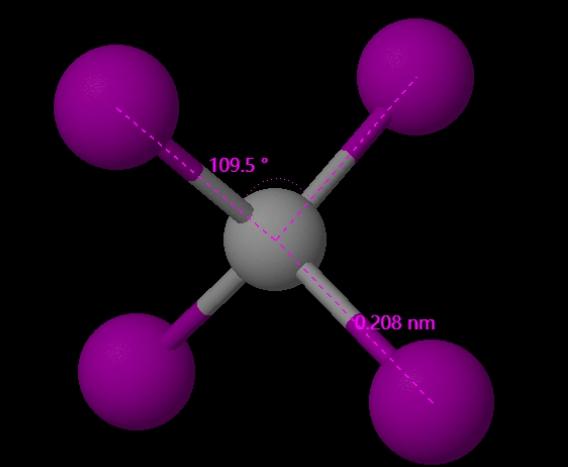
This theory addresses electron repulsion and the need for compounds to adopt stable forms. In CI4, four sigma bonds form between carbon and iodine, with no lone pairs on either atom. The involvement of d-orbitals in the bonding is not typical for this compound, as it primarily follows sp3 hybridization. Instead, the structure is dominated by the overlap of sp3 orbitals, leading to the tetrahedral geometry.
As mentioned earlier, the Lewis structure suggests that CI4 adopts a tetrahedral geometry. This arrangement places the four iodine atoms at the vertices of a tetrahedron around the central carbon atom, forming four bond pairs. This geometry minimizes electron-electron repulsion, resulting in a stable configuration.
In CI4, the central carbon atom undergoes sp3 hybridization. The 2s and 2p orbitals of the carbon atom mix to form four equivalent sp3 hybrid orbitals, each participating in a sigma bond with one of the four iodine atoms. This hybridization allows for the formation of the tetrahedral molecular geometry and satisfies the octet rule for both carbon and iodine atoms.
The bond angle in CI4 is approximately 109.5 degrees, consistent with the tetrahedral geometry. The bond length between carbon and iodine atoms is typically around 0.208 nm. These values reflect the balance between electron repulsion and the need for the atoms to maintain stable bonding configurations.
Here is a concise summary of the key properties of Carbon Tetraiodide (CI4):
| Carbon Tetraiodide (CI4) | |
| Molecular formula | CI4 |
| Molecular shape | Tetrahedral |
| Polarity | Nonpolar |
| Hybridization | sp3 hybridization |
| Bond Angle | 109.5 degrees |
| Bond length | 0.208 nm |
To determine if a Lewis structure is polar, consider the molecular geometry and bond polarity. For CI4, the tetrahedral geometry results in symmetrical distribution of electron density, leading to a nonpolar molecule. The polar bonds within CI4 cancel out due to the molecule's symmetry.
To calculate the total bond energy of CI4, first find the bond energy for a single carbon-iodine (C-I) bond, which is approximately 295 kJ/mol. Since CI4 contains four C-I bonds, multiply the bond energy by four: 295 kJ/mol * 4 = 1180 kJ/mol. This value represents the energy required to break all C-I bonds in one mole of CI4 molecules.
In CI4, each carbon-iodine bond is a single bond, so the bond order for each C-I bond is 1. This indicates that there is one sigma bond between each carbon and iodine atom, reflecting the sp3 hybridization of the carbon atom.
Electron groups in a Lewis structure encompass both bonding pairs (shared electrons) and lone pairs (non-bonded electrons) around an atom. In CI4, each carbon atom has four electron groups, corresponding to the four C-I bonds (four bonding pairs and no lone pairs on carbon).
In a Lewis dot structure, the dots represent valence electrons. Each dot signifies one valence electron of an atom. In CI4, the dots illustrate the arrangement of valence electrons around the carbon and iodine atoms, showing how they are shared or paired to form bonds.
|
 |
 |
 |
|
 EN
EN
 Agricultural News
 Food News
 Industrial News
 Cosmetic News
 Pharmaceutical News
 Science News

 3YRS
3YRS

