-
We detected your language preference as English. Would you like to switch to the English version for a better experience?
Switch to English
Stay here



The Lewis structure, developed by Gilbert N. Lewis, provides a visual representation of electron distribution within molecules. By illustrating valence electrons as dots and bonds as lines, these structures predict a molecule's shape and properties, primarily adhering to the octet rule. According to this rule, atoms strive for stability by achieving eight electrons in their outer shell.
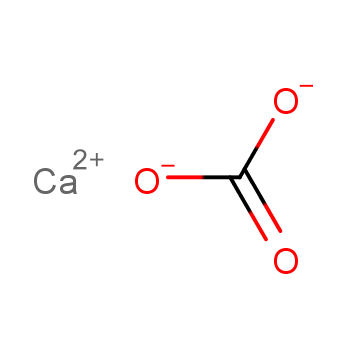
Compound Calcium Carbonate, often referred to as Calcium Carbonate, is a common chemical compound with the chemical formula CaCO3. It is known for its role in various applications, including construction materials, pharmaceuticals, and as a dietary supplement.
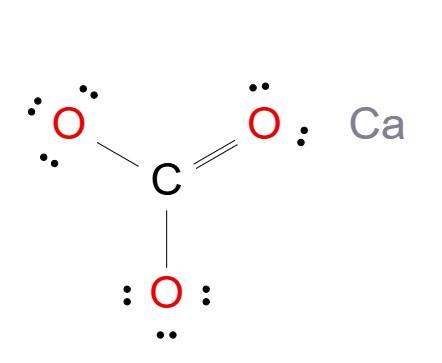
To create the Lewis structure for Calcium Carbonate (CaCO3):
Step 1: Identify the Central Atom: Calcium (Ca) serves as the central atom, since it is less electronegative than Carbon and Oxygen.Step 5: Check Formal Charges: Confirm that all atoms have stable electron configurations without formal charges.

The Lewis structure of Calcium Carbonate indicates a trigonal planar arrangement around the central Calcium atom, with each Oxygen atom bonded via a double bond, resulting in a stable trigonal planar molecular geometry.
Molecular orbital theory explains electron repulsion and the need for compounds to adopt stable configurations. In Calcium Carbonate, six sigma bonds form between Calcium and Oxygen, with double bonds contributing to the overall stability of the molecule. Although Calcium has only two valence orbitals, the Lewis structure suggests the involvement of additional orbitals in the bonding process, reflecting the compound's complex electronic structure.
The trigonal planar geometry of Calcium Carbonate is derived from the arrangement of Oxygen atoms around the central Calcium atom, forming a plane with three bond pairs, ensuring minimal electron-electron repulsion.
Calcium in Calcium Carbonate undergoes sp2 hybridization, with three hybrid orbitals used to form the three sigma bonds with Oxygen atoms, facilitating the trigonal planar molecular geometry.
The bond angles in Calcium Carbonate are approximately 120 degrees, characteristic of the trigonal planar geometry, and the bond length is typically around 122 pm, indicative of the strong covalent bonds formed between Calcium and Oxygen.
| Compound Calcium Carbonate | |
| Molecular Formula | CaCO3 |
| Molecular Shape | Trigonal Planar |
| Polarity | Nonpolar |
| Hybridization | sp2 Hybridization |
| Bond Angle | 120 degrees |
| Bond Length | 122pm |
To determine if a Lewis structure is polar, assess the molecular geometry and bond polarity. For Calcium Carbonate, the trigonal planar geometry results in symmetrical bond dipoles that cancel out, making the molecule nonpolar.
Calculating the total bond energy of Calcium Carbonate involves looking up the bond energy for a single Ca-O bond, which is approximately 412 kJ/mol, and then multiplying by the three Ca-O bonds present, yielding a total bond energy of 1236 kJ/mol.
The bond order in Calcium Carbonate is calculated as the number of bonds between each pair of atoms divided by two. Since there are three Ca-O bonds, the bond order for each Ca-O bond is 1.5, reflecting the double bonds present.
Electron groups in the Lewis structure of Calcium Carbonate include bonding pairs (shared electrons) and lone pairs (non-bonded electrons). Each Calcium atom has one bonding pair and three lone pairs, while each Oxygen atom has two bonding pairs and one lone pair.
In the Lewis dot structure of Calcium Carbonate, the dots represent valence electrons. Each dot signifies one valence electron, illustrating the electron distribution around the atoms and facilitating the understanding of bonding within the compound.
 |
 |
 |
 |
 |
 |
 EN
EN
 Agricultural News
 Food News
 Industrial News
 Cosmetic News
 Pharmaceutical News
 Science News

 1YR
1YR

