-
We detected your language preference as English. Would you like to switch to the English version for a better experience?
Switch to English
Stay here


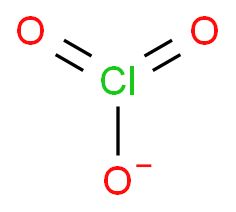
The Lewis structure of chlorate ion (ClO₃⁻) is a depiction of the electron distribution in this compound. Chlorate ion features one chlorine atom (Cl) at the center bonded to three oxygen atoms (O). Chlorine, being less electronegative than oxygen, typically takes on the role of the central atom in such structures. Chlorine has 7 valence electrons, while each oxygen atom contributes 6 valence electrons. However, considering the negative charge, the total number of valence electrons is 7 (for Cl) + 3(6) - 1 (because of the extra electron due to the negative charge) = 25 valence electrons. These electrons are distributed among single bonds, double bonds, and lone pairs, illustrating the chemical bonding and electron arrangement within the chlorate ion.
Chlorate ion (ClO₃⁻) is a polyatomic ion with a central chlorine atom bonded to three oxygen atoms. Its structure exhibits a trigonal planar geometry around the chlorine atom due to the presence of three equivalent O-Cl bonds. The oxygen atoms, in turn, have a bent structure due to the presence of lone pairs on them, contributing to the overall trigonal planar shape of the ion. Chlorate ions are negatively charged due to the additional electron carried by the ion.
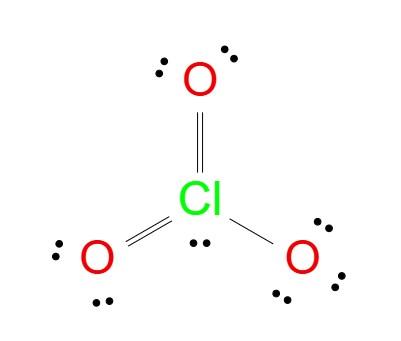
Let's explore the steps to construct the Lewis structure for chlorate ion (ClO₃⁻):

The Lewis structure of chlorate ion (ClO₃⁻) indicates a trigonal planar geometry around the central chlorine atom, with each oxygen atom adopting a bent structure due to the presence of lone pairs. This arrangement ensures the most stable configuration for the ion.
Molecular orbital theory elucidates the bonding in chlorate ion (ClO₃⁻) through the interaction of atomic orbitals. Chlorine and oxygen atoms contribute to bonding and antibonding molecular orbitals, with the highest occupied molecular orbital (HOMO) and the lowest unoccupied molecular orbital (LUMO) determining the stability and reactivity of the ion. The specific arrangement of these orbitals leads to the observed geometry and bonding characteristics.
The Lewis structure of chlorate ion (ClO₃⁻) demonstrates a trigonal planar geometry for the chlorine atom, with each oxygen atom exhibiting a bent structure due to lone pairs. This geometry ensures the most stable arrangement of electrons in the ion.
In chlorate ion (ClO₃⁻), the central chlorine atom undergoes sp² hybridization to form the trigonal planar geometry. The three sp² hybrid orbitals are used to form three sigma bonds with the oxygen atoms and accommodate one lone pair of electrons on chlorine.
Chlorate ion (ClO₃⁻) features bond angles of approximately 120 degrees between the chlorine-oxygen bonds, characteristic of a trigonal planar geometry. The bond lengths are roughly equal, reflecting the symmetrical arrangement of the atoms.
Chlorate ion (ClO₃⁻) can be summarized with the following key points:
| Chlorate Ion (ClO₃⁻) | |
| Molecular formula | ClO₃⁻ |
| Molecular shape | Trigonal planar |
| Polarity | Nonpolar |
| Hybridization | sp² hybridization |
| Bond Angle | 120 degrees |
| Bond length | 152 pm |
To ascertain if a Lewis structure is polar, examine the molecular geometry and bond polarity. In chlorate ion (ClO₃⁻), the structure reveals a trigonal planar geometry for the central chlorine atom with bent oxygen atoms due to lone pairs. Although individual bonds are polar, the symmetry of the molecule results in equal cancellation of dipole moments, making chlorate ion nonpolar.
To calculate the total bond energy of chlorate ion (ClO₃⁻), first, consult bond energies for chlorine-oxygen (Cl-O) bonds, which are approximately 273 kJ/mol. Since there are three Cl-O bonds in the ion, multiply the bond energy by three. This yields a total bond energy of 819 kJ/mol for chlorate ion. This value represents the energy required to break all Cl-O bonds in one mole of chlorate ion molecules.
Bond order is the number of chemical bonds between a pair of atoms. In chlorate ion (ClO₃⁻), each chlorine-oxygen bond is a single bond, indicating a bond order of 1 for each Cl-O bond.
|
 |
 |
 |
|
|
 EN
EN
 Agricultural News
 Food News
 Industrial News
 Cosmetic News
 Pharmaceutical News
 Science News

