-
We detected your language preference as English. Would you like to switch to the English version for a better experience?
Switch to English
Stay here


Phosphorus Chloride (PCl3) is a covalent compound consisting of a phosphorus atom (P) bonded to three chlorine atoms (Cl). Its Lewis structure can be determined by considering the valence electrons of each atom involved in the bonding. Phosphorus has 5 valence electrons, and each chlorine atom has 7 valence electrons. Together, they provide a total of 21 valence electrons to form a stable molecule. In PCl3, the phosphorus atom acts as the central atom, with three chlorine atoms bonded to it via single covalent bonds. The remaining electron pair on phosphorus forms a lone pair, completing the octet rule for both atoms.
Phosphorus Chloride (PCl3) is an inorganic compound with the chemical formula PCl3. It is a colorless gas under standard conditions, but it readily reacts with water to form phosphoric acid (H3PO4) and hydrochloric acid (HCl). PCl3 is highly reactive and can be found in various industrial applications, including the production of phosphorus-based fertilizers, flame retardants, and as a reagent in organic synthesis. Its orthohedral crystal structure contributes to its unique physical properties and chemical behavior.

To draw the Lewis structure for Phosphorus Chloride (PCl3), follow these steps:
The Lewis structure of Phosphorus Chloride (PCl3) indicates that it has a trigonal pyramidal molecular geometry. The phosphorus atom is at the center, bonded to three chlorine atoms with single covalent bonds, and one chlorine atom has a lone pair.
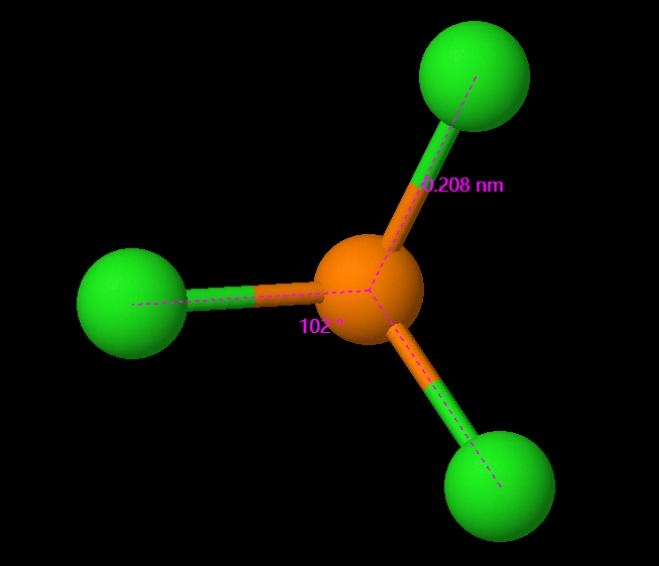
According to molecular orbital theory, the bonding in Phosphorus Chloride (PCl3) involves the interaction of atomic orbitals to form molecular orbitals. The bonding and antibonding orbitals contribute to the stability of the molecule. In PCl3, the 3p orbitals of phosphorus and chlorine atoms overlap to form bonding π* and σ* molecular orbitals, while antibonding π and σ molecular orbitals result from the overlap of the 3p and 3p* orbitals. The energy levels of these molecular orbitals determine the strength of bonding within the molecule.
The hybridization of the central phosphorus atom in Phosphorus Chloride (PCl3) can be determined by analyzing the atomic orbitals involved in bonding. Phosphorus has 5 valence electrons and needs to form 4 covalent bonds to achieve a stable electron configuration. This requires the mixing of one 3s orbital and three 3p orbitals to form 4 equivalent sp3 hybrid orbitals. These hybrid orbitals allow the phosphorus atom to form covalent bonds with the three chlorine atoms and accommodate the lone pair, resulting in a trigonal pyramidal molecular geometry.
In Phosphorus Chloride (PCl3), the approximate bond angles between the phosphorus atom and the chlorine atoms are around 102°. This is characteristic of a trigonal pyramidal geometry, where the lone pair on the phosphorus atom slightly distorts the ideal tetrahedral bond angles. The bond length in PCl3 varies slightly due to the presence of lone pairs, but the P-Cl bond is typically 0.208 nm.
| Phosphorus Chloride (PCl3) | |
| Molecular Formula | PCl3 |
| Molecular Shape | Trigonal Pyramidal |
| Polarity | Polar |
| Hybridization | sp3 |
| Bond Angle | 102° |
| Bond Length | 0.208 nm |
Phosphorus Chloride (PCl3) is polar due to the difference in electronegativity between phosphorus and chlorine. The electronegative chlorine atoms pull the shared electrons towards themselves, creating a partial negative charge on the chlorine atoms and a partial positive charge on the phosphorus atom. This polarity is responsible for the dipole-dipole interactions between PCl3 molecules, which affects its physical properties such as boiling point and solubility.
To calculate the bond energy of Phosphorus Chloride (PCl3), you would typically refer to experimental data or theoretical calculations. The bond energy of the P-Cl bond in PCl3 is approximately 311 kJ/mol. This value represents the energy released when one mole of PCl3 molecules is formed from its constituent atoms, and it reflects the stability of the PCl3 molecule compared to its constituent elements.
|
 |
 |
 |
 |
 EN
EN
 Agricultural News
 Food News
 Industrial News
 Cosmetic News
 Pharmaceutical News
 Science News

 1YR
1YR

