-
We detected your language preference as English. Would you like to switch to the English version for a better experience?
Switch to English
Stay here


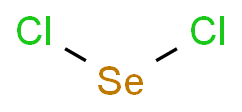
The Lewis structure for Selenium Dichloride (SeCl2) provides a visual representation of the electron arrangement within the molecule. It depicts selenium (Se) as the central atom bonded to two chlorine (Cl) atoms, adhering to the octet rule. By illustrating valence electrons as dots and bonds as lines, the structure predicts the molecule's shape and properties, aiding in understanding its chemical behavior.
Selenium Dichloride (SeCl2) is a chemical compound formed by the combination of selenium (Se) and two chlorine (Cl) atoms. It exists as a yellowish-green fuming liquid with a pungent smell. Selenium Dichloride finds applications in various fields, including organic synthesis, as a reagent in the production of other selenium compounds, and in the semiconductor industry.
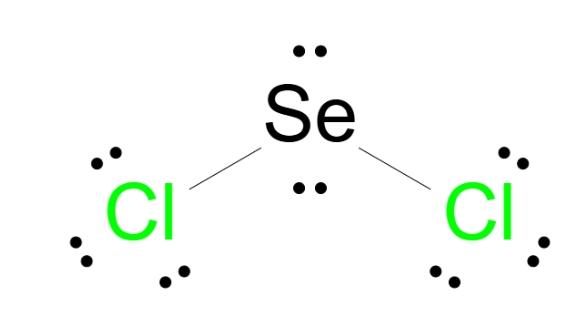
Let's delve into the steps to draw the Lewis structure for Selenium Dichloride (SeCl2):
The Lewis structure of Selenium Dichloride (SeCl2) indicates that the molecule adopts a bent geometry. The two chlorine atoms are positioned around the central selenium atom, creating a 101-degree bond angle due to the presence of lone pairs on the selenium atom.

According to molecular orbital theory, Selenium Dichloride (SeCl2) involves the mixing of atomic orbitals to form molecular orbitals. The bonding and antibonding interactions result in the stabilization of the molecule, contributing to its chemical properties. The exact molecular orbital diagram would require quantum mechanical calculations to accurately depict the energy levels of the electrons within the molecule.
The Lewis structure of Selenium Dichloride (SeCl2) suggests an angular or bent molecular geometry. The bent shape arises from the repulsion between the lone pairs on the selenium atom and the bonding pairs between selenium and chlorine, leading to a 109.5-degree bond angle.
The hybridization of Selenium Dichloride (SeCl2) can be determined by examining the orbitals involved in the bonding process. Selenium, with a 4s24p4 electron configuration, undergoes hybridization to accommodate the bonding and non-bonding electron pairs. The hybridization results in the formation of sp3 hybrid orbitals, which enable the molecule to adopt its bent geometry.
The bond angle in Selenium Dichloride (SeCl2) is approximately 101 degrees, reflecting the bent molecular geometry. The bond length between selenium and chlorine atoms is around 0.217 nm, taking into account the presence of lone pairs on the selenium atom, which slightly increases the distance between the bonded atoms.
| Selenium Dichloride (CAS 14457-70-6) | |
| Molecular formula | SeCl2 |
| Molecular shape | Bent |
| Polarity | Polar |
| Hybridization | sp3 hybridization |
| Bond Angle | 101 degrees |
| Bond length | 0.217 nm |
To determine if a Lewis structure is polar, examine the molecular geometry and bond polarity. In the case of Selenium Dichloride (SeCl2), the molecule has a bent geometry due to lone pairs on the selenium atom, leading to a net dipole moment. This makes Selenium Dichloride a polar molecule.
To calculate the bond energy in Selenium Dichloride (SeCl2), refer to standard bond energies. A single Se-Cl bond typically has a bond energy of around 335 kJ/mol. Since there are two such bonds in SeCl2, the total bond energy is approximately 670 kJ/mol. This value represents the energy required to break both Se-Cl bonds in one mole of SeCl2.
Bond order is the number of chemical bonds between a pair of atoms. In the Lewis structure of Selenium Dichloride (SeCl2), each Se-Cl bond is a single bond, so the bond order for each Se-Cl bond is 1. Bond order reflects the strength of the bond and is consistent throughout the molecule.
Electron groups in a Lewis structure include both bonding pairs (shared electrons) and lone pairs (non-bonded electrons) around an atom. In Selenium Dichloride (SeCl2), each selenium atom has two electron groups, consisting of two Se-Cl bonds (two bonding pairs) and no lone pairs on selenium.
|
 |
 EN
EN
 Agricultural News
 Food News
 Industrial News
 Cosmetic News
 Pharmaceutical News
 Science News