-
We detected your language preference as English. Would you like to switch to the English version for a better experience?
Switch to English
Stay here


Triphenyl phosphate (TPP) holds a significant position as a multifunctional compound across various domains. Delving into its characteristics, applications, and safety considerations, this article aims to showcase the importance and potential of TPP.
Triphenyl phosphate (TPP) is a representative aromatic organophosphate ester (OPE). It exists as a colorless, odorless crystalline powder at room temperature, with a molecular weight of 326.3, melting point at 49.39 ℃, and boiling point at 245 ℃ (11 mmHg). Triphenyl phosphate solubility characteristics include insolubility in water, solubility in ethanol, and high solubility in organic solvents such as ether, benzene, carbon tetrachloride, and chloroform. With a logKow partition coefficient of 4.59 and a bioaccumulation factor (BCF) of 113.3, TPP exhibits strong hydrophobicity and bioaccumulative properties. Triphenyl phosphate cas number is 115-86-6. TPP is widely utilized for its excellent flame retardancy, abrasion resistance, and insulation properties, commonly added to materials like rubber, electrical cables, hydraulic oil, and polyurethane foam to enhance their thermal stability and plasticity. Additionally, it serves as an antifoaming agent in starch glue. The flame retardant mechanism of OPEs involves both gas-phase and condensed-phase mechanisms, with TPP primarily operating through gas-phase inhibition. It undergoes decomposition into small molecules or PO· radicals at high flame temperatures, reacting with hydrogen radicals and hydroxyl groups in the air to terminate combustion.
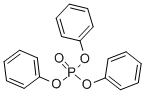
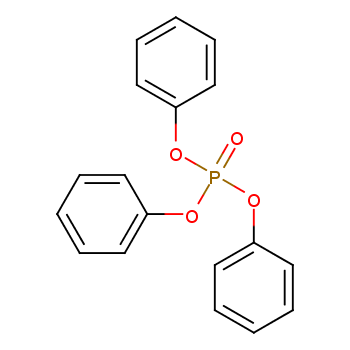
The triphenyl phosphate formula is C18H15O4P, The structural formula is as follows:

Triphenyl phosphate's structure directly influences its performance and diverse applications. At its core lies a phosphoric acid group, bound to a central phosphorus atom and four oxygen atoms. One oxygen atom further links to a phenyl group, forming an alternating single and double bond six-membered carbon ring, imparting aromaticity. The remaining three oxygen atoms can each bind to another phenyl group, resulting in the name "triphenyl." This aromatic ring arrangement creates a large molecule with hydrophobic properties. Conversely, the phosphoric acid group confers TPP with some water solubility and the ability to interact with metal surfaces. This unique combination of properties renders TPP valuable as a flame retardant, plasticizer, and anti-wear additive in lubricants, leveraging its substantial structure to reduce friction between moving components.
Triphenyl phosphate (TPP) finds extensive application across various industries including electronics, plastics, furniture, textiles, automotive, and petroleum (Shi et al., 2019). In consumer products in the Japanese market in 2008, TPP emerged as one of the most common components, with varying concentrations found in LCD TVs, laptops, curtains, sockets, insulating wallpaper, and building materials (Kajiwara et al., 2011). Moreover, TPP is present in waste oil from automobiles, trucks, and road construction materials, with concentrations ranging from 0.8 to 1.9 mg/g (Anneli et al., 2005). Studies have indicated continuous release of TPP into indoor air during the normal operation of computers (Wei et al., 2015). As smartphones become indispensable tools in modern life, TPP serves as a primary flame retardant in their production, with an average of 3.37×10⁷ ng/unit found in each smartphone, predominantly concentrated on the screen (Zhang et al., 2019). Zheng et al. (2017) further noted TPP as one of the most abundant chemical substances on the surface of smartphones, with an average concentration of 228 pg/cm-2. Today, TPP has become a widely utilized substance in everyday consumer products.
Although triphenyl phosphate (TPP) holds value in various industrial applications, it poses potential health hazards, necessitating appropriate safety measures. Exposure to TPP can occur through inhalation, ingestion, or skin contact. Inhalation may irritate the respiratory tract, with high concentrations potentially causing symptoms such as coughing, shortness of breath, and even pulmonary edema. Research also indicates potential neurotoxicity, with animal studies showing muscle weakness and paralysis upon exposure. Ingesting TPP can lead to gastrointestinal discomfort, while skin contact may result in allergic reactions or dermatitis.
Regulatory agencies like the National Institute for Occupational Safety and Health (NIOSH) establish workplace exposure limits to prevent adverse health effects. These guidelines specify permissible concentrations of triphenyl phosphate in the air to mitigate health risks. Ensuring proper ventilation in workplaces where TPP is used is crucial for preventing inhalation hazards. Additionally, wearing appropriate personal protective equipment (PPE) is essential, including gloves, safety glasses, and respirators designed to filter TPP particles. By adhering to these safety protocols, workers can significantly reduce the risk of exposure and associated health issues.
Triphenyl phosphate (TPP) is typically incorporated into products through physical blending methods such as adsorption. However, due to the absence of organic bonds, they are easily released from products through evaporation, abrasion, corrosion, and leakage, entering the natural environment and causing pollution due to air and water flow. Currently, TPP's presence can be detected in various environmental media such as air, water bodies, dust, soil, river sediment, and deposits. Dust is considered a primary source of human exposure to organophosphate flame retardants (OPFRs).
TPP exhibits poor compatibility, significant volatility, and poor thermal stability. Additionally, the manufacturing process often generates substantial amounts of organic pollution wastewater, especially phosphorus-containing wastewater, which is challenging to treat and contributes to environmental eutrophication, posing health hazards to people. Furthermore, TPP accumulates to varying degrees in animal bodies through exposure via the environment and the food chain, including in humans.
Statistics reveal TPP as one of the most abundant organophosphate esters (OPEs) in global air and dust samples. Due to its widespread use in electrical wires, cables, and electronic components, higher concentrations of TPP can be detected in air particle samples near electronic waste recycling facilities. For instance, air samples near electronic waste recycling stations in Quebec City, Canada, showed TPP concentrations as high as 120 ng/m3. Additionally, TPP serves as a vital component in commercial composite flame retardants like Firemaster 550 and Firemaster 600, making waste incineration emissions a significant source of TPP in air and dust. TPP is also frequently detected in water environments and can enter through various pathways such as rainfall, hydraulic oil leaks, and plastic leaching. Samples from the Yellow River's lower reaches in China showed TPP detection rates of 50%-75%. In Australia, TPP concentrations in road runoff water reached 50 ng/L, while in water samples from factory inflow and outflow in Norway, TPP concentrations ranged from 3100-14000 ng/L and 1700-3500 ng/L, respectively. In samples of bottled drinking water and tap water collected from the Pearl River Delta in China, TPP detection rates reached as high as 90%, with its metabolite DPhP detected in all samples.
Beyond industrial applications, Triphenyl Phosphate (TPP) plays a remarkable role in scientific research and analysis. In the field of Nuclear Magnetic Resonance (NMR) spectroscopy, a technique used to study molecular structures, TPP serves as a vital reference standard. NMR spectroscopy relies on precise measurements of nuclear magnetic properties within molecules. TPP's well-defined structure and predictable NMR signals make it a reliable reference point for instrument calibration and ensuring the accuracy of measurements for complex molecules. This empowers researchers to confidently interpret NMR data and gain valuable insights into the structures and functionalities of various materials.
This article delves into the characteristics, applications, and safety considerations of TPP, offering insights into its significance and potential. Emphasizing the wide-ranging utility and safe handling of TPP across industries, it encourages further research and responsible usage to ensure effectiveness and safety. Additionally, it advocates for exploring TPP applications, seeking alternative solutions, and promoting environmental awareness for sustainable development. Through collective efforts, leveraging the advantages of TPP can contribute positively to industry advancement and environmental protection.
[1] Fang Hui. Study on the Cardiotoxicity and Neurotoxicity Effects of Triphenyl Phosphate on Zebrafish [D]. Shandong Normal University, 2023. DOI: 10.27280/d.cnki.gsdsu.2023.002107.
[2] Zhang Mengdi. Study on the Toxicity of Triphenyl Phosphate and Cadmium Complex on Earthworms [D]. Shandong Agricultural University, 2022. DOI: 10.27277/d.cnki.gsdnu.2022.000642.
[3] Liu Jie, Guo Yushuo, Chen Xiyu, et al. Research Progress on Treatment Technology of Typical Organic Phosphorus Flame Retardant Triphenyl Phosphate [J]. Shandong Chemical Industry, 2021, 50(14): 73-74. DOI: 10.19319/j.cnki.issn.1008-021x.2021.14.029.
[4]https://www.tutorchase.com/answers/ib/chemistry/what-does-the-chemical-shift-in-an-nmr-spectrum-indicate
[5]https://en.wikipedia.org/wiki/Triphenyl_phosphate
|
 |
 |
 |
 EN
EN
 Agricultural News
 Food News
 Industrial News
 Cosmetic News
 Pharmaceutical News
 Science News

 15YRS
15YRS

