
I. Executive Summary
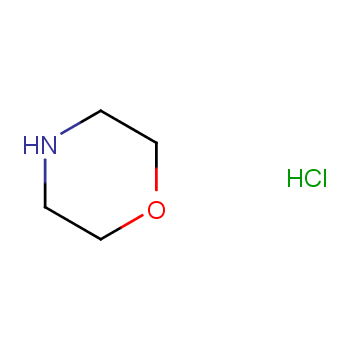
Morpholine hydrochloride (CAS 10024-89-2, C4H10ClNO, molecular weight 123.6 g/mol) is the hydrochloric acid salt of morpholine, a cyclic secondary amine that also contains an ether oxygen. The salt is a white, crystalline, strongly hygroscopic solid that provides a low-odour, weighable, non-volatile form of a base that is otherwise volatile, alkaline and corrosive. Buyers choose it for dosing accuracy, easier handling and reduced fire risk compared with the free amine.
Demand is anchored in four downstream sectors: agrochemical fungicides and plant-protection intermediates, pharmaceutical building blocks containing the morpholine ring, rubber chemicals including vulcanisation accelerators and sulfur donors, and water treatment where morpholine functions as a neutralising amine. Volumes are large but margins are thin, so producers compete on integration into the diethanolamine and diethylene glycol chains and on consistency rather than on molecular innovation.
The defining commercial issue for this substance in 2026 is the nitrosamine question. Morpholine is a secondary amine and therefore a nitrosamine precursor, and N-nitrosomorpholine is regulated as a carcinogenic impurity in pharmaceutical and certain article applications. Sourcing decisions now turn on documented nitrosamine risk assessment, validated trace-level testing, nitrite-free processing and storage segregation, alongside the conventional controls on assay, chloride stoichiometry, free base and water.
II. Product Deep Dive: Molecular Mechanisms and Production Evolution
2.1 Physicochemical Properties and Mechanisms
Morpholine combines a secondary amine with an ether oxygen in a six-membered ring. Protonation gives a conjugate acid with a pKa of about 8.3, so the free base is a moderately strong organic base, while the salt dissolves to give an acidic solution in which the amine is released only when an equivalent of stronger base is added.
- Salt Form as a Handling and Stoichiometry Tool: Free morpholine boils near 129 degrees Celsius, has a penetrating amine odour, is corrosive to tissue and is a flammable liquid, whereas the hydrochloride is crystalline, non-volatile and far easier to weigh and charge. Users liberate the base in situ with alkali where the free amine is required. The trade-offs are straightforward: roughly 1.34 times the mass per mole of morpholine, and a stoichiometric chloride burden in the aqueous waste stream.
- Hygroscopicity, Acidity and Material Compatibility: The salt takes up water readily and cakes, and its solutions are acidic enough to attack carbon steel, zinc and aluminium, while chloride introduces pitting and stress-corrosion risk in some stainless grades. Storage and process contact should therefore use polyethylene, polypropylene, glass-lined or suitably selected stainless equipment, with attention to dust control because the solid is irritating to the eyes and respiratory tract.
2.2 Synthesis and Manufacturing Technologies
Manufacture is a two-stage affair: build the morpholine ring, then convert it to the salt. Producers with captive morpholine from diethanolamine or diethylene glycol hold the structural cost advantage, and the salification step is where the physical quality of the product is decided.
- Morpholine Base Manufacture and Purification: Industrial morpholine is produced by acid-catalysed cyclodehydration of diethanolamine, followed by liberation with alkali, or by the catalytic reaction of diethylene glycol with ammonia over a hydrogenation and dehydration catalyst. Continuous distillation removes water, unreacted glycol and higher-boiling amine by-products. Impurity carry-over from this step, particularly residual amino-ether intermediates, is what later shows up as colour and odour in the salt.
- Salification, Crystallisation and Drying: Hydrogen chloride gas or concentrated hydrochloric acid is dosed into morpholine, often in alcoholic or aqueous medium, with cooling because the neutralisation is strongly exothermic. The endpoint is controlled to avoid residual free amine, the mass is crystallised, centrifuged and dried at moderate temperature to prevent discolouration, and mother liquor is recycled. The theoretical chloride content of about 28.7 percent is a useful check on stoichiometry in release testing.
2.3 Core Application Matrix
- Pharmaceutical and Agrochemical Intermediates: The morpholine ring is a privileged structural motif that raises aqueous solubility and tunes basicity without adding a strongly basic centre, so it appears in many active substances across kinase inhibitors, anti-infectives and central nervous system candidates. In crop protection it is the core of morpholine fungicides that inhibit sterol biosynthesis. The hydrochloride is preferred where the free amine's volatility, odour or fire classification complicates charging.
- Rubber Chemicals, Curing Systems and Polymer Additives: Morpholine derivatives serve as sulfenamide vulcanisation accelerators, dithiodimorpholine sulfur donors and antidegradants, and the salt is a convenient morpholine source in their manufacture. Tyre and technical-rubber demand links this outlet to automotive production cycles, and it is the most price-sensitive segment of the market. Producers serving it focus on assay, colour and caking behaviour rather than on trace impurity documentation.
- Water Treatment, Corrosion Inhibition and Buffer Systems: Morpholine is used as a neutralising amine in boiler water and condensate systems, where its volatility distributes protection throughout the steam circuit and controls carbon-dioxide corrosion. The hydrochloride is selected where a solid feed is required or where dosing into acidic circuits is convenient. The ring also underpins morpholine-based buffer compounds and is used in textile auxiliaries and optical brightener intermediates.
III. Global Market Supply-Demand Landscape and Export Trends
3.1 Demand Drivers and Market Shifts
Demand follows agrochemical seasonality, the pharmaceutical pipeline, tyre and technical-rubber output, and industrial water-treatment investment. The shift in the past few years is qualitative rather than volumetric: nitrosamine scrutiny has moved secondary amines from the commodity column into managed inputs, and customers increasingly ask for validated N-nitrosomorpholine data, nitrite declarations and segregation commitments. That requirement is now a market-access condition in regulated segments rather than a differentiator.
3.2 Capacity Distribution and Export Flows
Capacity tracks the ethylene oxide, ethanolamine and ammonia chains. China holds the largest morpholine and derivative base in Shandong, Zhejiang and Jiangsu, exporting through Shanghai, Ningbo and Qingdao. India adds dedicated amine capacity serving both domestic pharmaceutical contract manufacturers and export customers. Europe and North America retain integrated amine plants close to downstream rubber-chemical and water-treatment formulators. Flows run mainly from Asian amine plants to European, North American and Japanese downstream users.
3.3 Market Bifurcation and Pricing Dynamics
Two broad grades exist: technical material at 98 percent or above for rubber and water treatment, and documented low-nitrosamine, low-iron, low-colour grades for pharmaceutical and electronic use, which carry a substantial premium. Pricing follows diethanolamine and diethylene glycol, ammonia, hydrochloric acid and energy, but effective value depends on water content, since the material is hygroscopic and buyers pay for morpholine equivalents. Packaging in lined bags, drums or big bags therefore influences realised price per mole.
IV. In-depth Analysis of Global Compliance and Regulatory Barriers
Two regulatory layers apply. As an industrial chemical the salt must be registered and correctly classified for the European and United States markets; as a secondary amine it also sits inside the nitrosamine control frameworks that pharmaceutical, elastomer and certain article manufacturers must operate.
4.1 European Market: REACH, CLP, and Sector-Specific Directives
- CLP Classification, REACH Registration and Exposure Scenarios: The salt is classified for acute toxicity and for skin corrosion or irritation and serious eye effects, with the exact hazard statements depending on the harmonised entry or the notified self-classification, which buyers should verify against the current adaptation to technical progress and the supplier safety data sheet. REACH registration brings an extended safety data sheet with exposure scenarios for charging, dissolving and dust-generating operations, and downstream users must confirm that their uses are covered and reflected in their own assessments.
- Nitrosamines under European Law and Pharmaceutical Expectation: N-nitrosomorpholine is treated as a carcinogenic N-nitroso compound, and European rules restrict nitrosamines and nitrosatable substances in certain consumer articles, including elastomer and toy applications, while the pharmaceutical framework requires sponsors to run a documented nitrosamine risk assessment covering secondary amines in reagents, intermediates and process water. Where a nitrosamine cannot be excluded, control is set against structure-based acceptable intakes using the carcinogenic potency categorisation approach, typically in the low nanogram per day range.
4.2 North American Market: TSCA, EPA, and FDA Regulations
- TSCA Inventory Status and EPA Expectations: Morpholine and its hydrochloride are listed on the TSCA Inventory as active, so ordinary import does not require a premanufacture notice, but importers should document the listing basis, meet Chemical Data Reporting obligations where thresholds are exceeded and check for any significant new use rule. N-nitrosomorpholine is regarded as a carcinogen in United States and international assessments, so releases, discharges and workplace exposure to nitrosating conditions attract scrutiny beyond the parent amine itself.
- FDA Nitrosamine Guidance and Article-Specific Limits: For drug products the governing document is the Food and Drug Administration guidance on control of nitrosamine impurities in human drugs, which requires a risk assessment, confirmatory testing where risk is identified and control at or below recommended acceptable intakes. Rubber articles intended for repeated food contact are subject to nitrosamine limits under the applicable food-contact regulation, which is why tyre, seal and gasket supply chains now push nitrosamine specifications back to the amine supplier.
4.3 The Critical Hurdle: Quality Control and Safety Limits
Compliance Warning: Do not purchase this salt on assay alone. Require a specification covering assay by acid-base or argentometric determination, chloride content against the theoretical value, free morpholine or alkalinity, water by Karl Fischer titration, sulfate, iron, heavy metals and solution colour, and N-nitrosomorpholine by a validated GC-MS/MS or LC-MS/MS method with a stated limit and detection capability. Require a declaration that process water is nitrite-controlled, a nitrosamine risk assessment covering the manufacturing and packing steps, and written commitments on segregation from nitrite, nitrate and nitrogen oxide sources throughout storage and transport.
V. Green Trade Barriers and ESG in Manufacturing
The environmental profile combines the usual amine-plant concerns — distillation energy, odour and nitrogen-containing effluent — with a chloride load from neutralisation and the wider issue of nitrosamine formation in water systems where secondary amines and nitrosating agents coexist.
5.1 Carbon Footprint and Circular Economy
Upstream impact comes from the ethylene oxide and ammonia value chains feeding diethanolamine and diethylene glycol, and from membrane-cell chlor-alkali electricity for hydrogen chloride. Producers reduce plant footprint through heat-integrated distillation, vapour recompression, closed-loop scrubbing of amine vents and recovery of mother liquor. Aqueous effluent is neutralised and treated biologically, since morpholine is degradable in adapted systems, while salt load must be managed within discharge consent. Cradle-to-gate carbon footprints to ISO 14067 are increasingly requested.
5.2 Sustainable Sourcing and Traceability
Customers ask for ISO 9001, 14001 and 45001 certification, EcoVadis or equivalent assessment, corporate due diligence under the EU Corporate Sustainability Due Diligence Directive and the EU Forced Labour Regulation, and full material disclosure through IMDS for automotive rubber applications. For the nitrosamine question specifically, traceability means documented nitrite control in process water, cleaning and dedication records for packing lines, and retain samples enabling retrospective testing if a customer's risk assessment changes.
VI. Supply Chain Resilience and Export Logistics
The product is a hygroscopic, acidic, irritating solid whose two enemies are water and nitrosating agents. Most quality disputes originate from caking, colour change or elevated nitrosamine results after transport, both of which are logistics failures rather than synthesis failures.
6.1 Packaging Standards and Moisture/Contamination Control
- Moisture-Barrier Packaging and Caking Control: Standard presentations are 25 kilogram polyethylene-lined bags or fibre drums, 500 to 1000 kilogram lined big bags, and lined steel or plastic drums for larger users. Filling and packing are done at controlled relative humidity, liners are heat-sealed, and pallets are stretch-wrapped with edge protection. Paper-only sacks are unsuitable, and partly used containers must be resealed immediately, because the salt cakes into a hard mass that complicates charging.
- Segregation from Nitrosating Agents and Contamination: Storage and transport require separation from nitrite and nitrate salts, nitric and nitrous acid, nitrogen oxide sources and strong oxidizers, and containers previously used for those materials must never be reused. Pharmaceutical grades are packed on dedicated, cleaned lines with documented cleaning, and retain samples are tested for N-nitrosomorpholine. Dedicated rather than shared equipment is the practical answer where a customer's nitrosamine risk assessment is sensitive.
6.2 Dangerous Goods Identification and Transit Protocols
Classification depends on the hazard statements assigned in the safety data sheet: where corrosive properties are assigned, consignments move as Class 8 under UN3260, corrosive solid, acidic, inorganic, n.o.s., in packing group II or III, with IMDG, IATA and ADR/RID equivalents; where only irritation is assigned the material may be transported as a non-regulated solid. Either way, stowage must keep it dry and separated from alkalis, which liberate the free amine, and from oxidizers and nitrosating agents. Container desiccant and avoidance of thermal cycling prevent condensation.
VII. Enterprise Global Expansion Strategy Guide
Three moves determine competitive position for this intermediate.
- Differentiate on Nitrosamine Documentation: Offer a documented nitrosamine risk assessment covering the route, the process water and the packing operation, a validated N-nitrosomorpholine method with stated detection capability, batch or periodic testing with retain samples, and written segregation commitments. This package is what converts a commodity salt into a qualified pharmaceutical input and protects the customer's own regulatory submission.
- Sell Molar Value Rather Than Kilogram Price: Because the salt is hygroscopic and carries a chloride counter-ion, quotes should be compared on delivered morpholine equivalent, accounting for assay, water content and packaging losses. Suppliers who also offer the free amine, aqueous solutions or alternative salt forms, and who hold regional stock to shorten transit exposure, win on total delivered value even at a nominally higher unit price.
- Build Dual-Region Supply with Sector-Specific Grades: Pair a high-volume Asian producer for rubber and water-treatment grades with a European, Indian or North American source able to support documented low-nitrosamine pharmaceutical grades. Use framework agreements indexed to diethanolamine or diethylene glycol, ammonia and hydrochloric acid, and a quality agreement extending change control to the hydrogen chloride source, drying conditions and packaging materials.
VIII. Conclusion
Morpholine hydrochloride is a workhorse intermediate whose value lies in convenience: it delivers a versatile secondary amine in a stable, weighable form. Demand is structurally supported by agrochemicals, morpholine-containing pharmaceutical candidates, tyre and technical rubber, and industrial water treatment, and capacity follows the ethylene oxide, ethanolamine and ammonia chains into China, India, Europe and North America. Margin, however, is thin and moves with feedstock and energy costs.
The differentiating factor is nitrosamine governance. Buyers should specify assay, chloride, free base, water, iron, colour and N-nitrosomorpholine with methods and limits, require nitrite-controlled processing and documented segregation, and evaluate offers on morpholine-equivalent delivered cost. Producers who treat nitrosamine control, moisture control and documentation as integral to the product will hold regulated customers; those who sell on assay alone will be confined to the most price-sensitive outlets.
IX. Industry Resource Connection and Supplier Ecosystem
Powered by Guidechem
This white paper is exclusively compiled by the Guidechem Intelligence Team based on global customs data, regulatory databases, and industry research. Guidechem is a leading global B2B chemical platform, dedicated to connecting global buyers with verified, high-quality manufacturers.
Relying on Guidechem's extensive global database, we have mapped the core participants in the current global Morpholine hydrochloride supply chain:
- China — Integrated Amines and Morpholine Derivatives: Chinese producers in Shandong, Zhejiang and Jiangsu operate diethanolamine and diethylene glycol routes into morpholine and its salts, with downstream rubber chemicals, fungicide intermediates and water-treatment blends produced in the same industrial clusters. Exports move through Shanghai, Ningbo and Qingdao. Strengths are scale, cost and responsiveness; the diligence focus is nitrosamine documentation, water control at packing and lot-to-lot colour consistency.
- India — Amine Specialists Serving Regulated Customers: Indian amine manufacturers, including established morpholine producers with plants serving Gujarat and Maharashtra, supply both domestic pharmaceutical contract manufacturers and export customers. The advantage is experience of customer audits, English-language regulatory documentation and short lead times into Mumbai, Ahmedabad and Hyderabad. Capacity is more modest than in China, but documentation and nitrosamine awareness are typically stronger for pharmaceutical grades.
- EU and United States — Integrated Producers and Formulation Base: European and North American producers, anchored by integrated ethylene oxide, ethanolamine and ammonia complexes, supply amine and derivative capacity close to rubber-chemical, water-treatment and pharmaceutical formulators. Their value is REACH and TSCA registrant status, extended safety data sheets with exposure scenarios, local stock, technical service and mature environmental controls. Costs are higher, and their role is usually to guarantee compliance and continuity rather than to set price.
Disclaimer: The content of this white paper is compiled based on public market data and regulatory information available as of 2026. Global chemical regulations are subject to dynamic adjustments. In actual export operations, enterprises must consult professional regulatory advisors or relevant competent authorities to obtain the latest compliance guidance.


 EN
 Agricultural News
 Food News
 Industrial News
 Cosmetic News
 Pharmaceutical News
 Science News


 3YRS


