-
We detected your language preference as English. Would you like to switch to the English version for a better experience?
Switch to English
Stay here


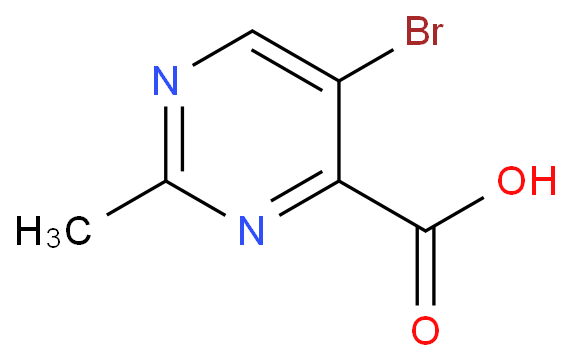
5-Bromo-2-methyl-4-pyrimidinecarboxylic acid (CAS 100707-39-9; C6H5BrN2O2; Mr 217.02) is a trifunctional heteroaryl building block combining an electron-deficient diazine ring, a carboxylic acid at the activated C4 position and a bromide at C5. The three groups are mutually productive: the acid is the standard attachment point for amide and ester libraries, the bromide is a reserved handle for cross-coupling, and the two ring nitrogens lower lipophilicity while offering hydrogen-bond-acceptor interactions valued in medicinal design. It is traded only as a research-grade intermediate with no indication of its own.
Demand follows the steady expansion of pyrimidine-containing portfolios, where this substitution pattern offers rigidity with low lipophilicity in one small fragment. Volumes stay in the development range, typically kilograms to low hundreds per programme, built around a defined route rather than stock. Supply is constrained less by raw material than by plants able to manage two hazards well: decarboxylation during isolation and drying, and palladium residues from early coupling steps.
This paper addresses what sourcing managers, quality officers and CDMO partners need: the properties that decide drying and shipping practice; the cyclocondensation routes that build the ring and their regiochemistry; amide formation and decarboxylation risks; the application matrix; capacity, pricing and export behaviour; the regulatory load carried by REACH, CLP, TSCA and ICH Q7, Q11, Q3C, Q3D and M7; ESG and traceability; and strategy across China, India and the European Union.
The compound is normally supplied as a free-flowing off-white to pale beige crystalline powder with high polarity and correspondingly poor solubility in non-polar media. It dissolves in polar aprotic solvents and in aqueous base, where it forms the corresponding carboxylate, and only sparingly in neutral water and alcohols. Its acidity is strengthened by the adjacent ring nitrogens, so the acid behaves as a genuinely polar, salt-forming fragment rather than as the lipophilic aromatic acid its structure at first suggests.
Industrial supply rests overwhelmingly on cyclocondensation, the classical union of a three-carbon 1,3-dicarbonyl equivalent with an amidine to build the diazine ring in one step, followed by functional-group operations. Some programmes instead assemble the ring already bearing the bromide by using a halogenated three-carbon component, while others install bromine last by electrophilic halogenation of the completed heterocycle. The choice is dictated by which route delivers acceptable regiochemistry and by where the inevitable purification burden is cheapest to carry.
Three drivers dominate. First, medicinal chemistry continues to shift toward heteroaromatic fragments with lower lipophilicity, and small diazines deliver exactly that combination of properties. Second, the acid plus bromide pairing supports two genuinely independent diversification axes, so it enters fragment-growing programmes early and follows them into development. Third, agrochemical discovery increasingly uses pyrimidine carboxamides, adding a second and less cyclical pull. Together these keep demand broad and shallow rather than concentrated in one blockbuster.
Chinese producers in Shandong, Jiangsu and Zhejiang are backward integrated into amidines and halogenated precursors, making them the default source at scale. Indian suppliers in Gujarat and the Hyderabad corridor compete on route-development speed and documentation, often winning campaigns where amidation follows downstream. European plants in Germany, Switzerland and Italy offset higher cost with confidentiality, analytical depth and proximity to clinical manufacturing.
Pricing splits along documentation rather than purity alone. Catalogue lots serve exploratory chemistry at comparatively high unit price and low commitment. Development campaigns introduce validated methods, named impurity limits, calorimetric drying justification and change control, and command a premium that reflects analytical labour more than yield. Retesting intervals also matter commercially: a supplier demonstrating real-time stability can extend shelf life and reduce write-offs, which for a thermally sensitive acid is worth more than a small discount.
Because this compound is almost always an intermediate rather than a product in its own right, compliance arrives through the customer's filing. Two tracks matter: inventory status, registration tonnage, classification and the safety data sheet, together with any intermediate registration relied upon; and process-derived quality, meaning residual palladium and phosphorus, class 2 solvent residues, and genotoxic-impurity reasoning on reagents used in the route.
Two features drive the environmental profile. Ring construction and halogenation generate nitrogen-rich and saline effluents, where total nitrogen and absorbable organic halogen are directly consented parameters in China and India, while chromatographic purification for regioisomer control multiplies solvent waste. For a material made in kilogram quantities, solvent intensity per kilogram of product can greatly exceed that of commodity chemicals, so the relevant question for buyers is not absolute emissions but intensity, tracked consistently and disclosed honestly.
The strongest improvements come from replacing chromatography with crystallisation, which removes the largest solvent contributor and usually raises recovery, and from recovering palladium rather than discarding carbon and filter cake. Process mass intensity and solvent-recovery figures should be requested per campaign, since they compare cleanly between bidders. European customers should meanwhile track whether carbon border adjustment is extended beyond its present sector list.
Palladium provenance is the distinctive traceability question here. Precious metal is a regulated material in most producing jurisdictions, so reputable plants document receipts, recovery contractor identities and metal losses per batch, which simultaneously resolves customer questions about supply ethics and about cross-contamination. Combining that with ammonia and nitrile raw-material records, ISO 9001, ISO 14001 and ISO 45001 certification and readiness for shared sustainability assessment gives the traceability file needed by both auditors and future due-diligence rules.
Logistics for this acid are governed less by hazard class than by physical stability. It is a polar, non-volatile dust that most commonly ships as non-classified cargo once acute toxicity, irritation and dust explosibility data support that conclusion, although some diazine intermediates do attract irritant classification and every claim requires testing rather than assumption. The genuine risks are absorbed moisture raising water content above specification, and excessive warmth during transport accelerating decarboxylation before the lot has even been released.
Where testing supports classification, consignments move under IMDG Code, ADR and RID and IATA provisions with certified packaging and trained-shipper documentation; otherwise they travel as general cargo on a documented rationale. Temperature is the operative measure either way: summer routes through hot hubs warrant temperature-controlled capacity, loads must never sit in steam-heated holds, and receivers should record arrival temperature so any elevated water or decarboxylation result can be attributed rather than argued over.
Because buyers change intermediates reluctantly, the winning supplier is the one whose development package survives the customer's own chemistry review without iteration. That advantage rests less on price than on demonstrated control of two things buyers fear: palladium carryover and silent thermal degradation. The three measures below convert those controls into arguments that catalogue vendors cannot match in a tender, and each costs little compared with the re-validation avoided.
5-Bromo-2-methyl-4-pyrimidinecarboxylic acid earns its place because it compresses three useful features into six carbons: a low-lipophilicity diazine core, an activatable acid and a reserved coupling handle. Since the prevailing direction in both pharmaceutical and agrochemical design favours fragments that add polarity without adding rotatable bonds, this substitution pattern should remain in demand well beyond any individual programme that currently uses it.
The commercial lesson is that value sits in control rather than in nameplate purity. Buyers who specify palladium, decarboxylation and regioisomer endpoints, require calorimetric justification of drying, and dual-qualify across China, India and the European Union avoid the failures that cost programmes months. Suppliers investing in crystallisation, noble-metal recovery and honest itemised certificates will find this small molecule supports unusually durable relationships.
Powered by Guidechem
This white paper is exclusively compiled by the Guidechem Intelligence Team based on global customs data, regulatory databases, and industry research. Guidechem is a leading global B2B chemical platform, dedicated to connecting global buyers with verified, high-quality manufacturers.
Relying on Guidechem's extensive global database, we have mapped the core participants in the current global 5-Bromo-2-methyl-4-pyrimidinecarboxylic acid supply chain:
Disclaimer: The content of this white paper is compiled based on public market data and regulatory information available as of 2026. Global chemical regulations are subject to dynamic adjustments. In actual export operations, enterprises must consult professional regulatory advisors or relevant competent authorities to obtain the latest compliance guidance.
|
 |
 |
 |
 EN
 Agricultural News
 Food News
 Industrial News
 Cosmetic News
 Pharmaceutical News
 Science News


 14YRS

