
I. Executive Summary
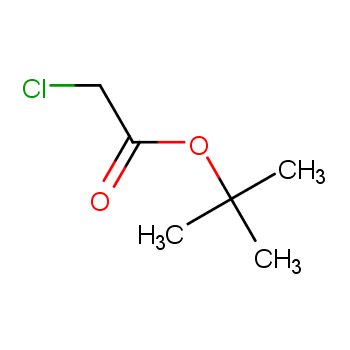
tert-Butyl chloroacetate (CAS 107-59-5; C6H11ClO2, relative molecular mass approximately 150.6) is a reactive chloroacetate ester supplied as a colourless to pale yellow liquid. It is bought for two reasons: it introduces a chloroacetyl group into amines, thiols, phenols and carbanions, and its tert-butyl ester is an acid-labile protecting group removable to reveal a carboxylic acid. Demand is project-linked rather than continuous, concentrated in pharmaceutical, agrochemical and specialty synthesis run in-house or through contract development and manufacturing organisations.
Manufacture belongs to a single route class: esterification of a chloroacetic acid derivative with a tert-butyl source, either by acid-catalysed addition of isobutylene or tert-butanol to chloroacetic acid, or by reaction of chloroacetyl chloride with tert-butanol in the presence of a base. Both are run to suppress the defining instability of the molecule, acid-catalysed and thermal elimination of the tert-butyl group to isobutylene. That instability is the second technical centrepiece: it is at once a purity problem, because the ester converts to chloroacetic acid, and a pressure hazard, because isobutylene raises internal pressure in a sealed drum during storage and transit.
The first technical centrepiece is hazard. Chloroacetates are potent alkylating agents and lachrymators with skin-corrosion potential, and where the material enters a pharmaceutical chain the genotoxic-impurity logic of ICH M7 applies to residues derived from it. Buyers therefore qualify suppliers on containment capability — occupational exposure bands, health-based exposure limits, closed handling and verified cleaning validation — as much as on specification. Add REACH and CLP obligations, strict harmonised classifications, TSCA inventory status and corrosive-goods transport classification, and this is a high-barrier, documentation-intensive product.
II. Product Deep Dive: Molecular Mechanisms and Production Evolution
2.1 Physicochemical Properties and Mechanisms
The molecule presents two electrophilic centres: the ester carbonyl, which reacts by addition-elimination, and the alpha carbon bearing chlorine, which reacts by direct nucleophilic substitution. It is the second pathway that makes the compound valuable and dangerous in equal measure. Chlorine is a good leaving group activated by the adjacent carbonyl, so amines, thiolates, phenolates and enolates are alkylated readily — and the same reactivity is directed at biological nucleophiles.
- Alkylating reactivity and its hazard consequence: Facile substitution at the alpha carbon underpins every synthetic use, and it also explains the toxicological profile: chloroacetates are electrophilic, corrosive to skin and eyes and strongly lachrymatory. Where residues derived from the compound can reach a drug substance, ICH M7 class 2 acceptable-intake logic applies, so the supplier must be able to discuss impurity fate and carryover quantitatively. Handling is correspondingly governed by occupational exposure banding, health-based exposure limits, closed transfer and verified protective equipment.
- The tert-butyl ester: acid-lability and thermal elimination: tert-Butyl esters cleave under acid through a tert-butyl cation that loses a proton to give isobutylene and the free carboxylic acid, and the same elimination is promoted thermally. Both consequences matter commercially: the product drifts toward chloroacetic acid, itself corrosive and a genotoxic-impurity concern, and isobutylene pressurises closed containers. The same chemistry is exploited deliberately, because it allows mild deprotection to the acid that a methyl or ethyl ester would not permit.
2.2 Synthesis and Manufacturing Technologies
Production is a straightforward esterification executed under unusually tight control, because the product decomposes under the very conditions used to make it. Capable plants are multipurpose fine-chemical facilities with glass-lined or Hastelloy equipment, low-temperature vacuum distillation and containment adequate for a potent lachrymator. Differentiation comes from residual-acid control, water exclusion and packaging rather than from reactor productivity.
- Acid-catalysed esterification with a tert-butyl source: Chloroacetic acid is combined with isobutylene or tert-butanol under acid catalysis. The route is atom-efficient and avoids chloride-bearing by-product salts, but the acidic medium is precisely what promotes elimination to isobutylene and reversion to acid, so temperature, residence time and catalyst choice are balanced continuously. Work-up requires prompt neutralisation and low-temperature separation to arrest that drift before it reaches the certificate of analysis.
- Chloroacetyl chloride with tert-butanol and a base: Acylating tert-butanol with chloroacetyl chloride in the presence of an HCl scavenger avoids a strongly acidic medium and gives better residual-acid control, at the cost of a salt stream requiring disposal. Purification is low-temperature washing and drying followed by vacuum distillation, because thermal exposure at atmospheric pressure accelerates elimination. Release testing is GC assay, free acidity or acid value, water by Karl Fischer, related chlorinated impurities including chloroacetic acid and dichloroacetyl species, residual tert-butanol and colour.
2.3 Core Application Matrix
- Pharmaceutical intermediate synthesis: Used to install a chloroacetyl moiety or a protected carboxymethyl group, with the tert-butyl ester removed under mild acid to unmask a carboxylic acid. Campaigns are small-volume and high-value, and the customer expects ICH Q7-aligned manufacture, ICH Q11-style process understanding and a defensible impurity-fate argument rather than a commodity specification.
- Agrochemical and fine-chemical building block: Alkylation of amines, thiols and phenols gives intermediates for crop-protection and specialty-chemical programmes. These customers buy on reactivity, residual-acid control and delivery reliability and still require full hazard communication.
- Custom synthesis and material science: Contract development and manufacturing organisations supply the material both as a catalogue item and within bespoke sequences, distinguishing research-use-only campaigns from GMP campaigns with different documentation, containment and release requirements. Specialty polymer and monomer modification use the ester for the same alkylating logic.
III. Global Market Supply-Demand Landscape and Export Trends
3.1 Demand Drivers and Market Shifts
Demand follows outsourced synthesis pipelines rather than macro-economic cycles. As pharmaceutical and agrochemical sponsors concentrate development in external partners, orders for reactive building blocks shift from captive to merchant and contract supply, and the qualifying question becomes containment and documentation capability rather than installed capacity. The tert-butyl ester benefits from the preference for acid-labile protection in complex synthesis, because deprotection proceeds under conditions that leave many other functionalities intact.
3.2 Capacity Distribution and Export Flows
Capacity tracks the chloroacetic acid and chloroacetyl chloride industry, concentrated in China, with significant Indian production and smaller European assets oriented to captive and high-specification custom synthesis. Because the product is corrosive, moisture-sensitive and pressure-generating, it travels in small packages rather than bulk parcels, and long-distance trade favours suppliers with dangerous-goods competence. Export flows run from Chinese and Indian plants to European, North American and Japanese customers, with European producers retaining the high-specification segment.
3.3 Market Bifurcation and Pricing Dynamics
The market splits into research-use-only material bought on GC assay and price, and qualified material bought with impurity-fate documentation, health-based exposure limits, cleaning validation and GMP-aligned manufacture, the latter commanding a substantial premium. Feedstock costs follow chloroacetic acid and tert-butanol or isobutylene, but the decisive cost elements are containment infrastructure, low-temperature distillation, corrosion-compatible packaging and rejected-lot risk from acid drift. Buyers who specify on price alone typically discover the hidden cost when a drum arrives pressurised and off-specification.
IV. In-depth Analysis of Global Compliance and Regulatory Barriers
Compliance for an electrophilic, corrosive alkylating ester operates on three levels. First, inventory and classification: REACH registration with a dossier consistent with the safety data sheet, CLP notification reflecting the strict harmonised classifications of the chloroacetic-acid parent family, and TSCA inventory listing with import certification. Second, occupational health: exposure banding, health-based exposure limits, closed handling and verified cleaning validation where equipment serves pharmaceutical campaigns. Third, trade control: restricted-customer qualification, know-your-customer screening and end-use declaration.
4.1 European Market: REACH, CLP, and Sector-Specific Directives
- REACH registration and CLP classification: European supply requires registration for the relevant tonnage band with exposure scenarios covering synthesis, formulation and waste, and CLP notification aligned to the current adaptation to technical progress. Chloroacetic-acid-related substances carry strict harmonised classifications covering acute toxicity, skin corrosion and aquatic hazard, and classification drives labelling, packaging group, transport documentation and the customer's risk assessment. Suppliers should expect requests for the full classification basis, not merely label elements.
- Worker protection and major-accident rules: Use at the customer site falls under the Chemical Agents Directive 98/24/EC and, where mutagenic or carcinogenic classifications apply, the Carcinogens and Mutagens Directive 2004/37/EC, which require risk assessment, hierarchy-of-controls substitution thinking, exposure monitoring and health surveillance. Larger inventories can bring sites within Seveso-III major-accident prevention obligations. Suppliers support customers by providing consistent hazard data and by documenting containment expectations in the technical file.
4.2 North American Market: TSCA, EPA, and FDA Regulations
- TSCA inventory, reporting and import certification: The substance must be listed on the TSCA Inventory for the relevant commercial activity, importers must certify positive or negative import certification under the TSCA import rule, and Chemical Data Reporting obligations attach above exposure-based thresholds. Because the material is reactive and handled in closed systems, the practical duties are inventory, recordkeeping and certification, but a gap in any of them blocks clearance.
- OSHA hazard communication and waste obligations: Downstream users operate under the OSHA Hazard Communication Standard with GHS-aligned labels and safety data sheets, respirator and skin-protection programmes, and emergency eyewash and shower provision appropriate to a lachrymator and skin-corrosive agent. Chlorinated organic residues from synthesis and cleaning fall under RCRA hazardous waste management, so customers routinely ask suppliers for composition disclosure sufficient to support their own waste classification.
4.3 The Critical Hurdle: Quality Control and Safety Limits
Compliance Warning: The specification that matters is not assay but the degradation couple: free acidity or acid value and water by Karl Fischer, because the ester hydrolyses and eliminates to chloroacetic acid and isobutylene. Buyers should require GC assay, free acidity, water, related chlorinated impurities including chloroacetic acid and dichloroacetyl species, residual tert-butanol and colour, with stated methods and numeric results. Where the material enters a pharmaceutical chain, chloroacetic-acid-derived residues are a classic genotoxic-impurity registration issue, so ICH M7 class 2 acceptable-intake reasoning, ICH Q3C solvent control for tert-butanol and ICH Q3D elemental assessment for catalyst-derived metals must be documented. Packaging must be corrosion-compatible and must accommodate isobutylene generation rather than assume a pressure-neutral container.
V. Green Trade Barriers and ESG in Manufacturing
The environmental profile of a chlorinated ester is defined by chloride-bearing waste and solvent use rather than by carbon alone. Neutralisation brines, spent wash liquors and distillation residues contain organic chlorine and must be routed to high-temperature incineration or dedicated treatment, and that cost is a real component of delivered price. Customers look for documented waste routing, ISO 14001 certification and a product carbon footprint for Scope 3 reporting.
5.1 Carbon Footprint and Circular Economy
Cradle-to-gate emissions come from chloroacetic acid manufacture, from the vacuum distillation that protects the product from thermal elimination, and from solvent recovery. Producers differentiate through solvent recycling, heat integration around low-temperature distillation, and high capture efficiency on chlorinated vent streams. Circularity is constrained by the hazard: recycled solvent must be revalidated for water and acid content because both accelerate degradation, and rework of off-specification lots is generally unacceptable. Product carbon footprints per ISO 14067 or the GHG Protocol product standard are increasingly requested by European customers.
5.2 Sustainable Sourcing and Traceability
For a reactive alkylating agent, traceability means customer traceability as much as feedstock traceability. Responsible suppliers operate know-your-customer screening, restricted-customer qualification and documented end-use declarations, and maintain lot-level records linking each shipment to a named customer, application and campaign. That discipline is not merely reputational: it is what allows a supplier to answer a regulator's question quickly and to distinguish a research-use-only campaign from a GMP campaign with different release and containment obligations. Feedstock-side documentation covers chloroacetic acid origin, solvent provenance and, where applicable, renewable or recycled content claims.
VI. Supply Chain Resilience and Export Logistics
This is a corrosive, moisture-sensitive liquid that can generate gas in its own container, and logistics must address all three properties at once. Failures are rarely dramatic: they take the form of drums arriving with elevated acidity, pressurised containers, or corroded closures that compromise the barrier. A supplier who treats packaging, temperature control and closure specification as quality decisions will out-perform one who treats them as shipping details.
6.1 Packaging Standards and Moisture/Contamination Control
- Corrosion-compatible packaging and moisture exclusion: Packaging must resist hydrochloric and chloroacetic acid formation, which in practice means lined steel or compatible high-density polyethylene with verified closure compatibility, filled dry under inert gas with minimal headspace. Water is the enemy: absorbed moisture hydrolyses the ester, so drums are closed under dry conditions and buyers specify water content at release and on arrival as the leading indicator of barrier failure.
- Pressure management and temperature control: Because thermal elimination releases isobutylene, containers must either incorporate compliant pressure relief or be shipped and stored under controlled temperature with documented limits. Buyers should ask for the supplier's thermal stability data and for the storage temperature range that underpins the claimed shelf life, and should treat any pressurised or bulging container as a quality and safety event rather than a handling nuisance.
6.2 Dangerous Goods Identification and Transit Protocols
Shipment is as a corrosive dangerous good under the UN class 8 regime for road, sea and air, with the specific UN entry and packing group confirmed against the current safety data sheet and applicable modal regulations rather than assumed. Consignments require compliant packaging with valid design-type approval, correct marking and labelling, a transport emergency card, and segregation from bases, amines, oxidisers and foodstuffs. Given the gas-generation potential, temperature-controlled transport and logging are prudent for long or tropical routes, and documentation should travel with the goods so a receiver can verify acid value and water before release.
VII. Enterprise Global Expansion Strategy Guide
Suppliers should compete on containment and impurity-fate documentation rather than on capacity. The esterification is not difficult to run; what is scarce is a plant that can handle a potent lachrymator safely, prove low residual acid and water, articulate an ICH M7 position, and maintain the customer screening that a reactive alkylating agent demands. Three priorities follow.
- Make containment a sellable capability: Establish occupational exposure banding with health-based exposure limits, closed transfer and dedicated handling suites, documented cleaning validation, and emergency provisions appropriate to a lachrymator and skin-corrosive agent. Publish what can be published: containment performance and exposure controls are increasingly the first questions a pharmaceutical buyer asks.
- Build the impurity and solvent documentation: Provide GC assay, free acidity, water, related chlorinated impurities and residual tert-butanol with stated methods, and pair them with an ICH M7 class 2 acceptable-intake argument for chloroacetate-derived residues, ICH Q3C solvent control and ICH Q3D elemental assessment. Align manufacture with ICH Q7 and process understanding with ICH Q11 so that GMP campaigns can be supported without redevelopment.
- Segment research-use-only from GMP and screen customers: Offer clearly separated research-use-only and GMP campaign offerings with different release, documentation and containment obligations, and apply know-your-customer screening with end-use declaration and restricted-customer qualification on every account. This protects the business, satisfies downstream auditors and makes legitimate custom-synthesis relationships easier to onboard.
VIII. Conclusion
tert-Butyl chloroacetate is a small, reactive molecule whose commercial success depends on how well a supplier manages its two instabilities. The first is chemical: acid-catalysed and thermal elimination to isobutylene and chloroacetic acid, which degrades specification and pressurises containers. The second is toxicological: an electrophilic chloroacetate demanding containment discipline and, in pharmaceutical chains, a defensible genotoxic-impurity position. Producers who specify packaging, temperature and closure integrity as quality parameters win repeat business.
The outlook is stable and skewed toward qualified suppliers. Outsourced pharmaceutical and agrochemical development continues to move reactive building blocks into merchant and contract channels, and the tert-butyl protecting group remains a standard tool in complex synthesis. Participants who combine REACH and CLP readiness, TSCA compliance, corrosive-goods transport competence, ICH Q7 and Q11 alignment and documented customer screening will capture that demand profitably through 2026.
IX. Industry Resource Connection and Supplier Ecosystem
Powered by Guidechem
This white paper is exclusively compiled by the Guidechem Intelligence Team based on global customs data, regulatory databases, and industry research. Guidechem is a leading global B2B chemical platform, dedicated to connecting global buyers with verified, high-quality manufacturers.
Relying on Guidechem's extensive global database, we have mapped the core participants in the current global tert-Butyl chloroacetate supply chain:
- China — chloroacetic acid and chloroacetyl chloride heartland: Chinese capacity is anchored in the world's largest chloroacetic acid and acyl chloride base, giving integrated feedstock logistics for esterification and low-temperature distillation. Leading multipurpose plants have added glass-lined capacity, closed handling for lachrymators and corrosion-compatible packaging, and increasingly serve export customers with REACH dossiers and GHS-aligned documentation, while smaller workshops supply domestic research demand.
- India — custom synthesis and export-oriented fine chemicals: Indian producers combine halogenated building-block capability with a strong contract development and manufacturing tradition, supplying both catalogue quantities and bespoke multi-step sequences. Their competitive position rests on campaign flexibility, English-language regulatory documentation, and growing experience with occupational exposure banding and health-based exposure limit programmes requested by pharmaceutical customers.
- European Union — high-specification and GMP-adjacent supply: European assets are smaller and oriented to captive use, custom synthesis and high-specification campaigns, operating under REACH and CLP with strict harmonised classification awareness, and under the Chemical Agents and Carcinogens and Mutagens Directives at customer sites. Their value to buyers is documentation depth: impurity-fate arguments, ICH Q7 and Q11 alignment, validated cleaning and containment evidence, and dangerous-goods competence for corrosive, gas-generating liquids.
Disclaimer: The content of this white paper is compiled based on public market data and regulatory information available as of 2026. Global chemical regulations are subject to dynamic adjustments. In actual export operations, enterprises must consult professional regulatory advisors or relevant competent authorities to obtain the latest compliance guidance.



 EN
 Agricultural News
 Food News
 Industrial News
 Cosmetic News
 Pharmaceutical News
 Science News


 5YRS

