-
We detected your language preference as English. Would you like to switch to the English version for a better experience?
Switch to English
Stay here


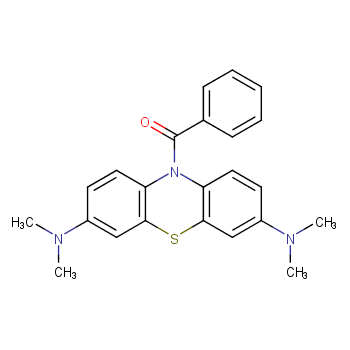
Benzoyl leuco methylene blue, CAS 1249-97-4, is the benzoylated, reduced leuco derivative of methylene blue. In its supplied state it is a substantially colourless to pale chromogenic material; upon oxidation it regenerates the conjugated phenothiazine cation and develops the intense blue of methylene blue. That single property made it a workhorse colour former in carbonless copy paper and in imaging systems, and it is now also supplied as a photo-oxidisable and redox-active reagent for industrial and laboratory research. This paper is written for industrial and institutional buyers and deliberately provides no consumer guidance of any kind.
Specification practice for this dye is unusual because performance is physical as much as chemical. Assay and hue development potential matter, but so does the particle size distribution and dispersibility of the powder in the customer's coating binder, because uneven dispersion produces speckled or weak image development. Alongside those sit the impurity questions that decide whether the material can be sold into Europe at all: residual aromatic amine, heavy metals, residual solvent and the intrinsic stability of the leuco state during storage.
The compliance picture in 2026 is dominated by end-use rather than by the dye itself. Methylene blue and phenothiazine derivatives carry their own REACH registration and CLP classification position and must be screened against the SVHC Candidate List and the REACH restrictions, while the paper systems into which the dye is formulated are being reshaped by the restriction on bisphenol A in thermal paper under REACH Annex XVII entry 66 and the wider bisphenol-free substitution wave. Add TSCA inventory and food-contact considerations in the United States and the result is a material whose commercial future depends on documentation discipline.
At market level, the functional principle of this material is a reversible optical switch. The leuco, benzoylated state interrupts the delocalised conjugation of the phenothiazine system, so the material absorbs little in the visible region and appears near colourless. Oxidation, whether triggered by an electron-accepting developer, by light or by thermal activation within the coating, restores the conjugated thiazine cation and produces the characteristic strong visible absorption band of methylene blue. Formulators tune the trigger, the rate and the final hue through the coating matrix rather than by changing the dye.
Manufacture proceeds by route classes that are common across phenothiazine dyes: build or procure the methylene blue chromophore, reduce it to the leuco form, protect the reduced nitrogen by benzoylation, and then isolate and finish the product without allowing premature oxidation. The competitive skill is in the finishing and in exclusion of oxygen and light, not in the coupling chemistry.
The demand structure is genuinely two-speed. Pressure-sensitive carbonless copy paper continues to decline in Europe and North America as transaction digitisation removes forms entirely, while thermal and label-based record materials grow with e-commerce fulfilment, parcel logistics and regulatory labelling requirements. For a dye supplier this means that absolute volume can fall while value rises, because the growing outlets impose stricter developer compatibility and impurity requirements than the legacy channel ever did.
China is the dominant manufacturing base for phenothiazine dyes and their leuco derivatives, exporting both as intermediates and as formulated coating components. Japan retains high-specification capability for imaging and light-sensitive materials where consistency and narrow particle distributions are decisive. Europe and the United States have largely exited bulk dye manufacture but remain important as converters, as research-grade buyers and as the source of the regulatory pressure that shapes specification.
Pricing has bifurcated between commodity colour-former grades, where competition is on price per kilogram and switching is easy, and specification-driven grades sold to imaging, thermal-label and research customers, where low residual aromatic amine, tight particle distribution, documented heavy-metal limits and full REACH and TSCA documentation support durable margins. Freight, packaging and the cost of light- and moisture-barrier packing are material components of landed cost in the second tier.
Compliance for this dye has to be understood at two levels. At substance level the question is whether the dye and its phenothiazine chemistry are registered, classified and screened under REACH, CLP and TSCA. At article level the question is whether the paper or coating system into which it is formulated meets restrictions on developers, food-contact rules and packaging and recyclability expectations. Buyers audit both, and suppliers who answer only the first lose tenders.
Environmental scrutiny of this dye arrives through the paper chain rather than through its own production footprint. European converters ask for evidence that coated products remain compatible with paper recycling and deinking, and ISO 14001 certification of the dye plant is typically treated as a baseline expectation for suppliers into that chain.
Production footprint is driven by solvent-intensive purification, the energy cost of milling and classification to a narrow particle distribution, and the drying duty needed to reach a low moisture specification. Downstream, the more consequential topic is circularity: coated paper that resists deinking or leaves coloured fibre reduces recycled pulp yield, so dye suppliers are increasingly asked for data supporting deinkability and for compatibility with recycled-content paper production.
Traceability requests focus on raw material provenance and on documented control of restricted substances. Buyers expect supplier declarations covering REACH SVHC and restriction screening, conflict-free and responsible sourcing of any metal-containing catalysts, solvent recovery and waste treatment documentation, and chain-of-custody evidence where the coated article is sold with recycled-content or ecolabel claims.
This is a light-sensitive, moisture-sensitive organic powder whose value is destroyed by premature oxidation. The logistics design therefore prioritises exclusion of light, control of moisture and avoidance of oxidising contaminants over any temperature-driven cold chain.
Most consignments of this dye move as general chemicals rather than as regulated dangerous goods under IMDG, ADR and IATA, supported by a GHS-aligned safety data sheet and label. That position depends on the classification dossier for the specific grade and must be evidenced, not assumed, particularly where aquatic hazard drives marine pollutant marking. Air freight of research quantities is normally handled under standard chemical provisions, while bulk shipments travel sealed, palletised and shrink-wrapped with desiccant and light protection.
Suppliers that hold share in a declining-but-restructuring market do so by following the reformulation rather than by defending legacy grades. The priorities below reflect where buying decisions are actually made for chromogenic phenothiazine dyes.
Benzoyl leuco methylene blue is a mature chromogenic material whose market is contracting in one direction and expanding in another. Legacy carbonless copy volumes continue to erode as transactions digitise, while thermal, label and imaging applications grow on the back of logistics and labelling demand and impose materially stricter developer compatibility and impurity requirements.
For exporters, the strategic conclusion is that this is now a documentation-led business. Suppliers combining ISO 9001 and ISO 14001 systems with demonstrated bisphenol-free compatibility, verifiable residual aromatic amine control, stable particle engineering and a current REACH, CLP and TSCA position will retain specification-driven margins even as commodity colour-former volumes decline. This article is addressed to industrial and institutional purchasers and provides no consumer guidance.
Powered by Guidechem
This white paper is exclusively compiled by the Guidechem Intelligence Team based on global customs data, regulatory databases, and industry research. Guidechem is a leading global B2B chemical platform, dedicated to connecting global buyers with verified, high-quality manufacturers.
Relying on Guidechem's extensive global database, we have mapped the core participants in the current global Benzoyl leuco methylene blue supply chain:
Disclaimer: The content of this white paper is compiled based on public market data and regulatory information available as of 2026. Global chemical regulations are subject to dynamic adjustments. In actual export operations, enterprises must consult professional regulatory advisors or relevant competent authorities to obtain the latest compliance guidance.
|
 |
 |
|
 EN
 Agricultural News
 Food News
 Industrial News
 Cosmetic News
 Pharmaceutical News
 Science News


 3YRS


