-
We detected your language preference as English. Would you like to switch to the English version for a better experience?
Switch to English
Stay here


Sodium 3-chloro-2-hydroxypropanesulfonate (CHPS-Na, CAS 126-83-0; C3H6ClNaO4S, relative molecular mass approximately 196.6) is a bifunctional C3 sulfonate: a sulfonate at C1, a secondary hydroxyl at C2 and a reactive chloromethyl at C3. Supplied as a white, hygroscopic, highly water-soluble solid or as an aqueous concentrate, it has almost no direct end use. Its value lies entirely in the terminal chlorine, displaced by tertiary amines to give the 2-hydroxy-3-sulfopropyl betaines known as hydroxysultaines. Demand therefore tracks personal-care reformulation rather than bulk detergent volume, and the material is bought on impurity profile, not on assay.
The route class is sulfite or bisulfite ring-opening of an epichlorohydrin-type substrate in water, followed by desalting, decolourisation and crystallisation. Because the epoxide starting material carries an EU-harmonised carcinogen classification, the decisive specification is residual epichlorohydrin, not assay. Buyers increasingly apply ICH M7 class 2 acceptable-intake logic to this industrial intermediate by analogy, converting a parts-per-million residual into an exposure argument. That step, plus control of residual chlorinated alcohols and inorganic salt, defines cosmetic grade and a roughly twofold price spread.
The 2026 opportunity is structural. Sulphate-free and ethylene-oxide-free positioning is pushing formulators from ethoxylated sulphates toward amphoteric sulfonate surfactants made with no ethoxylation step, removing residual ethylene oxide and 1,4-dioxane compliance from the chain. Meanwhile cocamidopropyl betaine specifications have tightened on dimethylaminopropylamine and on monochloroacetic-acid-derived glycolic acid and sodium monochloroacetate. A sultaine made from CHPS-Na carries neither; that impurity ledger drives the substitution.
CHPS-Na is a densely functionalised three-carbon platform. The sulfonate is fully ionised across the whole industrial pH range, the alcohol adds hydrophilicity, and the primary chloride is activated toward nucleophilic displacement yet also hydrolyses and can cyclise back to an epoxide under base. Those three properties dictate drying conditions, packaging, pH control and the analytical release panel.
All commercial material belongs to one reaction class: a sulfur(IV) oxyanion attacks an activated three-carbon electrophile in the aqueous phase, then inorganic salt is removed and the product isolated. Producers differentiate on sulfite source and pH control, and above all on the work-up, which sets residual epichlorohydrin, colour and salt burden. Plants are usually multipurpose sulfonation assets, so changeover cleaning and campaign traceability are real audit items.
The driver is substitution, not volume growth. Hydroxysultaines are positioned as the mild, ethylene-oxide-free alternative to cocamidopropyl betaine in sulphate-free systems. The interesting comparison is the impurity ledger: betaine specifications have tightened on dimethylaminopropylamine, a sensitiser from the amidoamine coupling step, and on monochloroacetic-acid-derived glycolic acid and sodium monochloroacetate from carboxymethylation. A hydroxysultaine has no carboxymethylation residues; its impurity story is residual epichlorohydrin and residual chlorinated alcohols, which brand owners find easier to defend.
Intermediate capacity is concentrated in China, where sulfonation and epoxide-derivative chemistry sits beside large epichlorohydrin production, much of it glycerine-based and therefore linked to biodiesel by-product availability. Consumption is distributed: sultaine manufacture is significant in China, Western Europe, North America and increasingly India and Southeast Asia, so the trade is a China-to-world intermediate flow with regional conversion. Volumes move in 25 kg bags and in intermediate bulk containers of aqueous concentrate, with air freight reserved for qualification samples.
The market splits into an industrial grade sold into plating, textile and polymer outlets on assay and price, and a cosmetic grade sold on residual epichlorohydrin, colour, chloride and full impurity disclosure. The second carries a premium and is contractually sticky, because requalifying a sultaine plant is expensive. Feedstock pass-through is asymmetric: glycerine-derived epichlorohydrin links costs to biodiesel economics, while evaporation and crystallisation link them to regional energy prices. Buyers contracting on assay alone routinely find the cheap lot fails the epichlorohydrin clause.
Compliance is three-layered. First, chemical inventory and hazard communication: REACH registration consistent with the safety data sheet, aligned CLP notification, and Toxic Substances Control Act inventory listing. Second, the downstream surfactant layer: Detergent Regulation 648/2004, EU Ecolabel criteria, the OECD 301 ready-biodegradability battery, and the REACH Annex XVII restriction on residual 1,4-dioxane that ethoxylated chains must manage and sultaine chains avoid by construction. Third, the finished cosmetic: EU Regulation 1223/2009 with responsible person, safety assessor, CMR prohibition and CPNP notification; MoCRA; and China's NMPA ingredient filing regime.
Because CHPS-Na is invisible inside a consumer-facing surfactant, it inherits the brand's ESG obligations rather than escaping them. Brand owners running Scope 3 inventories push cradle-to-gate product carbon footprints down the ingredient chain, and an intermediate with energy-intensive evaporation and crystallisation is an obvious target. Suppliers offering ISO 14001 certification and a product carbon footprint consistent with ISO 14067 or the GHG Protocol product standard are increasingly scored separately from price-only bidders.
Dominant cradle-to-gate contributions are the upstream epichlorohydrin — lower in fossil carbon when made from bio-glycerine rather than propylene — and the thermal duty of water removal. Producers differentiate through multi-effect evaporation, mechanical vapour recompression, heat integration between reaction exotherm and concentrator, and recovery of the inorganic salt fraction instead of discharging high-COD brine. A glycerine route is not automatically lower-carbon once land-use change is allocated, so buyers should request the underlying assumptions.
The hydrophobic chain of the downstream sultaine comes from coconut or palm kernel oil, and this is where traceability becomes concrete. RSPO certification covers palm and palm kernel oil, not coconut; the EU Deforestation Regulation 2023/1115 lists oil palm among its relevant commodities, while coconut is not among them. A customer demanding RSPO or EUDR documentation is therefore asking about the palm kernel fraction of the amidoamine, and the correct answer is a mass-balance or segregated claim with geolocation data, not a blanket certificate. ISO 22716 alignment and halal, kosher and vegan declarations complete the file.
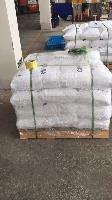
CHPS-Na is a hygroscopic, water-soluble solid whose principal logistics risk is moisture uptake and caking rather than hazard. A container arriving with hardened, partially fused bags generates handling losses, dust exposure and disputed assay results even when the chemistry is unchanged. Resilience therefore rests on packaging integrity, container-level moisture management and lot-level documentation, not on any exotic transport solution.
Supplied as the technical solid or as an aqueous solution, CHPS-Na is not normally assigned a dangerous-goods classification for road, sea or air transport, but that must be verified against the current safety data sheet and the applicable modal regulations rather than assumed. Shippers should still apply conservative practice: clean, dry, closed equipment, no co-loading with strong oxidisers or amines that could react with residual alkyl chloride, avoidance of prolonged high-temperature exposure in tropical transhipment, and humidity logging through hot hubs. For air-freighted samples, review the SDS before booking and send the residual epichlorohydrin result with the material.
Suppliers should treat CHPS-Na as a documentation product. The reactor chemistry is mature and widely available; what is scarce is a producer willing to stand behind a residual epichlorohydrin number, disclose its chlorinated alcohol and salt profile, and support customer REACH, MoCRA and NMPA filings with consistent data. Three moves separate qualified suppliers from price-only bidders.
CHPS-Na is a small molecule with a disproportionately large compliance footprint. Its chemistry is simple — sulfite opening an epoxide, then desalting and isolation — but its commercial fate is decided by what remains in the crystal: parts-per-million epichlorohydrin, chlorinated alcohols, inorganic salt, water and colour. Producers who build quality systems and analytical capability around that reach the cosmetic-grade tier, where contracts are long and margins defensible. Those selling on assay alone remain confined to plating, textile and polymer outlets.
The outlook is favourable. Migration from ethoxylated sulphates toward mild amphoteric sulfonate surfactants is compliance-driven rather than fashion-driven, reinforced by the difficulty of defending amidoamine and monochloroacetate residue specifications in the incumbent betaine chain. CHPS-Na enables a sultaine route class with no ethoxylation and no carboxymethylation — exactly the combination regulatory and brand pressure rewards. Participants pairing that with REACH, TSCA, MoCRA and NMPA readiness and honest oleochemical traceability will capture the 2026 opportunity.
Powered by Guidechem
This white paper is exclusively compiled by the Guidechem Intelligence Team based on global customs data, regulatory databases, and industry research. Guidechem is a leading global B2B chemical platform, dedicated to connecting global buyers with verified, high-quality manufacturers.
Relying on Guidechem's extensive global database, we have mapped the core participants in the current global Sodium 3-chloro-2-hydroxypropanesulfonate (CHPS) supply chain:
Disclaimer: The content of this white paper is compiled based on public market data and regulatory information available as of 2026. Global chemical regulations are subject to dynamic adjustments. In actual export operations, enterprises must consult professional regulatory advisors or relevant competent authorities to obtain the latest compliance guidance.
|
 |
 |
 |
 EN
 Agricultural News
 Food News
 Industrial News
 Cosmetic News
 Pharmaceutical News
 Science News


 1YR

