
I. Executive Summary
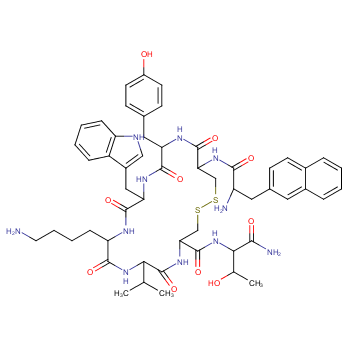
Lanreotide acetate (CAS 127984-74-1) is the acetate salt of lanreotide, a cyclic octapeptide somatostatin analogue whose sequence — D-2-naphthylalanyl-cysteinyl-tyrosyl-D-tryptophyl-lysyl-valyl-cysteinyl-threoninamide, closed by a single disulfide bridge — gives it the conformational rigidity required for prolonged receptor engagement. It is an approved prescription medicine rather than a research reagent, and its active substance is a high-value, low-volume peptide manufactured by specialist peptide organisations for licensed finished-dose producers.
From a contract-manufacturing standpoint the molecule is a textbook case in synthetic peptide process design: Fmoc solid-phase assembly on a resin that delivers the C-terminal amide, acidolytic cleavage, solution-phase oxidative folding to install the disulfide, preparative reversed-phase purification, counter-ion exchange into the acetate form and lyophilisation. Each step creates a characteristic impurity family — deletion sequences from incomplete coupling, scrambled connectivity from folding, residual trifluoroacetate from purification.
The differentiating demands come from the finished form. Long-acting presentations, including a self-assembling nanotube gel and microsphere systems, are sensitive to peptide purity, to counter-ion and acetate content and, for encapsulation, to particle size and solid-form consistency, so the specification is written around the formulation rather than around the molecule in isolation. Add ICH Q11 development expectations, ICH Q7 GMP, CEP or drug master file coverage, containment set from a health-based exposure limit, cold-chain distribution and a full analytical armoury, and the barrier to entry becomes clear. This paper addresses licensed manufacturers and contains no clinical guidance.
II. Product Deep Dive: Molecular Mechanisms and Production Evolution
2.1 Physicochemical Properties and Mechanisms
Lanreotide comprises eight residues with a disulfide bridge between the two cysteine positions, a C-terminal threoninamide and two non-natural residues — D-2-naphthylalanine at the N-terminus and D-tryptophan within the ring. Those residues constrain the pharmacophore and block exopeptidase attack, giving a duration of action far longer than native somatostatin. The free base corresponds to C54H69N11O10S2, and commercial material is the acetate salt, supplied as a lyophilised powder with defined water and acetate content.
- Receptor pharmacology and conformational constraint: The cyclic disulfide fixes a turn pharmacophore centred on the tryptophan-lysine motif that engages somatostatin receptor subtypes. Because receptor engagement depends on that turn, correct disulfide connectivity is not a quality detail but the biological activity itself: a mis-bridged isomer is a different molecule with a different profile.
- Self-assembly and its formulation consequences: At the high concentrations used in long-acting presentations, lanreotide acetate spontaneously assembles in water into monodisperse nanotubes that form a gel, and that behaviour underpins the marketed depot presentation. It is exquisitely sensitive to purity, counter-ion composition and pH, which is why residual trifluoroacetate, acetate stoichiometry and related-substance levels are written into the API specification rather than left to the finished-product developer.
2.2 Synthesis and Manufacturing Technologies
Two manufacturing philosophies compete. The classical approach is stepwise Fmoc solid-phase synthesis with a single solution-phase oxidation, while convergent or hybrid strategies assemble protected fragments and couple them in solution, improving crude purity and cutting resin and reagent consumption at scale.
- Fmoc solid-phase assembly and cleavage: The chain is built from the C-terminal threonine outward on a Rink amide or equivalent resin using Fmoc-protected amino acids, including both D-residues, with uronium or carbodiimide activation and piperidine-mediated deprotection. Coupling completeness is monitored in-process and difficult couplings are double-coupled or capped, because deletion sequences dominate the related-substance profile. Cleavage with a trifluoroacetic acid cocktail containing scavengers releases the linear dithiol, and reagent choice is also a safety question, since benzotriazole-based coupling additives carry thermal hazards requiring calorimetric screening.
- Oxidative folding, purification and salt formation: Disulfide formation is run in dilute aqueous solution at controlled pH, most often with air, dimethyl sulfoxide or a redox pair, monitored for monomer, dimer and mis-bridged species; high dilution suppresses intermolecular dimerisation at the cost of solvent and time. Purification by preparative reversed-phase chromatography leaves the peptide as a trifluoroacetate salt that must be exchanged to acetate, before isolation by lyophilisation to a defined water content.
2.3 Core Application Matrix
- Long-acting injectable presentations: The self-assembling nanotube gel and microsphere depot formulations used for chronic therapy, where API purity, acetate content and solid-form consistency determine whether the depot performs to specification.
- Generic and regional-market development programmes: Abbreviated filings against the originator product require an API with equivalent stereochemistry, disulfide connectivity, counter-ion content and impurity profile.
- Clinical and lifecycle supply: Registration batches, process-validation campaigns and post-approval changes run under a quality agreement, where the deliverables are transfer protocols, validated methods and comparability reports rather than drums alone.
III. Global Market Supply-Demand Landscape and Export Trends
3.1 Demand Drivers and Market Shifts
Demand is driven by three factors: diagnosed and treated prevalence of acromegaly and of gastroenteropancreatic neuroendocrine tumours, the shift toward long-acting somatostatin analogue therapy as first-line management, and the gradual arrival of generic competition as originator protection expires in major markets. Because annual API volumes for a peptide of this type are measured in kilograms rather than tonnes, market structure is set by the number of qualified peptide manufacturers with the right containment, chromatography and lyophilisation capacity, and by qualification cycles measured in years.
3.2 Capacity Distribution and Export Flows
Peptide API capacity is concentrated in three ecosystems. China has built large-scale solid-phase capability in the Hangzhou, Shanghai and Nanjing clusters with integrated Fmoc amino-acid supply and substantial preparative chromatography and lyophilisation capacity. Europe and Switzerland host the specialist peptide houses with the longest regulatory track record and much of the peptide CEP and master-file coverage. The United States combines synthesis with injectable finishing, and India has been expanding peptide capacity in Hyderabad and Bangalore. Trade flows accordingly run from synthesis sites to sterile filling sites, usually within the same regulatory bloc.
3.3 Market Bifurcation and Pricing Dynamics
Price is set by campaign economics rather than raw material. Fmoc-protected amino acids, resin and coupling reagents dominate variable cost, preparative chromatography determines throughput and solvent consumption, and the yield of the folding step determines everything downstream. Buyers pay for three things beyond the molecule: a defensible impurity and counter-ion data set, the regulatory pedigree of the producing site, and security of supply, since single-sourcing a chronic-therapy peptide API is a recognised business risk.
IV. In-depth Analysis of Global Compliance and Regulatory Barriers
For a peptide active of this kind, compliance is one integrated question: whether the developer's understanding of the molecule, documented under ICH Q11, is matched by the manufacturer's control under ICH Q7 and by the dossier that carries it into each market.
4.1 European Market: REACH, CLP, and Sector-Specific Directives
- ASMF or CEP, EU GMP and the written confirmation: European filings proceed either through a certification of suitability where a monograph exists or, as is usual for a peptide of this type, through an active substance master file with closed and open parts and a letter of access to each applicant. Manufacturing must meet EudraLex Volume 4 Part II, the European adoption of ICH Q7, and non-EU sites need a written confirmation of equivalent GMP oversight. Because the substance is a peptide, the dossier must address starting materials, reagents and stereochemical control explicitly.
- REACH, CLP and occupational containment: Peptide actives above the one-tonne threshold require REACH registration with a chemical safety report, and below it CLP classification and labelling duties still apply. The operative control is occupational: a health-based exposure limit derived from pharmacological potency sets the containment band, and that band determines isolator or closed-system handling, cleaning validation limits, gowning and environmental monitoring.
4.2 North American Market: TSCA, EPA, and FDA Regulations
- TSCA, the FDA DMF and peptide-specific expectations: Entry requires the positive or negative TSCA certification with inventory listing or exemption, and the API is supported by a Type II drug master file reviewed only within a referencing application, with the site subject to ICH Q7, to GDUFA facility fees where named in a generic application, and to inspection. For a synthetic peptide, reviewers expect the dossier to cover amino-acid starting-material control, chiral purity, disulfide connectivity, counter-ion and residual trifluoroacetate and peptide-related impurities, with methods validated to ICH Q2.
- Nitrosamines, residual solvents and elemental impurities: Nitrosamine risk assessment is now expected, and peptide synthesis brings a specific pathway: piperidine, the secondary amine used for Fmoc deprotection, is itself a nitrosamine precursor, so nitrite control in water and solvents and, where justified, substitution of the deprotection base belong in the assessment. Residual solvents are controlled under ICH Q3C, notably acetonitrile and dimethylformamide, and reagent-derived elemental impurities under ICH Q3D, with peptide content corrected for water, acetate and residual counter-ions.
4.3 The Critical Hurdle: Quality Control and Safety Limits
Compliance Warning: Three attributes decide acceptance, and all three are invisible to a single purity figure. First, disulfide connectivity: a mis-bridged, scrambled or trisulfide variant can co-elute, so orthogonal confirmation by LC-MS or by peptide mapping after reduction and alkylation is required. Second, counter-ion and acetate stoichiometry: residual trifluoroacetate and the acetate content shift peptide content and assay and, for this molecule, the self-assembly behaviour on which the depot presentation depends. Third, stereochemistry: the two D-residues must be confirmed by chiral analysis after hydrolysis, because a racemised batch is pharmacologically different and no amount of chromatographic purity will rescue it.
V. Green Trade Barriers and ESG in Manufacturing
Environmental performance for a peptide API is dominated by solvent. Solid-phase synthesis and preparative chromatography consume very large volumes per kilogram of product, and that fact shapes both the footprint and the economics of every campaign.
5.1 Carbon Footprint and Circular Economy
The dominant contributors are the amide solvent used in coupling and deprotection, the acetonitrile used in preparative chromatography, and the energy of lyophilisation and of solvent recovery or disposal. Credible abatement levers include solvent recovery by distillation with audited recovery rates, substitution of amide solvents with greener alternatives where coupling efficiency permits, coupling-reagent selection that reduces equivalents and waste, and a move from batch to multi-column or continuous chromatography to raise loading and cut eluent. Buyers now request a cradle-to-gate footprint per kilogram on a Scope 1, 2 and 3 basis following pharmaceutical supply-chain methodology.
5.2 Sustainable Sourcing and Traceability
Traceability for this API runs back to the amino acids and reagents rather than to a mine, so the questions are different: animal-derived material and transmissible-spongiform-encephalopathy status, solvent and reagent origin, and documentation that no material of human or animal origin enters the chain. Buyers also ask about the environmental fate of peptide material in waste streams and about solvent recovery and disposal routes, and suppliers able to document amino-acid provenance, reagent chain of custody and solvent destination are preferred in regulated tenders.
VI. Supply Chain Resilience and Export Logistics
The physical supply chain is a cold chain for a lyophilised, moisture-sensitive, high-potency solid. Everything about packaging and transit follows from those three properties, and the cost of getting it wrong is the full value of a small, expensive lot.
6.1 Packaging Standards and Moisture/Contamination Control
- Moisture, light and temperature protection: The lyophilised acetate is packed in sealed glass vials or in double polyethylene bags inside a sealed container with desiccant, protected from light, with a defined residual water content and a labelled storage temperature. Headspace should be dry and closures tamper-evident, and the container-closure system must be qualified for the intended storage period.
- Containment and identification: Because the substance is pharmacologically potent with a documented health-based exposure limit, handling requires the containment band appropriate to its occupational exposure category, with dedicated or validated-clean equipment, documented cleaning verification and, at the highest bands, isolator transfer. Containers must be individually identified with certificate traceability and campaigns segregated.
6.2 Dangerous Goods Identification and Transit Protocols
Peptide API of this type is not classified as dangerous for transport, so the governing regime is temperature rather than hazard class: validated cold-chain packaging with qualified coolants or dry ice, continuous temperature monitoring, documented excursion assessment and a defined return or rejection procedure. Air freight is the norm because lots are small and valuable, with customs and any import licensing cleared in advance. Stability commitments must rest on ICH Q1A data generated on the actual packaged presentation.
VII. Enterprise Global Expansion Strategy Guide
For a peptide development and manufacturing organisation, the commercial contest is won on development science and regulatory documentation rather than on installed capacity. Customers qualify a peptide supplier once and stay for years, and they qualify on evidence.
- Invest in the development package, not just the campaign: Build an ICH Q11-quality development history — route selection, folding-study design, impurity identification and purge, counter-ion control strategy — and mirror it into an active substance master file open part and a US drug master file. Offer analytical method transfer, comparability protocols and variation support.
- Win on analytical depth: Offer peptide mapping, LC-MS and tandem mass spectrometry for connectivity and sequence confirmation, amino acid analysis for peptide content, chiral analysis for the D-residues, ion chromatography or nuclear magnetic resonance for acetate and trifluoroacetate, and full ICH Q3C and Q3D screening, all validated to ICH Q2 and presented as an audit-ready package.
- Engineer containment, cold chain and continuity: Set the occupational exposure band from a documented health-based exposure limit, build isolator or closed-transfer capability to match, qualify cold-chain packaging with real lane data, and offer second-suite or second-site options so chronic-therapy supply does not depend on one line. Supply only licensed manufacturers of authorised medicines, under quality agreements and without clinical guidance.
VIII. Conclusion
Lanreotide acetate is a small-volume, high-value peptide active whose market is defined by chronic therapy, by long-acting formulation science and by a small number of qualified manufacturers. Generic entry will broaden the customer base, but it will also tighten price discipline and raise the evidentiary bar, because abbreviated filings depend on demonstrating sameness rather than novelty.
The durable advantages in this business are therefore scientific and documentary rather than commercial. Master the folding step, prove the connectivity, control the counter-ion and the acetate, run the cold chain with data, and hold a dossier a regulator can read without questions. Producers who do that will be written into customers' lifecycle plans; those competing only on kilogram price will find themselves excluded from the qualification lists that govern this market.
IX. Industry Resource Connection and Supplier Ecosystem
Powered by Guidechem
This white paper is exclusively compiled by the Guidechem Intelligence Team based on global customs data, regulatory databases, and industry research. Guidechem is a leading global B2B chemical platform, dedicated to connecting global buyers with verified, high-quality manufacturers.
Relying on Guidechem's extensive global database, we have mapped the core participants in the current global Lanreotide acetate supply chain:
- China — scaled solid-phase peptide capacity: Producers in the Hangzhou, Shanghai and Nanjing clusters combine Fmoc amino-acid supply with large-volume solid-phase synthesis, preparative chromatography and lyophilisation, exporting to formulation partners worldwide. Their advantage is capacity and cost; their task is building the regulatory track record and the impurity and counter-ion data sets that regulated customers require.
- European Union and Switzerland — peptide CDMO heritage: The specialist peptide houses here hold much of the certification and master-file experience for peptide actives, with mature folding, chromatography and containment practice and established inspection histories. They set the evidentiary standard for stereochemistry and connectivity.
- United States — integrated peptide and injectable capability: US peptide organisations combine synthesis with sterile finishing and FDA-facing dossier experience, supporting abbreviated filings with Type II master-file packages and inspection readiness under ICH Q7 and GDUFA. Their differentiator is proximity to the finished-dose customer.
Disclaimer: The content of this white paper is compiled based on public market data and regulatory information available as of 2026. Global chemical regulations are subject to dynamic adjustments. In actual export operations, enterprises must consult professional regulatory advisors or relevant competent authorities to obtain the latest compliance guidance.


 EN
 Agricultural News
 Food News
 Industrial News
 Cosmetic News
 Pharmaceutical News
 Science News


 2YRS

