
I. Executive Summary
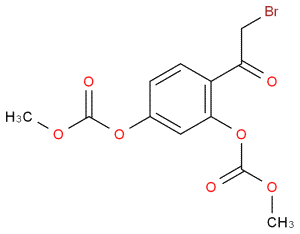
4-(Bromoacetyl)-1,3-phenylene dimethyl biscarbonate (CAS 1428451-07-3; C12H11BrO7; molecular weight about 347.1) is a multifunctional aromatic building block that combines an alpha-bromoketone with two methyl carbonate groups on the same ring. It is not bought as a commodity but commissioned: it arrives in trade as a custom-synthesis or toll-manufacturing brief for peptide and peptidomimetic programmes, prodrug linkers and related convergent syntheses, each with its own purity, impurity and containment requirements.
Two features drive every specification and every quotation. The bromoacetyl group is an electrophilic alkylating function, so hazard assessment, containment and end-use screening matter as much as purity. The two methyl carbonate groups are deliberately present as protecting groups, so their lability under basic or nucleophilic conditions determines both the impurity profile and the storage regime.
This white paper stays within legitimate custom-synthesis practice. It discusses route classes without procedural or enabling detail, and covers hazard banding in the style of ICH M7, occupational exposure banding and contained handling, lachrymator and corrosivity hazards, moisture and temperature sensitivity, carbonate-deprotection behaviour and its impurities, the European and North American regulatory position, and know-your-customer obligations.
II. Product Deep Dive: Molecular Mechanisms and Production Evolution
2.1 Physicochemical Properties and Mechanisms
The molecule is best read as three functional elements sharing one aromatic ring: an electrophilic alkylating centre, two labile carbonate protecting groups and a deactivated ring. Each behaves differently under process conditions and each generates a recognisable family of impurities.
- Electrophilic reactivity at the alpha-haloketone: Alpha-haloketones rank among the most reactive alkylating classes, because the adjacent carbonyl withdraws electron density and stabilises nucleophilic substitution at the carbon bearing bromine. The practical consequence is that this compound is designed to react, so any nucleophile present, including water, alcohols and amine bases, competes with the intended transformation. That single fact explains why dry, low-temperature, nucleophile-free handling is a process requirement rather than a preference, and why the toxicological profile is dominated by alkylating hazard.
- Carbonate lability and phenol release: Aryl methyl carbonates cleave under basic or nucleophilic conditions to release the free phenol together with carbonate fragments, and partial cleavage gives mono-carbonate phenols that differ from the product by one protecting group. Those species are difficult to resolve and typically dominate the related-substance profile, which is why specifications should name them individually. Thermal stress adds rearrangement products, so neutral finishing pH and controlled drying temperature do more for quality than any final polish.
2.2 Synthesis and Manufacturing Technologies
Manufacture falls into a small number of route classes, summarised below without sequences, quantities or enabling conditions, because those belong inside mutually executed development agreements rather than in published material.
- Friedel-Crafts acylation with selective bromination: Installing the acetyl unit by Friedel-Crafts acylation of a suitably protected resorcinol derivative, then brominating the methyl ketone selectively, is the classical route family. Its attractions are short step count and inexpensive reagents. Its penalties are positional selectivity on an activated ring, Lewis-acid and halide residues that complicate the elemental impurity assessment, and bromination control, since over-brominated species are hard to purge and belong to exactly the halogenated class that attracts genotoxic scrutiny.
- Late-stage carbonate installation: An alternative class carries the bromoacetyl unit through from a precursor and installs the two methyl carbonate groups late using methyl chloroformate or carbonate-transfer chemistry. Better control of the substitution pattern and no exposure of the sensitive alpha-bromoketone to Lewis-acidic conditions are bought at the cost of chloroformate-derived impurities and residual chloride control. Which class wins is normally decided by purge studies and by whether the carbonate groups are introduced before or after bromination.
2.3 Core Application Matrix
- Peptide and peptidomimetic linker chemistry: Bromoacetyl units alkylate thiol or amine nucleophiles to forge durable connections in peptide-derived constructs. Demand is project-driven and small in tonnage but exacting on purity, with documentation obligations that resemble those of an advanced intermediate rather than of a catalog reagent.
- Prodrug and conjugable spacer intermediates: The same alkylating handle attaches payloads to carriers in prodrug designs, where leaving-group quality and the absence of competing nucleophiles determine usability. Depending on programme phase, supply is framed either as research-use material or as development-stage GMP manufacture under ICH Q7.
- Analytical monitoring and residual-control services: Because an alkylating intermediate must be controlled at trace levels downstream, a substantial share of value sits in analytical work: derivatisation-based LC-MS methods for alkylating residues, headspace methods for volatile halogenated species, and stability work to define sampling and storage conditions.
III. Global Market Supply-Demand Landscape and Export Trends
3.1 Demand Drivers and Market Shifts
Demand tracks the peptide therapeutic and conjugate pipeline rather than general fine-chemical output. Three shifts are visible. Programmes that once ran alkylation chemistry in-house now outsource it, because fewer companies retain high-potency suites for reactive intermediates. Expectations around genotoxic impurity control arrive earlier in development than they did, pushing analytical requirements into the first campaign. And cold-chain capable distribution has become a selection criterion rather than a convenience.
3.2 Capacity Distribution and Export Flows
No commodity capacity exists. Capability sits with organisations running contained kilo-laboratory and pilot-plant suites alongside trace-level analytics: Chinese providers in Shanghai, Jiangsu and Zhejiang offer dense raw-material access and fast campaigns; Indian providers in Hyderabad, Bengaluru and Ahmedabad offer development depth and strong English-language reporting; European providers in Switzerland, Germany and Italy offer contained small-scale GMP with validated cleaning and regulatory-facing documentation. Physical flows are small parcels moving under temperature control to named research and development sites.
3.3 Market Bifurcation and Pricing Dynamics
Work is priced per campaign. Research-grade material carries identity and purity evidence; GMP-grade material adds ICH Q7 manufacture, validated methods, change control and cleaning verification, and typically costs several times more for the same quantity. Real cost drivers are containment and cleaning, dedicated equipment, cold chain, and the effort required to validate methods at the trace levels that genotoxic-impurity control demands. Note that this compound has no perfluoroalkyl moiety, so it escapes the reporting and pricing pressure now applied to fluorinated substances.
IV. In-depth Analysis of Global Compliance and Regulatory Barriers
Three compliance questions govern this molecule: how a reactive alkylating intermediate is classified and labelled, how it is contained during manufacture, and to whom it may responsibly be sold.
4.1 European Market: REACH, CLP, and Sector-Specific Directives
- REACH thresholds and tonnage-independent CLP duties: Volumes placed on the European Union market are typically low, so registration may not be triggered, yet classification and labelling obligations are not tonnage-thresholded. Expect self-classifications reflecting corrosivity or severe irritation together with sensitisation and aquatic hazard, and verify them against the C and L inventory rather than accepting inherited text. Because no harmonised classification exists, buyers should also request the handling rationale derived from that classification.
- Contained operations and halogenated waste control: European operators run this class in dedicated containment with documented cleaning verification, and halogenated or carbonyl-bearing solvent streams are routed to permitted destruction rather than to ordinary recovery. Several Member States apply additional national supervision to reactive alkylating agents, so buyers should confirm with their own competent authority whether notification or licensing attaches to receipt and use, rather than assuming that absence of European harmonisation means absence of national obligation.
4.2 North American Market: TSCA, EPA, and FDA Regulations
- TSCA inventory verification and reporting: Inventory status must be confirmed before import; where the substance is not listed, either a premanufacture notice or a defined exemption governs the shipment, and exemptions carry record-keeping obligations. Presenting a commercial shipment as exempt research material is a familiar enforcement pattern and should be avoided deliberately. The PFAS reporting rule under TSCA section 8(a)(7) does not reach this compound, which contains no perfluoroalkyl moiety, and stating that prevents escalation in automated customer questionnaires.
- ICH quality expectations downstream: Because the material is itself a reactive alkylating species, any customer using it in an active-substance route must control its residues as potentially genotoxic impurities, using the hazard-banding logic of ICH M7 with threshold-of-toxicological-concern limits, purge-factor arguments and validated trace methods. Alongside that come ICH Q7 manufacture from an agreed starting-material point, ICH Q11 justification, and an ICH Q3D elemental assessment covering bromide and any Lewis-acid metals such as aluminium or iron.
4.3 The Critical Hurdle: Quality Control and Safety Limits
Compliance Warning: Treating this material as an ordinary solid is the error to avoid. No occupational exposure limit has been agreed and no harmonised classification exists, while the alpha-haloketone function is both a lachrymator and an alkylating hazard. The default must therefore be conservative: assign a provisional occupational exposure band, operate in contained equipment with dedicated cleaning verification, suppress dust, and open containers only under local exhaust. Shipments require documented end-use declarations, and the absence of a written containment rationale is the finding most often raised when these campaigns are audited.
V. Green Trade Barriers and ESG in Manufacturing
Environmental pressure here comes from halogenated waste, solvent intensity in low-temperature operations and cold-chain distribution rather than from tonnage, which remains negligible.
5.1 Carbon Footprint and Circular Economy
Two levers dominate. Avoiding Lewis-acidic route options removes metal-contaminated streams and the neutralisation salt load that follows them, and replacing long low-temperature holds with shorter semi-continuous operations cuts refrigeration duty substantially. Halogenated and carbonyl-bearing solvent streams generally cannot be discharged and are destroyed in permitted facilities, so solvent selection should be made with that disposal routing decided at the outset rather than discovered later. Because these are campaign operations, buyers should request the relevant energy and waste figures explicitly and expect them to be quoted.
5.2 Sustainable Sourcing and Traceability
Reactive alkylating agents attract scrutiny wherever they move, so responsible suppliers apply know-your-customer screening, sanctioned-party checks and documented end-use declarations, restricting distribution to named qualified recipients. Chain-of-custody records should also cover storage temperature history and confirmation that material has not been repacked outside validated conditions, since both alter the impurity profile. Commercially, structure confidentiality until agreements are executed and clear allocation of intellectual property in any improved process are part of the same package.
VI. Supply Chain Resilience and Export Logistics
Logistics are governed by reactivity rather than by hazard class. The material is moisture-sensitive and thermally labile, so temperature history and closure integrity decide whether it arrives usable.
6.1 Packaging Standards and Moisture/Contamination Control
- Moisture barrier and inert filling: Typical presentation is amber glass or lined containers sealed under dry inert gas with low-permeability closures and desiccant secondary packaging. Hydrolytic loss of the bromoacetyl function and carbonate cleavage both produce impurities no downstream customer will accept, so containers should be filled cool, with dust suppression, and with closure integrity verified before release.
- Temperature control and cold chain: Where stability data are limited, material ships refrigerated in qualified insulated containers with calibrated loggers through trained forwarders. Where data support controlled ambient shipment, excursion limits should still be defined and recorded, since extended warmth accelerates both deprotection and rearrangement chemistry and arrives as elevated phenol-related impurities on receipt.
6.2 Dangerous Goods Identification and Transit Protocols
Transport classification follows whatever hazard data exist: where classification supports it, carriage as a Class 8 corrosive solid may apply, and where no classification is established the assessment must still be documented rather than shipped silent. Receivers should be told in advance that the material is a lachrymator and that packages are opened only under local exhaust. Most delays in this segment arise from commercial documents rather than hazard: missing end-use declarations, absent temperature records, or an invoice carrying no CAS number.
VII. Enterprise Global Expansion Strategy Guide
The winning combination is contained capacity, trace-level analytics and documented end-use controls sold together rather than separately.
- Sell containment as a capability, not as overhead: Assign the compound a provisional occupational exposure band, publish your containment standard and cleaning verification approach, and put both into qualification packs. Sponsors select suppliers on this evidence, and it is frequently the reason a programme can proceed at all rather than a cost they are asked to bear.
- Validate trace methods before tendering: Genotoxic-impurity control requires demonstrated sensitivity at the relevant control threshold, so a supplier offering a validated method package alongside the material removes months from the customer's own development plan and converts analytical effort into a commercial advantage.
- Offer compliant distribution with the campaign: End-use declarations, counterparty screening, lane-specific cold-chain qualification and structure confidentiality held until agreements are executed turn a chemical quotation into a development partnership that customers are reluctant to requalify away from.
VIII. Conclusion
This compound illustrates what modern reactive intermediate trade actually rewards. Value sits in the capability to make, contain, analyse and ship a deliberately reactive molecule under documented controls, and in the discipline to keep that discussion at the level of legitimate industrial practice. Price matters less than whether a supplier can evidence containment and validate at trace levels.
The practical priorities are short. Keep route discussion at route-class level. Set a provisional exposure band and document the reasoning before handling begins. Specify individual deprotection impurities rather than a single total. Make end-use declarations a precondition of shipment, and qualify cold-chain lanes rather than assuming they perform. Buyers who apply those tests will find that few suppliers pass all of them, which is precisely why the qualification is worth conducting.
IX. Industry Resource Connection and Supplier Ecosystem
Powered by Guidechem
This white paper is exclusively compiled by the Guidechem Intelligence Team based on global customs data, regulatory databases, and industry research. Guidechem is a leading global B2B chemical platform, dedicated to connecting global buyers with verified, high-quality manufacturers.
Relying on Guidechem's extensive global database, we have mapped the core participants in the current global 4-(bromoacetyl)-1,3-phenylene dimethyl biscarbonate supply chain:
- China: custom synthesis with dense raw-material access in Shanghai, Jiangsu and Zhejiang: Chinese providers compete on rapid access to bromoacetyl and chloroformate raw materials and on fast kilo-laboratory campaigns. Their constraints are variable containment infrastructure for lachrymatory solids, cold-chain parcel performance that must be validated lane by lane, and the export-control and audit expectations of Western customers, which they meet unevenly.
- India: process development and genotoxic analytics in Hyderabad, Bengaluru and Ahmedabad: Indian organisations offer established development depth, English-language reporting and practical experience with genotoxic impurity method development. Buyers should verify actual contained capacity and dedicated equipment rather than nominal capability, and should specify cleaning verification evidence at the quotation stage.
- European Union: high-containment small-scale GMP in Switzerland, Germany and Italy: European providers compete on contained campaigns, validated cleaning, data integrity and regulatory-facing dossiers, often close to sponsors managing later-stage programmes. Strengths are quality rigour and proximity; constraints are cost per development hour and longer campaign lead times when emergent requests appear.
Disclaimer: The content of this white paper is compiled based on public market data and regulatory information available as of 2026. Global chemical regulations are subject to dynamic adjustments. In actual export operations, enterprises must consult professional regulatory advisors or relevant competent authorities to obtain the latest compliance guidance.


 EN
 Agricultural News
 Food News
 Industrial News
 Cosmetic News
 Pharmaceutical News
 Science News


 6YRS

