-
We detected your language preference as English. Would you like to switch to the English version for a better experience?
Switch to English
Stay here


Potassium titanium(IV) oxalate dihydrate (potassium titanyl oxalate, CAS 14402-67-6) is a water-soluble titanium–oxalate complex that supplies titanium in a form usable from aqueous solution. That single property explains its entire application set: leather tanning and, increasingly, chrome-free tanning systems; textile mordanting and dyeing; metal surface treatment and conversion coating; titanium dioxide photocatalyst and precursor routes; electroplating; and analytical chemistry. It occupies the practical middle ground between insoluble titanium dioxide and violently hydrolytic titanium tetrachloride.
The commercial specification is unusually specific to the complex rather than to the element. Buyers must control titanium dioxide equivalent or assay, the oxalate-to-titanium molar ratio, the water of crystallisation and its drying behaviour, iron, chloride and sulfate impurities, and the clarity and pH of the prepared solution. Light and thermal sensitivity of the oxalate ligand is a real stability constraint: the complex decomposes under sustained heating and on prolonged light exposure, so drying history and storage conditions are specification matters, not packaging niceties.
Two compliance themes dominate export in 2026. The first is oxalate itself — acute toxicity and irritant classification under CLP, occupational handling, and oxalate-bearing wastewater with its chemical oxygen demand and discharge consent implications. The second is the tanning end market, where chrome-free systems are being pulled forward by the REACH Annex XVII entry 47 restriction on chromium VI in leather articles, by EU Ecolabel footwear and textile criteria, by ZDHC MRSL conformance and by Leather Working Group protocol requirements. A third, less obvious but genuinely export-relevant issue is the ilmenite and mineral-sands feedstock chain and its naturally occurring radioactive material screening obligations.
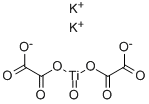
The material is a titanyl oxalate complex: titanium(IV) chelated by oxalate ligands with potassium as the counter-cation and two waters of crystallisation. Chelation is what makes the chemistry useful — it suppresses the otherwise immediate hydrolysis and precipitation of titanium(IV) in water. In tanning, the titanium centre is delivered to collagen and crosslinks it; in surface treatment, thermal or oxidative decomposition of the oxalate leaves a titanium oxide or titanium-containing conversion film; in photocatalyst routes, controlled decomposition yields titanium dioxide of controlled morphology.
Industrial supply is built on a complexation route class: a titanium-bearing intermediate derived from titanium dioxide, titanyl sulfate or a titaniferous mineral digest is brought together with oxalic acid or an oxalate source under acidic conditions to form the soluble titanyl oxalate complex, which is then converted to the potassium salt and isolated by crystallisation. The following is confined to route class and control philosophy; no operating conditions, ratios or procedural detail are provided.
The strongest single driver is chrome-free tanning. Footwear, apparel and automotive leather brands are committing to chromium-free or low-chromium material, which shifts tannery chemistry toward titanium, aluminium, zirconium and aldehyde-based or synthetic systems — and titanium oxalate complexes are among the most practical ways to deliver titanium from an aqueous bath. Secondary drivers include titanium-containing conversion coatings as replacements for older chromate systems, and continued photocatalyst demand in environmental and self-cleaning applications. Buyers are also moving from spot buying to annual framework agreements with specification attachments, because the product is used in continuous processes where consistency matters more than price.
Capacity follows titanium chemical infrastructure rather than tannery geography. Production clusters near titanium dioxide and titanyl sulfate capacity in China, India, Europe and the United States; consumption clusters in tannery regions of South and Southeast Asia, China, Italy, Spain and Brazil, and in textile and metal-finishing regions. Export flows therefore run from titanium-chemical producers to leather and textile processing countries, with local distribution and technical service.
The market divides into a technical grade competing on titanium dioxide equivalent and price, and a low-iron, tightly specified grade sold into tanning and surface treatment where colour and consistency dominate. In the second tier, the premium is justified by iron control, hydration-state stability and technical service; in the first, price tracks titanium feedstock and oxalic acid cost. The most common sourcing failure is buying technical grade for a tanning application and discovering iron-induced colour and uneven fixation, which costs far more than the grade premium.
Potassium titanium(IV) oxalate dihydrate is an industrial chemical, but it is sold into three of the most audited value chains in manufacturing: leather, textiles and metal finishing. Compliance is therefore a composite of substance law and end-market scheme requirements, and suppliers must be able to speak to both.
The environmental story for this molecule is two-sided and must be told honestly. On one side, it enables chrome-free tanning and chromate-free surface treatment, which are genuine environmental improvements. On the other, oxalate is a carbon-oxygen load that must be destroyed or precipitated before discharge.
Emissions intensity is dominated by the upstream titanium dioxide or titanyl sulfate route rather than by complexation, which is comparatively mild aqueous chemistry, plus crystallisation and low-temperature drying energy. Reporting should be grounded in a Scope 1–2 inventory with an explicit Scope 3 view of titanium feedstock and oxalic acid, since upstream dominates. Circular-economy opportunities exist at the customer end: spent tanning and surface-treatment baths can be treated for oxalate recovery or destruction rather than discharged untreated.
Traceability should extend to the titanium source and, where mineral sands are involved, to the mine or concentrate origin with documented naturally occurring radioactive material screening results, since mineral-sands-derived streams are subject to radioactivity controls in several jurisdictions and failure to document them can block a shipment at import. Leather and textile customers will additionally require ZDHC MRSL conformance evidence, Leather Working Group protocol support, and confirmation of absence of restricted chromium VI, arylamine and formaldehyde species. ISO 9001 combined with ISO 14001 is the expected minimum quality and environmental management baseline.
This is a crystalline, mildly hygroscopic, light- and heat-sensitive solid with an oxalate hazard profile. Logistics must therefore protect hydration state and exclude light and excessive heat, while presenting the correct hazard communication.
Classification for transport must be determined for the specific substance and form rather than assumed; soluble oxalate salts are commonly regulated as toxic or harmful substances for transport, and shipments move under ADR, IMDG or IATA as applicable in UN-approved packaging with correct hazard labelling, segregation from food and feed, and complete documentation including emergency response information. Sea freight is the normal mode for drum and intermediate-bulk volumes, and containerised shipments should avoid sustained high temperature, particularly on equatorial lanes, Any transit-temperature excursion should trigger re-verification of solution clarity and assay before the material enters a production bath.
Suppliers who win in this molecule treat it as an application-sold specialty rather than as a titanium commodity, and they invest in the three areas below.
Potassium titanium(IV) oxalate dihydrate is a stable, soluble titanium delivery system whose value is set by the quality of the complex. Titanium dioxide equivalent, oxalate-to-titanium ratio, water of crystallisation with a validated drying window, iron, chloride and sulfate, and solution clarity and pH form the specification that separates a usable tanning or surface-treatment material from a titanium salt of indeterminate behaviour. Light and thermal sensitivity make drying history, packaging and storage part of the specification rather than logistics detail, and suppliers who control them will hold the premium grade as chrome-free tanning grows.
Commercially, the molecule sits where regulatory pressure creates opportunity: REACH Annex XVII entry 47 on chromium VI in leather, EU Ecolabel criteria, ZDHC MRSL and the Leather Working Group protocol are pulling tanneries toward titanium systems, while oxalate toxicity and classification, oxalate-bearing wastewater with its COD and discharge limits, and naturally occurring radioactive material screening in mineral-sands-derived titanium streams define the compliance perimeter that suppliers must manage. This paper is confined to sourcing, specification and compliance analysis and provides no dosing or operational instruction.
Powered by Guidechem
This white paper is exclusively compiled by the Guidechem Intelligence Team based on global customs data, regulatory databases, and industry research. Guidechem is a leading global B2B chemical platform, dedicated to connecting global buyers with verified, high-quality manufacturers.
Relying on Guidechem's extensive global database, we have mapped the core participants in the current global Potassium titanium(IV) oxalate dihydrate supply chain:
Disclaimer: The content of this white paper is compiled based on public market data and regulatory information available as of 2026. Global chemical regulations are subject to dynamic adjustments. In actual export operations, enterprises must consult professional regulatory advisors or relevant competent authorities to obtain the latest compliance guidance.
|
 |
 |
 |
 EN
 Agricultural News
 Food News
 Industrial News
 Cosmetic News
 Pharmaceutical News
 Science News


 6YRS

