Guideview >  Articles >  Trends  > Trifluoromethanesulfonic acid:Exports & Compliance White Paper 2026

Trifluoromethanesulfonic acid:Exports & Compliance White Paper 2026

Trifluoromethanesulfonic acid (CAS 1493-13-6) is a strong acid catalyst for synthesis in 2026, handled under strict controls. Buyers gain full safety documentation, compliance-aware logistics and dependable supply. Octavia5 MIN READOctober 8, 2026
Trifluoromethanesulfonic acid (TfOH) White Paper

I. Executive Summary

Trifluoromethanesulfonic acid, CAS 1493-13-6, commonly called triflic acid or TfOH, is an exceptionally strong, non-oxidizing Brønsted acid used in high-value pharmaceutical synthesis, electronic chemicals, electrolyte research, and polymer or fine-chemical catalysis. Procurement requires unusually close alignment between acid assay, water, metals, color, ionic impurities, packaging, and end use. The material is highly corrosive, reacts exothermically with water, and demands engineered transfer rather than routine acid handling.

The decisive 2026 compliance issue is the global expansion of PFAS management. Under broad structural definitions used in major policy work, TfOH and triflate salts fall within the PFAS universe because they contain a fully fluorinated methyl group. The EU’s five-country universal PFAS restriction proposal under REACH remains a developing proposal rather than a final universal ban; its scope, derogations, transitions, and timing must be checked against the latest ECHA and Commission progress. U.S. TSCA and PFAS reporting analysis is separately required. The proposal has advanced through ECHA committee opinions with targeted derogations under discussion, so exposure assessment should be maintained on a rolling basis rather than settled once.

Buyers should build an application-specific necessity case, quantify releases and waste fate, screen alternatives, and maintain regulatory-change clauses before approving long-term supply. Methanesulfonic acid, p-toluenesulfonic acid, solid acids, Lewis-acid systems, and ionic-liquid or heterogeneous catalysts may reduce PFAS exposure in some processes, but substitution must compare activity, selectivity, corrosion, recovery, toxicity, life-cycle impacts, and revalidation cost. “PFAS-free” replacement is not automatically safer or technically equivalent.

II. Product Deep Dive: Molecular Mechanisms and Production Evolution

2.1 Physicochemical Properties and Mechanisms

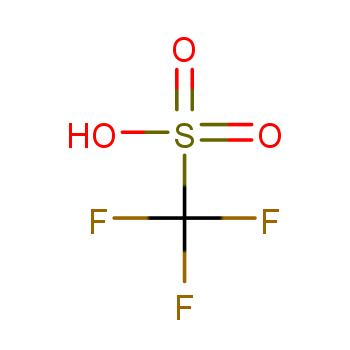
TfOH has formula CF3SO3H and relative molecular mass about 150.08. Strong electron withdrawal by CF3 and extensive charge delocalization stabilize the triflate conjugate base, producing superacid behavior with a Hammett acidity function commonly reported near −14 for the neat acid. It is a dense, hygroscopic liquid, and absorbed water changes effective acidity, speciation, conductivity, and reaction performance. Triflate is weakly coordinating, which is valuable for generating reactive cationic intermediates.

  • Acid Strength and Selectivity: TfOH protonates substrates and promotes transformations that weaker sulfonic acids may not drive efficiently. Its low-nucleophilicity conjugate base can preserve reactive intermediates, enabling catalysis, salt formation, and polymer initiation. This performance also increases sensitivity to trace water, basic contaminants, equipment surfaces, and quench conditions, so laboratory success cannot be transferred to production without calorimetry and materials review.
  • Purity and Ionic Control: Commercial grades are differentiated by titrated acid content, water, color, sulfate or fluoride-related impurities, and metals such as sodium, iron, nickel, chromium, copper, and aluminum. Pharmaceutical and electronic uses may require low parts-per-billion or parts-per-million impurity profiles, depending on process. Assay should be supported by validated acid-base titration and an explicit water method rather than difference alone.

2.2 Synthesis and Manufacturing Technologies

Industrial manufacture can be grouped into electrochemical fluorination routes, historically associated with Simons-type ECF chemistry, and routes that construct or transform a trifluoromethyl sulfur precursor before oxidation and acid formation. Producers protect proprietary details because fluorination, corrosive intermediates, electrolysis, separation, and anhydrous finishing are technically demanding. Commercial qualification should focus on route-consistent impurities, fluorinated emissions, materials of construction, purification capability, and closed-system control rather than recipe disclosure.

  • ECF Route Family: Electrochemical fluorination can generate perfluorinated sulfonyl intermediates that are converted and purified to TfOH. Key manufacturing questions include electrochemical selectivity, hydrogen fluoride management, byproduct capture, fluorinated waste, cell materials, distillation or rectification, and worker protection. Audits should test mass balance and emissions controls, not merely finished-product assay.
  • Anhydrous Finishing and High-Purity Grades: Water removal and purification must avoid metal pickup and thermal degradation. Dedicated corrosion-resistant equipment, controlled distillation, high-purity feedstocks, filtered transfer, dry nitrogen blanketing, and low-metal sampling support electronic or pharmaceutical grades. Lot genealogy should link acid assay, Karl Fischer water, ion chromatography, ICP-MS or ICP-OES metals, and packaging preparation.

2.3 Core Application Matrix

  • Pharmaceutical and Fine-Chemical Synthesis: TfOH is used at controlled scale as a strong-acid catalyst, activation reagent, or source of triflate salts in route development and manufacturing. Pharmaceutical use requires impurity fate, purge, cleaning, materials compatibility, and residual-control assessment. The acid is a process chemical or intermediate input, not a finished medicine.
  • Electronic Chemicals: Ultra-low-metal grades support specialty photoresist chemistry, ionic formulations, electrochemical research, and advanced material synthesis where trace metals and particles can damage yield. Supplier change, packaging extractables, moisture, ionic background, filtration, and fab-specific qualification frequently outweigh bulk assay in purchasing decisions.
  • Polymer and Catalytic Processes: TfOH can initiate or catalyze polymerization, alkylation, rearrangement, and condensation chemistry where very high proton activity and a weakly coordinating anion improve conversion or selectivity. Closed dosing, heat-flow characterization, neutralization planning, catalyst recovery, and fluorine mass balance are essential for scale-up.

III. Global Market Supply-Demand Landscape and Export Trends

3.1 Demand Drivers and Market Shifts

Demand is supported by complex synthesis, high-performance catalysis, semiconductors, batteries, and specialty polymers, but PFAS restrictions are changing project economics. Customers increasingly ask whether TfOH is intentionally present in the final article, consumed or recovered in process, emitted to water or air, or transformed into persistent triflate salts. New projects face earlier alternatives analysis, while critical applications demand stronger documentation, containment, and waste-treatment evidence. Customers in electronics and pharmaceutical chains increasingly ask which derogation category a given use would fall under, so suppliers should be able to map application to use category.

3.2 Capacity Distribution and Export Flows

China is an important fluorochemical production and export base, the United States has specialty fluorine and electronics demand, and Europe combines fine-chemical consumption with the strictest emerging PFAS policy pressure. Capacity is concentrated because electrochemical fluorination, hydrogen-fluoride infrastructure, corrosion-resistant assets, and high-purity finishing create barriers. Exporters often ship small hazardous lots through specialized forwarders; redundant qualified packaging and alternate ports are more meaningful than nominal annual capacity.

3.3 Market Bifurcation and Pricing Dynamics

Industrial grade is priced on assay, water, logistics, and volume, while electronic grade carries premiums for ultra-low metals, particles, dedicated handling, lot documentation, and small-container filling. PFAS compliance, emissions control, liability allocation, and waste acceptance can add cost independently of purity. Buyers should avoid long fixed-price commitments without regulatory-change mechanisms and should compare total process cost, including corrosion, neutralization, destruction, analytical monitoring, and potential substitution. Pricing should also reflect fluoropolymer-compatible packaging cost and the residual value of recovered triflate streams, both of which vary widely between suppliers.

IV. In-depth Analysis of Global Compliance and Regulatory Barriers

TfOH sits at the intersection of hazardous-chemical law and group-based PFAS policy. Compliance teams must distinguish current binding restrictions from proposals, substance from salt or mixture, manufacture from import, and process use from presence in a final article. A supplier statement that the product is “not PFOA or PFOS” is not an adequate PFAS assessment.

4.1 European Market: REACH, CLP, and Sector-Specific Directives

  • EU Universal PFAS Proposal: Authorities from Denmark, Germany, the Netherlands, Norway, and Sweden submitted a broad REACH restriction dossier covering PFAS manufacture, placing on the market, and use, with potential transitions or derogations evaluated through the restriction process. TfOH should be screened within that structural scope. The proposal is not itself final law; status, final wording, sector outcomes, and dates require verification against the latest ECHA and EU decisions.
  • REACH and CLP Duties: Independently of the broader proposal, importers must confirm REACH registration and existing restrictions, communicate uses, and maintain an SDS. Neat TfOH is expected to require severe corrosivity hazard communication, with classifications for skin and eye damage and potentially corrosivity to metals based on the actual dossier. Concentration changes classification; harmonized entries and supplier self-classification should be checked at transaction time.

4.2 North American Market: TSCA, EPA, and FDA Regulations

  • TSCA and Inventory Control: U.S. manufacturers and importers should verify TSCA Inventory status, applicable use rules, chemical data reporting, and records for the specific substance and commercial activity. Pharmaceutical-process use does not automatically exempt all manufacture, import, or downstream technical use. State PFAS disclosure and product restrictions may use definitions or thresholds different from federal programs.
  • TSCA Section 8(a)(7): EPA’s PFAS reporting rule covers historical manufacture, including import, under a broad structural definition and requires data on identity, volumes, uses, disposal, exposure, and hazards, subject to final scope and exemptions. EPA revised or proposed elements and timing after the original rule; companies must confirm the current 40 CFR Part 705 requirements and submission schedule, including treatment of R&D, impurities, intermediates, mixtures, and articles.

4.3 The Critical Hurdle: Quality Control and Safety Limits

Compliance Warning: TfOH can cause severe chemical burns, attack incompatible materials, and release substantial heat during dilution. Never treat water addition as routine mixing: process order, rate, cooling, agitation, venting, splash containment, and emergency response require a site-specific hazard analysis and calorimetry. GHS labels and transport descriptions must follow the actual concentration and supplier classification. PFAS status adds separate release, waste, reporting, and substitution obligations that corrosivity controls do not address.

V. Green Trade Barriers and ESG in Manufacturing

PFAS persistence shifts ESG attention from plant-gate carbon alone to fluorine stewardship over the full life cycle. Producers and users should quantify feedstock fluorine, process losses, wastewater and air emissions, off-spec material, container residues, neutralized salts, and destruction routes. OECD and UNEP work reinforces global movement toward better PFAS inventories, alternatives assessment, emissions prevention, and international information exchange.

5.1 Carbon Footprint and Circular Economy

Electrochemical fluorination and high-purity distillation can be electricity- and resource-intensive, while corrosion-resistant equipment and hazardous-waste treatment add embedded impacts. Efficiency measures include renewable power, high selectivity, leak detection, closed recovery, optimized distillation, longer equipment life, and verified destruction of unrecoverable fluorinated waste. Recycling is appropriate only when purity and containment are maintained; dispersing persistent residues into lower-grade uses is not circularity.

5.2 Sustainable Sourcing and Traceability

Traceability should identify manufacturing route family, fluorine feedstock, site, lot, grade, container, transporter, use, waste contractor, and final disposition. Buyers should request PFAS composition statements covering TfOH, salts, related byproducts, and packaging contact materials, plus evidence of emission permits and incident management. Confidential process information can be protected through third-party review, but confidentiality should not eliminate the minimum data needed for legal classification and reporting.

VI. Supply Chain Resilience and Export Logistics

Supply resilience depends on scarce fluorochemical infrastructure, corrosion-compatible filling, hazardous-goods carriers, and receiving-site readiness. Water ingress degrades anhydrous grade, while container damage creates a severe response problem. Procurement should qualify a second producer or grade, validate incoming transfer connections, maintain emergency neutralization and spill plans, and establish legal-review triggers for PFAS or transport changes.

6.1 Packaging Standards and Moisture/Contamination Control

  • Fluoropolymer-Contact Packaging: Qualified PTFE or PFA contact surfaces, compatible lined containers, closure gaskets, dip tubes, and secondary containment help prevent corrosion and metal pickup. Material compatibility must be documented for acid concentration, temperature, and duration; ordinary metals or unqualified glass closures should not be assumed suitable. Packaging itself may also be relevant to customer PFAS inventories.
  • Dry Filling and Nitrogen Blanketing: Containers should be cleaned, dried, sealed, and filled under controlled dry conditions, with inert nitrogen headspace where justified. Tamper evidence, compatible overpacks, orientation marks, absorbent or containment systems as required, and documented leak testing support safe distribution. Sampling should use closed, dry, corrosion-resistant equipment to avoid moisture and particles.

6.2 Dangerous Goods Identification and Transit Protocols

TfOH solutions are transported as corrosive liquids under the applicable UN model, ADR, IMDG, and IATA provisions, but the proper shipping name, UN number, packing group, limited-quantity eligibility, and packaging instruction must be selected from the actual SDS and composition. Only trained dangerous-goods personnel should classify and tender shipments. Segregation from bases and incompatible materials, package inspection, emergency contact information, and destination import permits must be confirmed before dispatch.

VII. Enterprise Global Expansion Strategy Guide

A defensible TfOH strategy combines technical necessity, high-purity supply, corrosion engineering, PFAS governance, and exit planning. Buyers should not wait for a final universal restriction before mapping uses and alternatives, nor should they treat a pending proposal as an already effective blanket prohibition.

  1. Define Grade and Impurity Fate: Contract titrated assay, water, color, sulfate or halide-related impurities, metals, particles, and packaging. Link limits to reaction selectivity, pharmaceutical purge, electronic yield, and equipment corrosion. Approve analytical methods and representative data, then require notification before route, purification, site, or container changes.
  2. Build a PFAS Compliance File: Record structural-definition conclusions, tonnage, uses, customers, imports, emissions, waste, and transformations. Check the latest EU REACH proposal progress, existing PFAS restrictions, TSCA Inventory status, Section 8(a)(7) scope and dates, and relevant state law. Use contract clauses for data updates, substitution support, and regulatory change.
  3. Run Non-Regrettable Alternatives Studies: Compare methanesulfonic acid, p-toluenesulfonic acid, solid or supported acids, Lewis acids, and ionic-liquid systems against conversion, selectivity, corrosion, recovery, toxicology, persistence, energy, and requalification. Prioritize applications where function is non-essential or substitutes are mature, while documenting critical uses that need transition time.

VIII. Conclusion

TfOH delivers unusual acid strength and weakly coordinating triflate chemistry, but its value is inseparable from water control, low-metal processing, corrosion-resistant packaging, disciplined dilution engineering, and dangerous-goods execution. High-purity pharmaceutical, electronics, and polymer applications need tailored specifications and change control rather than a generic assay certificate.

PFAS regulation is now the defining strategic uncertainty. Organizations should treat TfOH and its salts as within broad PFAS screening, verify the latest EU proposal progress and U.S. reporting rules, quantify releases, and qualify safer feasible alternatives. Suppliers able to document fluorine mass balance, containment, waste fate, and regulatory readiness will be better positioned than those relying only on performance or historical market status. Early preparation of use-level derogation dossiers is the most valuable investment a supplier can make while the proposal is still moving.

IX. Industry Resource Connection and Supplier Ecosystem

Powered by Guidechem

This white paper is exclusively compiled by the Guidechem Intelligence Team based on global customs data, regulatory databases, and industry research. Guidechem is a leading global B2B chemical platform, dedicated to connecting global buyers with verified, high-quality manufacturers.

Guidechem Global Trifluoromethanesulfonic acid (TfOH) Supplier Ecosystem List

Relying on Guidechem's extensive global database, we have mapped the core participants in the current global Trifluoromethanesulfonic acid (TfOH) supply chain:

  • China Fluorochemical Manufacturing Base: Integrated fluorine chemistry, specialty-acid production, fine-chemical demand, and export infrastructure support broad grade availability. Qualification should examine route-specific impurities, hydrogen-fluoride and fluorinated-emission controls, high-purity finishing, real manufacturing ownership, corrosion-resistant filling, and the completeness of PFAS, REACH, TSCA, and dangerous-goods documentation.
  • United States Specialty and Electronics Network: U.S. distributors, fluorochemical specialists, semiconductor suppliers, and pharmaceutical processors value local hazardous inventory, rapid technical response, low-metal grades, and secure packaging. Buyers must integrate federal TSCA and Section 8(a)(7) review with state PFAS measures, site emergency planning, waste acceptance, and customer-specific electronics qualification.
  • European Fine-Chemical and Regulatory Hub: Europe combines sophisticated pharmaceutical and polymer chemistry with strong REACH infrastructure and the evolving universal PFAS restriction process. Regional suppliers and only representatives can support registration and SDS communication, while users increasingly document essentiality, emissions, alternatives, and closed-loop handling. Latest ECHA and Commission decisions remain critical sourcing inputs.

Disclaimer: The content of this white paper is compiled based on public market data and regulatory information available as of 2026. Global chemical regulations are subject to dynamic adjustments. In actual export operations, enterprises must consult professional regulatory advisors or relevant competent authorities to obtain the latest compliance guidance.

Make Guideview Preferred Source on Google
Related News