-
We detected your language preference as English. Would you like to switch to the English version for a better experience?
Switch to English
Stay here


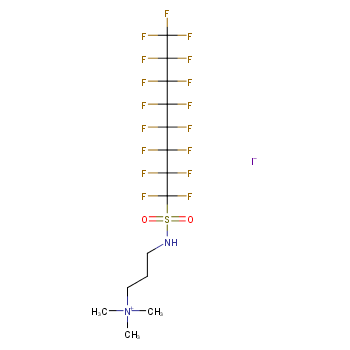
Perfluorooctyl quaternary ammonium iodide (CAS 1652-63-7), historically supplied as Fluorad FC-135, is a cationic perfluoroalkyl surfactant whose commercial profile has been rewritten by global restriction of per- and polyfluoroalkyl substances (PFAS). Technically it remains among the most efficient interfacial agents commercialised, driving aqueous surface tension into the mid-teens of mN/m at tens of parts per million. Commercially it is no longer a growth product but a transition material, and every transaction carries regulatory, analytical and liability content.
The reason is structural, not reputational: a C8 perfluoroalkyl chain is a recognised precursor pool for perfluorooctanoic acid (PFOA) under environmental and metabolic degradation. PFOA, its salts and PFOA-related compounds are listed under the Stockholm Convention and in Annex I to EU POP Regulation (EU) 2019/1021, with defined unintentional trace contaminant limits. In parallel, REACH Annex XVII entry 68 restricts C9-C14 perfluorinated carboxylic acids and precursors, the 2023 five-authority universal PFAS restriction proposal moved the debate from single substances to the whole class, and the United States has activated TSCA section 8(a)(7) reporting, drinking-water maximum contaminant levels, CERCLA hazardous substance designations and state product bans.
For B2B buyers the practical consequence is that this material should be sourced only where a documented essential-use case exists, with a written end-use declaration, compositional disclosure down to impurity level, and a supplier operating a maintained PFAS-transition programme. This paper is written for sourcing managers, compliance officers and formulation teams deciding whether to keep qualifying residual supply or to substitute. It covers specification and analytical control, the European and North American regulatory perimeter, green trade barriers, packaging and transit, buyer qualification, and the regional ecosystems that still serve this chemistry. It contains no consumer guidance and no recommendation for non-essential applications.
The performance of this molecule follows from its amphiphilic architecture: a perfluorinated C8 chain provides oleophobicity and hydrophobicity, while the quaternary ammonium group provides permanent positive charge independent of pH. Commercial grades are rarely single substances but are dominated by the C8 homologue with C6, C10 and occasional branched species inherited from the fluorinated intermediate, and that distribution is a compliance variable, because adjacent homologues fall under different regulatory entries.
Industrial supply of C8 cationic fluorosurfactants rests on two fluorination lineages. The historical route is electrochemical fluorination of an organic feedstock in anhydrous hydrogen fluoride; it is inseparably associated with legacy PFOA and PFOS chemistry and has been wound down in North America, Western Europe and Japan. Contemporary material more often originates from telomerisation, in which a perfluoroalkyl iodide intermediate of controlled chain length is built from tetrafluoroethylene and converted by Menshutkin-type quaternisation into the ammonium salt. Process discussion is held at route-class level.
Demand is no longer governed by formulation economics but by regulation, litigation exposure and end-user specification. Fire-fighting foam is contracting fastest, driven by fluorine-free foam qualifications at airports, refineries, chemical terminals and military sites, and by state restrictions. Plating and electronics demand is more durable but conditional: corporate restrict-and-report mandates push purchasers to justify continued use in writing, and many have set internal sunset dates.
Western C8 capacity was largely retired through the PFOS phase-out and the PFOA stewardship programme, so remaining production sits in Asian fluorochemical parks with integrated tetrafluoroethylene, fluoropolymer and telomer assets, supplemented by Japanese and Korean specialists serving electronics grades. Customs scrutiny is increasing, and EU importers must carry their own registration and only-representative obligations.
The market has split into a documented essential-use tier and an undocumented spot tier, and the price gap widens yearly. Fully documented material, backed by accredited targeted analysis, precursor testing and a transition dossier, commands a substantial premium and sells under contract with end-use declaration. The discount on undocumented material is illusory: it carries POP trace-contaminant risk, downstream article liability, remediation exposure and near-certain stranded inventory. Buyers should price offers on total cost of compliance, including verification testing, disposal contracts and insurance.
This substance must be assessed by class, not by CAS number, because a perfluoroalkyl surfactant is caught simultaneously by POP listings, REACH restriction entries written for perfluorinated acids and precursors, universal PFAS restriction proposals, reporting obligations and sector product bans. Compliance starts with an inventory of the molecule and every fluorinated impurity and precursor it contains, and ends with documented end-use and disposal.
PFAS is the reference case for a green trade barrier operating through finance and procurement rather than tariffs. Reporting under the EU Corporate Sustainability Reporting Directive, investor screens, lender exclusions and litigation reserves price persistence and mobility into the cost of holding fluorinated inventory, and insurers increasingly exclude PFAS pollution liability. A supplier without a published transition position is a supply-chain risk in its own right.
Fluorochemical manufacture is energy-intensive, particularly where fluorination is electrochemical, and producers should be asked for cradle-to-gate footprint data consistent with ISO 14067 and for Scope 3 disclosure. Circularity is the harder constraint: perfluoroalkyl substances cannot be recovered, so the accepted end-of-life path is thermal destruction in permitted units with hydrogen fluoride scrubbing, following Stockholm Convention BAT guidance. Substitution should be assessed on persistence as well as carbon, since some fluorine-free alternatives need higher use rates.
Traceability expectations now exceed those of most specialty chemicals. Buyers should require composition disclosure including impurities, site-level identification of fluorination assets, testing by ISO/IEC 17025 accredited laboratories, and a written supplier PFAS-transition roadmap with dated milestones. Legacy soil and groundwater contamination at fluorochemical and fire-training sites is a material diligence item, since a supplier's historic footprint can become a buyer's disclosure problem. Sector restricted substance lists add documentation duties downstream.
Volumes are small, unit values are high, and the material normally ships as an aqueous or alcohol-water concentrate. Documentation is therefore the binding constraint on logistics: a shipment can be held at import, rejected by a customer's incoming-testing regime, or stranded by a regulatory change landing between order and delivery. Packaging and transit discipline belong inside the compliance package.
Most concentrates of this type carry no dangerous-goods transport class for the surfactant function itself, but classifications for skin and eye irritation and chronic aquatic hazard drive GHS labelling, and alcohol-containing solutions may attract a flammable-liquid classification under ADR, IMDG and IATA. Iodide salts can liberate iodine under oxidising conditions, so contact with oxidisers should be avoided. Shipments need an SDS carrying a PFAS statement, a certificate of analysis with the homologue and impurity profile, the end-use declaration, and any import or POP documentation the destination requires; waste and off-spec material must go to licensed destruction facilities under applicable transboundary waste controls.
The commercial objective for any organisation still involved with C8 cationic fluorosurfactant is controlled contraction, not growth. The following measures define a defensible position for suppliers, distributors and downstream users during the transition.
Perfluorooctyl quaternary ammonium iodide is a technically excellent surfactant whose market has been redefined by the persistence and mobility of its degradation products. Its remaining commercial value lies in essential-use supply supported by rigorous documentation, in reference-standard and analytical demand, and in the transition engineering around it. Growth assumptions are inappropriate; managed decline with disciplined qualification is the realistic model.
Competitive advantage here has migrated from price and formulation performance to evidence. Organisations able to demonstrate what is in the drum, what it degrades to, where it is used and how the residue will be destroyed will retain access to essential-use customers and to the fluorine-free business replacing them. Those that cannot will see inventory stranded by rulemaking rather than demand. Buyers should lock specifications, secure disposal routes and complete substitution testing while compliant supply is available.
Powered by Guidechem
This white paper is exclusively compiled by the Guidechem Intelligence Team based on global customs data, regulatory databases, and industry research. Guidechem is a leading global B2B chemical platform, dedicated to connecting global buyers with verified, high-quality manufacturers.
Relying on Guidechem's extensive global database, we have mapped the core participants in the current global Perfluorooctyl quaternary ammonium iodide (Fluorad FC-135) supply chain:
Disclaimer: The content of this white paper is compiled based on public market data and regulatory information available as of 2026. Global chemical regulations are subject to dynamic adjustments. In actual export operations, enterprises must consult professional regulatory advisors or relevant competent authorities to obtain the latest compliance guidance.
|
 |
 |
|
 EN
 Agricultural News
 Food News
 Industrial News
 Cosmetic News
 Pharmaceutical News
 Science News


 1YR


