
I. Executive Summary
Hopantenate calcium (hopantenic acid calcium salt, CAS 17097-76-6) is the calcium salt of D-(+)-4-(2,4-dihydroxy-3,3-dimethylbutyramido)butyric acid, the amide formed between pantoyl lactone chemistry and gamma-aminobutyric acid. It is best known as a prescription pharmaceutical substance in a limited number of countries rather than as an internationally harmonised ingredient, supplied business-to-business to licensed pharmaceutical manufacturers and qualified distributors. No dosage or clinical guidance is provided here, and none should be inferred from any statement below.
Regulatorily, the defining characteristic of this molecule is jurisdictional fragmentation. Marketing status differs substantially between countries, and in several major markets it is not authorised as a food ingredient or dietary supplement at all. Purchase and onward sale therefore require verification against the current pharmaceutical or novel-food list of the specific destination country before any offer is made, together with buyer qualification, declarations of intended use and a documented Know-Your-Customer file. Suppliers marketing the material as a nootropic or cognitive-enhancement ingredient place themselves and their customers outside the law in those jurisdictions.
Technically the molecule is straightforward — a small, water-soluble amide salt made by coupling a pantoyl-derived acid with a butyric acid amine and forming the calcium salt — but the quality requirements are not. Because the material is a pharmaceutical active ingredient in its registered markets, the operative standard is ICH Q7 cGMP with ICH Q3C residual solvents, ICH Q3D elemental impurities and ICH M7 assessment, supported by a stability programme, a defined polymorph and particle-size specification and a full regulatory dossier.
II. Product Deep Dive: Molecular Mechanisms and Production Evolution
2.1 Physicochemical Properties and Mechanisms
Hopantenate calcium is a low-molecular-mass, highly water-soluble calcium salt of a gamma-aminobutyric acid derivative bearing a pantoyl-derived amide side chain. It contains a defined stereocentre inherited from D-pantoyl lactone, so the material is optically active and the D-configuration is a specification attribute rather than an incidental feature. Solid form, hygroscopicity, aqueous solubility as a function of pH and solution stability are fundamental to formulation and analytical method design.
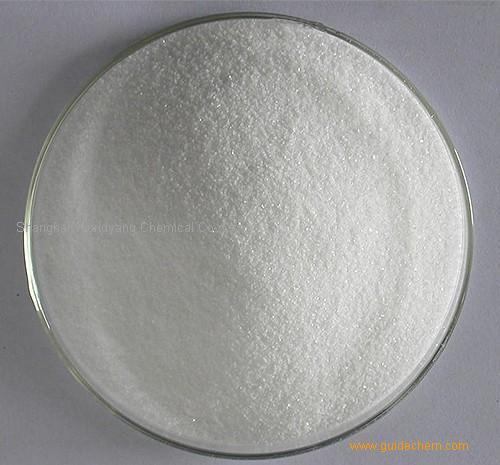
- Physicochemical and Specification Profile: The substance is a white to off-white crystalline powder, freely soluble in water and practically insoluble in non-polar organic solvents, normally specified on assay, calcium content by complexometric or atomic-spectroscopic determination, water by Karl Fischer titration, related substances by HPLC, and optical rotation or chiral purity to verify the D-configuration. Particle size distribution and bulk density are release-relevant where the material is compressed, because a hygroscopic salt with variable particle size changes blend uniformity.
- Formulation Behaviour and Stability: In aqueous solution the salt dissociates and the organic anion is the pharmacologically relevant species, which is why counter-ion content and solution pH are monitored as quality attributes. The molecule is chemically robust but should be protected from humidity and heat: amide hydrolysis under strongly acidic or alkaline conditions and Maillard-type discolouration in the presence of reducing sugars and moisture are the principal degradation risks, and they define the forced-degradation studies that belong in a regulatory package.
2.2 Synthesis and Manufacturing Technologies
Production follows a conventional amide-forming assembly: a pantoyl-lactone-derived carboxylic acid fragment is activated and coupled to a butyric acid amine bearing a terminal amino group, and the resulting hopantenic acid is neutralised with a calcium source to give the salt. Each of the three stages carries its own scale-up and quality logic, and route selection is driven far more by impurity control and stereochemical integrity than by yield.
- Amide Formation and Stereochemical Control: The pantoyl fragment derives from D-pantoyl lactone or an equivalent D-configured precursor, and the amide bond is formed either through an activated ester or mixed anhydride, or through direct aminolysis of the lactone with a primary amine at controlled temperature. Because the D-configuration carries through the sequence, racemisation at the pantoyl centre — most plausibly from excessive temperature or strongly basic conditions — produces an enantiomeric impurity that must be detected by chiral HPLC or optical rotation and controlled by process design rather than purification.
- Calcium Salt Formation, Isolation and Purification: Neutralisation with calcium hydroxide, oxide or carbonate in aqueous or hydroalcoholic medium gives the salt, and the crystallisation conditions — stoichiometry, addition rate, temperature profile and seeding — determine polymorph, particle size and residual free acid content. Impurity purge is achieved through crystallisation and washing rather than chromatography, so the process must be designed so that lactone-derived open-chain impurities, unreacted amine and inorganic residues partition into the mother liquor. Residual solvents must be controlled to ICH Q3C limits because class 2 solvents may not be fully removed by drying alone.
2.3 Core Application Matrix
- Prescription Pharmaceutical Active Ingredient: Supply as an API to licensed marketing-authorisation holders and their designated manufacturers in those jurisdictions where hopantenate calcium is a registered medicinal product, with the specification, analytical methods, impurity profile and stability data set defined by the registration rather than by the supplier.
- Analytical Reference Standards and Pharmacopoeial Use: Supply of qualified reference standards for identity and assay testing, of related-substance and degradation-product markers for method development, and support for monograph establishment where no harmonised monograph exists — all confined to qualified analytical laboratories.
- CDMO Development and Regulatory Services: Route scouting and process optimisation for the pantoyl-lactone-derived fragment, stereochemical purity strategies, polymorph and particle-size screening, validated analytical development, and compiled regulatory dossiers delivered under confidentiality to pharmaceutical sponsors.
III. Global Market Supply-Demand Landscape and Export Trends
3.1 Demand Drivers and Market Shifts
Demand is driven almost entirely by established prescription use in a small number of national markets, making total volumes modest and concentrated among a handful of licensed buyers. The significant development of recent years is not rising clinical demand but a shifting regulatory boundary: as authorities tighten the treatment of neuro-active substances in the supplement channel, several markets have restricted or clarified the status of hopantenate calcium, and responsible suppliers have tightened customer qualification rather than widening distribution. At the same time, generic and alternate-source interest among existing marketing-authorisation holders has created real demand for documented API and dossier support.
3.2 Capacity Distribution and Export Flows
Manufacturing capacity is concentrated in Japan, where the substance has the longest commercial history as a prescription medicine and domestic API and formulation supply is well established, with additional capability in China and, to a lesser extent, Europe and India serving specific registered markets. Trade follows registration rather than geography: material moves from a small number of qualified API plants into the countries where product registrations exist, so volumes are small and predictable. The practical channel question is therefore authorisation — whether the consignee holds the registration and licence that make the transaction lawful.
3.3 Market Bifurcation and Pricing Dynamics
The market splits between documented pharmaceutical-grade API supplied against a registration or DMF, and lower-purity material circulating in unregulated channels, frequently offered with cognitive-enhancement marketing language. The first segment prices on compliance: validated methods, impurity and stereochemical data, stability, change control and dossier maintenance carry much of the cost, and switching suppliers requires re-qualification and often a regulatory variation. The second trades on low price and undefined end-use and represents a legal and reputational risk no legitimate pharmaceutical buyer should accept.
IV. In-depth Analysis of Global Compliance and Regulatory Barriers
Two compliance propositions must be established before any commercial discussion. The first is destination legality: the material's status must be confirmed against the most recent pharmaceutical or novel-food list of the destination country, and where it is a registered medicine only licensed parties may handle it. The second is end-use integrity: it must be sold for legitimate pharmaceutical or analytical purposes, never positioned as a dietary supplement, nootropic or consumer product, and never accompanied by a therapeutic claim.
4.1 European Market: REACH, CLP, and Sector-Specific Directives
- REACH Status, the Medicinal-Products Interface and Novel-Food Screening: Substance used as an active ingredient in a medicinal product falls within the REACH medicinal-products carve-out, so registration is normally not the binding constraint at these volumes; the decisive questions are Union authorisation status and the Novel Food Regulation. A substance with a medicinal history in third countries may be treated as a medicinal product by function in one member state and as a food in another, and placing it on the market as a food ingredient without authorisation is unlawful. Buyers and suppliers should confirm the position with the competent authority of the relevant member state.
- CLP, SDS and Health-Claim Boundaries: Classification, labelling and packaging obligations apply to the substance as supplied, with a hazard classification from the official tables or a justified self-assessment notified to the C and L Inventory, and an SDS under Annex II of Regulation 2020/878 consistent with the label. Health claims relating to cognitive function or mental performance are subject to the Health Claims Regulation, and a substance that is a prescription medicine in any market cannot be presented as a food supplement, promoted for cognitive enhancement or carry disease-related claims.
4.2 North American Market: TSCA, EPA, and FDA Regulations
- FDA Status, the Supplement Boundary and Import Screening: Hopantenate calcium is not an FDA-approved drug ingredient for the United States and is not a permitted dietary supplement ingredient; a substance not marketed as a dietary supplement or food in the United States before the applicable cut-off is excluded from the supplement definition, and importation for supplement use is inadmissible. Suppliers must not describe the material as a supplement, nootropic or cognitive-enhancement ingredient in documentation reaching US customs or customers, and FDA import screening of misbranded neuro-active products should be assumed.
- TSCA, Export Controls and End-Use Declarations: Where the substance is imported for a legitimate analytical purpose it must be supported by a positive or negative TSCA certification under Section 13 at entry, and the invoice description must match the identity used for that certification. Exporters should screen consignees against BIS and OFAC restricted-party lists, confirm the export classification, obtain a signed end-use declaration identifying the licensed pharmaceutical or analytical purpose, and decline orders that cannot be documented.
4.3 The Critical Hurdle: Quality Control and Safety Limits
Compliance Warning: Verify status before you verify price. Confirm in writing that the material may lawfully be imported and held in the destination country for the stated purpose against the most recent national pharmaceutical and novel-food lists, obtain a signed end-use declaration and buyer qualification file, and refuse any transaction whose purpose is supplement, nootropic or consumer use. Hopantenate calcium must not be marketed as a dietary supplement or a cognitive-enhancement ingredient, and no therapeutic, cognitive or performance claim may accompany it in any jurisdiction. On quality, a release specification must include assay, calcium content, water, related substances, stereochemical purity confirming the D-configuration, residual solvents to ICH Q3C and elemental impurities to ICH Q3D, with ICH M7 assessment and a defined polymorph and particle-size specification where the material is to be formulated. No dosage or self-administration guidance is provided by this document or by any compliant supplier.
V. Green Trade Barriers and ESG in Manufacturing
Environmental performance for a small-volume pharmaceutical API is assessed per kilogram of released product, not in absolute terms, because purification, drying and quality-control overhead dominate the footprint. Sponsors and marketing-authorisation holders increasingly include environment and labour criteria in supplier qualification, particularly for third-country sourcing, so documented ESG practice is now part of the commercial file.
5.1 Carbon Footprint and Circular Economy
The principal levers are solvent recovery and crystallisation efficiency. Because purification is by crystallisation and washing rather than chromatography, a well-developed process concentrates impurities into mother liquors that can be treated or recovered rather than diluted across a large solvent stream. Practical measures include recovery of the crystallisation solvent, closed-loop cooling, heat recovery from drying, high-efficiency filtration and documented renewable electricity supply. Reporting process mass intensity and solvent recovery rates lets a customer populate its Scope 3 inventory with primary data.
5.2 Sustainable Sourcing and Traceability
Traceability must be complete because the material may be filed in a regulatory dossier: batch genealogy for the pantoyl-lactone and butyric-amine fragments, documented supplier qualification for each raw material, confirmation that precursors are not animal-derived and carry no transmissible spongiform encephalopathy risk, and statements covering conflict minerals and substances of very high concern. ISO 9001 and ISO 14001 certification, auditable change control, retained reserve samples and an electronic batch record complete the package.
VI. Supply Chain Resilience and Export Logistics
Volumes and the number of legitimate consignees are both small, so logistics is physically uncomplicated but requires strict document discipline. The specific risks are humidity damage to a hygroscopic salt, temperature excursions, and customs seizure of a consignment whose documentation appears to describe a supplement rather than a pharmaceutical ingredient.
6.1 Packaging Standards and Moisture/Contamination Control
- Primary Packaging and Storage Conditions: Material is packed in double polyethylene bags inside fibre drums or sealed foil laminate pouches, with desiccant where tropical routes are involved, and some suppliers specify a container-closure system qualified for moisture-sensitive solids. Storage is typically below 25 degrees Celsius in a dry area protected from light and moisture, with retest date and storage condition stated on the certificate of analysis.
- Labelling, Documentation and Identity Discipline: Each unit carries the chemical name, CAS number, lot number, net mass, storage condition, retest date and hazard labelling consistent with the SDS, supported by the certificate of analysis and, where applicable, a GMP statement. Documentation must identify the material as a pharmaceutical active ingredient or analytical standard according to its actual purpose, must never describe it as a supplement or nootropic, and must be consistent across the invoice, packing list and customs declaration so the shipment cannot be misread at the border.
6.2 Dangerous Goods Identification and Transit Protocols
The neat solid is not normally classified as dangerous goods and usually moves by air freight or courier as non-regulated cargo, with HS classification within the organic-compound headings of Chapter 29; any hazard class reported in the SDS must still be reflected in the transport documentation. For temperature-sensitive lots, gel packs with a calibrated logger are standard and excursion limits should be agreed in writing. Because lawful consignees are few, chain-of-custody records, tamper-evident seals and a pre-shipment release check against the customer's licence and registration are proportionate controls.
VII. Enterprise Global Expansion Strategy Guide
The commercial opportunity in hopantenate calcium lies in serving licensed pharmaceutical customers well and in refusing the rest. The three moves below define that strategy.
- Map Destination Legality Country by Country: Maintain a live regulatory matrix recording, for each target country, whether hopantenate calcium is a registered medicine, a permitted food or supplement ingredient, a restricted substance or unregulated, with the source instrument and date checked. Treat that matrix as the gate on quotation: no offer is issued and no sample released until the destination position is confirmed and recorded.
- Institutionalise Know-Your-Customer and End-Use Control: Require a completed qualification form identifying the legal entity, the licence or registration held and the intended pharmaceutical or analytical use; obtain a signed end-use declaration on company letterhead; screen against BIS, OFAC and EU consolidated lists; and apply a written policy that the material is not sold as a supplement or nootropic and carries no therapeutic or cognitive claim anywhere in the chain.
- Build the Dossier-Grade Quality Package: Run production under ICH Q7 cGMP with validated methods for assay, calcium content, water, related substances and stereochemical purity; control residual solvents to ICH Q3C and elemental impurities to ICH Q3D with an ICH M7 assessment; control polymorph and particle size where formulation requires it; run an ICH Q1A stability programme; and maintain a DMF, ASMF or national dossier with a letter of access so sponsors can file or vary without delay.
VIII. Conclusion
Hopantenate calcium rewards discipline rather than scale. The molecule is easy to make and hard to sell correctly, because its lawful market is defined by national registration and its reputation by the marketing claims circulating around it. Suppliers that anchor their offer to the pharmaceutical channel — documented cGMP API, stereochemical control, a real stability and impurity package, and dossier support for licensed customers — will find a stable, modest business with low churn, because re-qualification costs protect incumbent suppliers.
The boundary conditions are not negotiable. The status of this substance must be verified against the most recent pharmaceutical and novel-food lists of the destination country before any transaction; it must not be marketed as a dietary supplement or a nootropic or cognitive-enhancement ingredient, and no therapeutic, cognitive or performance claim may be attached to it. Buyers must be qualified, end uses declared and recorded, and no dosage, administration or self-medication guidance is provided by this document or by any compliant supplier.
IX. Industry Resource Connection and Supplier Ecosystem
Powered by Guidechem
This white paper is exclusively compiled by the Guidechem Intelligence Team based on global customs data, regulatory databases, and industry research. Guidechem is a leading global B2B chemical platform, dedicated to connecting global buyers with verified, high-quality manufacturers.
Relying on Guidechem's extensive global database, we have mapped the core participants in the current global Hopantenate calcium supply chain:
- Japan — Origin Market and Registration Anchor: Japan accounts for the longest established prescription use of hopantenate calcium and the deepest domestic capability in API manufacture and finished dosage form, with documented GMP practice, Japanese Pharmacopoeia-aligned analytical standards and mature pharmacovigilance. The Japanese registration package and manufacturing practice are the natural reference benchmark for quality and regulatory assessment, and Japanese buyers typically apply the most demanding supplier qualification of any market.
- China — API Manufacturing and Regional Export Base: Chinese producers offer the most cost-competitive synthesis of the pantoyl-lactone-derived fragment and the finished salt, serving registered markets in Asia-Pacific and beyond through GMP-compliant API manufacture and DMF or national-dossier support. Buyers engaging this ecosystem should confirm that the site operates a documented quality system, that stereochemical purity and related-substance methods are validated, and that no unregulated supplement-channel distribution accompanies the pharmaceutical business.
- Europe and India — Compliance-Led Supply and Dossier Capability: European and Indian manufacturers serve specific national registrations with dossier-ready documentation, and European competent authorities are the most likely to have taken an explicit position on the substance's status as a medicine or novel food, making the region a useful regulatory reference. Indian CDMOs contribute route-development and analytical-validation capacity for sponsors seeking an alternate source, and both regions increasingly require ESG performance alongside GMP compliance.
Disclaimer: The content of this white paper is compiled based on public market data and regulatory information available as of 2026. Global chemical regulations are subject to dynamic adjustments. In actual export operations, enterprises must consult professional regulatory advisors or relevant competent authorities to obtain the latest compliance guidance.



 EN
 Agricultural News
 Food News
 Industrial News
 Cosmetic News
 Pharmaceutical News
 Science News



 11YRS

