
I. Executive Summary
Uridine-5'-triphosphoric acid trisodium salt (CAS 19817-92-6), shortened to UTP trisodium, is a ribonucleotide triphosphate supplied into three markets: biochemical research, diagnostic reagent manufacturing, and food and flavour applications. Each imposes different quality systems, and confusing them is the costliest mistake available to a buyer. Material sold for research or diagnostic manufacturing carries no approved therapeutic indication, is not a finished consumer or dietary product, and no health, hydration, energy, cognitive or disease claim is made for it.
The dominant technical problem is instability, and specifically water. Nucleotide triphosphates are notoriously hygroscopic, and UTP trisodium additionally loses phosphate to give UDP and UMP, particularly outside a narrow pH window. Water content, hydrate form, related-substance profile and storage temperature therefore decide whether a lot performs. Everything else in the specification - sodium stoichiometry, heavy metals, endotoxin and nuclease-free certification - sits downstream of how water and pH were controlled.
This paper sets out the production route classes, purification strategy, the specification that separates usable lots from unusable ones, the cold-chain discipline the material demands, and the regulatory framing each market imposes, including where food regulation legitimately applies and where it must not leak into research supply.
II. Product Deep Dive: Molecular Mechanisms and Production Evolution
2.1 Physicochemical Properties and Mechanisms
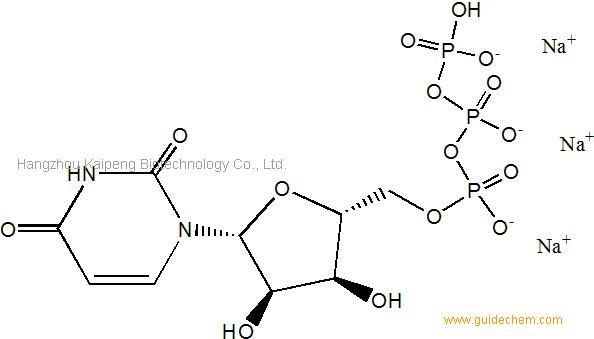
Chemically, UTP trisodium is the trisodium salt of uridine triphosphate: a uracil nucleoside carrying three phosphate groups, delivered as a defined sodium salt rather than the free acid. That detail is commercial, because counter-ion stoichiometry drives both how assay results are interpreted and how much water the powder holds.
- Triphosphate lability and pH-dependent hydrolysis: Phosphoanhydride bonds hydrolyse in water, and rate follows pH: acid cleaves to UDP and phosphate, while alkali and heat drive loss to UMP and uridine. Because the molecule carries its own acid, solution pH shifts with concentration, so grades must specify a buffered solution pH and acceptance limits for UDP, UMP and uridine reflecting shelf behaviour rather than release values.
- Hygroscopicity, hydrate control and weighing discipline: UTP trisodium takes up water rapidly at ambient humidity and lots stabilise at different hydrate states, so an as-is assay can differ from an anhydrous-basis one by several percent. Buyers should require Karl Fischer water on every lot and a stated agreed basis. Weighing belongs under controlled humidity, because apparent purity disputes usually begin with a reading taken after long exposure.
2.2 Synthesis and Manufacturing Technologies
Manufacture runs through two route classes. Nucleoside production is typically fermentative, using engineered strains to generate uridine from carbohydrate feedstock, while conversion to the triphosphate is enzymatic, using kinase cascades with ATP regeneration. Both operate in cold aqueous media, and neither tolerates the hold times that bulk fine-chemical processes absorb easily.
- Enzymatic phosphorylation cascades: Uridine is converted to UMP by uridine kinase using phosphate donation from ATP, then further phosphorylated to UDP and UTP by nucleoside monophosphate and diphosphate kinases, with ATP regenerated enzymatically to keep stoichiometry economical. Reactions run cold and near neutral pH before quenching, and enzyme is removed by ultrafiltration. Process economics turn largely on ATP regeneration efficiency and enzyme lifetime, which is why those details stay inside supplier know-how.
- Purification, desalting and isolation: Downstream, anion-exchange chromatography separates UTP from UDP, UMP, uridine and inorganic phosphate, sometimes followed by preparative reversed-phase or boronate-affinity steps. Salt load is reduced by nanofiltration or size-exclusion desalting, and product is isolated either by lyophilisation to an amorphous powder or by crystallisation to a defined hydrate. Lyophilised material dissolves faster but holds more water; crystalline hydrates handle better where an agreed water basis is declared.
2.3 Core Application Matrix
- Molecular biology and biochemical research use: UTP trisodium is purchased for in vitro transcription, enzymology and nucleotide-dependent research systems. Material is supplied for research use only, carries no approved therapeutic indication, is not a finished consumer product, and no physiological or health claim attaches to it. Molecular-biology grades additionally require certified absence of DNase, RNase and protease activity, low endotoxin for cell-based systems, and documentation of the test methods used.
- Diagnostic and IVD reagent manufacturing: Reagent manufacturers buy larger lots as assay components, and their constraint is reproducibility: every lot must behave identically inside a validated method. Change control, documented origin, retained samples and advance notification therefore matter more than price. Whether a finished assay conforms to Regulation (EU) 2017/746 remains the device manufacturer's responsibility, but the supplier provides the evidence.
- Food, flavour and nutrition ingredient supply: Nucleotide salts are also traded as food-chain ingredients used as flavour-relevant components under food law. That is a separate regulatory track and should never be served from research inventory. Nothing here makes a nutritional, health or performance claim for any use, and research literature should contain no claim borrowed from the food business.
III. Global Market Supply-Demand Landscape and Export Trends
3.1 Demand Drivers and Market Shifts
Research demand tracks molecular biology throughput, while the fastest structural growth comes from diagnostic reagent manufacturing, where kit volumes convert nucleotide purchase from gram-scale to kilogram-scale and impose industrial supply discipline on a research molecule. Food-chain demand for fermentation-derived nucleotides continues to grow as formulators look for taste-building components. Each stream rewards suppliers who hold documentation ready, since qualification cycles are long and rarely reopened once passed.
3.2 Capacity Distribution and Export Flows
Fermentation capacity sits mainly in China, Japan retains deep historical expertise in these nucleotides, and European and United States participants concentrate on diagnostics-grade purification and documentation. Flows favour air freight: high value, modest mass, cold chain dominating routing. Regional warehousing increasingly matters more than ex-works price, because customs delays at warm points destroy more material than any process variable.
3.3 Market Bifurcation and Pricing Dynamics
Prices span an order of magnitude across the three grades, and the spread is legitimate. Molecular-biology grades carry analytical work, nuclease testing and small-lot packing; diagnostics grades add change control, retained samples and stability commitments; food grades compete on cost. Buyers should check whether water basis and related-nucleotide limits are quoted identically, since cheaper figures usually assume a looser basis.
IV. In-depth Analysis of Global Compliance and Regulatory Barriers
Regulation here depends entirely on declared intended use, which is why grade separation is a compliance control rather than a marketing decision. Nothing below should be read as permitting cross-use between tracks.
4.1 European Market: REACH, CLP, and Sector-Specific Directives
- REACH registration, CLP and the diagnostic interface: Registration status should be evidenced for the exact substance supplied, and naturally-occurring character does not by itself exempt a chemically modified salt from registration duties. Classification and labelling follow measured data, with particular attention to any residual solvent or metal contribution. Separately, European diagnostic customers operate under Regulation (EU) 2017/746 and typically require ISO 13485-aligned supplier control; the nucleotide supplier's obligation is evidence, traceability and change notification, not device conformity.
- European food framework, kept in its own box: Where material is genuinely traded as a food-chain ingredient, Regulation (EU) 1334/2002 on flavourings and Regulation (EU) 231/2012 purity criteria apply, with Regulation (EU) 2016/127 relevant where ingredients enter infant and follow-on formula, alongside Regulation (EC) 178/2002 general principles. This paper makes no nutrition claim and no health claim for any use. It notes only that food-grade and research-grade material should be separately identified, documented and stored.
4.2 North American Market: TSCA, EPA, and FDA Regulations
- TSCA status and United States food ingredient frameworks: Importation requires inventory listing or a valid exemption, and the importer carries the TSCA certification at entry. Where material enters the food chain, that is a separate question governed by food additive or generally recognised as safe frameworks and by specifications such as the Food Chemicals Codex monograph and JECFA specifications, none of which transfers any claim to research material. A food clearance for one use neither permits another use nor supports any physiological claim.
- Research supply discipline and documentation expectations: North American institutional buyers expect certificates separating fact from inference: measured purity and related substances, water and its basis, sodium stoichiometry, metals, endotoxin where relevant, and nuclease-free statements citing the method. Documentation should carry research-use-only wording and no protocol or dosing information. Suppliers should answer customs requests on composition and origin in writing, since nucleotide shipments are often held for clarification.
4.3 The Critical Hurdle: Quality Control and Safety Limits
Compliance Warning: Specify the whole packet, not just purity: HPLC purity with the related-nucleotide profile reported individually for UDP, UMP, uridine and any other UTP-related degradant; Karl Fischer water with the declared calculation basis; sodium stoichiometry by ICP-OES or ion chromatography; heavy metals assessed against ICH Q3D thinking; endotoxin by LAL assay and bioburden for cell-based use; certified absence of DNase, RNase and protease activity with the methods named; identity supported by an enzymatic assay as well as chromatography; appearance, solution clarity and colour, and pH of a stated solution. Require real-time stability data developed under ICH Q1A principles rather than an assertion of shelf life, plus retention samples and agreed re-test intervals.
V. Green Trade Barriers and ESG in Manufacturing
Fermentation avoids much of the solvent burden of synthetic phosphorylation, and this material's footprint is dominated by water treatment and cold chain rather than by organic synthesis.
5.1 Carbon Footprint and Circular Economy
Fermentation plus enzymatic conversion compares favourably with purely chemical phosphorylation, largely because it avoids hazardous reagents and heavy solvent use. Against that, aqueous streams carry high dissolved-solids loads, and downstream purification is energy-intensive. Many lots then travel and are stored cold, so distribution emissions can rival manufacture over the product life. European plants operate under EU Emissions Trading System cost pressure, and exporters increasingly field carbon data requests, making a cradle-to-gate figure worth producing once and reusing.
5.2 Sustainable Sourcing and Traceability
Because production is biological, buyers ask questions with no synthetic equivalent: whether production strains are genetically modified, whether any animal-derived enzyme or medium component was used, whether vegan, halal or kosher declarations hold, and whether non-GMO statements rest on documented evidence. Suppliers earning that business maintain ISO 9001 and ISO 14001 systems and issue consistent, auditable statements.
VI. Supply Chain Resilience and Export Logistics
Most quality losses attributed to the factory actually occur during shipping and opening, which makes packaging and temperature history the decisive variables.
6.1 Packaging Standards and Moisture/Contamination Control
- Moisture barrier, desiccant and metal-contact control: Small lots belong in amber glass or high-barrier polymer vials closed under low humidity with desiccant and tamper-evident sealing; larger lots use double polyethylene liners within sealed drums, again with desiccant. Since nucleotide solutions pick up trace metals, closures should use inert liners rather than bare metal. Nuclease-free expectations also argue against reusing containers that have been in general circulation.
- Sub-division, repeated opening and aliquot discipline: Because every opening admits humidity, sub-divide on receipt into dry sealed portions, leaving bulk closed until needed. Let containers reach room temperature before opening so condensation does not form inside, and quarantine any lot showing caking or changed colour.
6.2 Dangerous Goods Identification and Transit Protocols
The substance itself is normally not classified as dangerous for transport, so the transport question is almost always the coolant: dry ice falls under UN 1845 with IATA packing instruction 954 requirements, quantity limits per aircraft depending on operator, and labelling that must match the declaration exactly. Regardless of coolant, validated insulated packaging with sufficient conditioned coolant for worst-case routing, plus continuous temperature logging, is the defensible standard, because the failure mode is a silent warm excursion rather than a visible spill.
VII. Enterprise Global Expansion Strategy Guide
Three moves decide competitive position in this grade-sensitive market.
- Compete on documented stability rather than nominal purity: Generate real-time and accelerated data supporting a defined retest period, publish the water basis with every assay, and quote related-nucleotide limits individually rather than as a total. Bind these into the supply agreement together with retained samples. Diagnostics customers in particular buy the stability file, and a supplier who can show degradation trajectories across lots removes the customer's largest qualification risk.
- Keep the three markets structurally separate: Run research-use-only, diagnostics and food grades as distinct products with distinct stock, labelling and literature, and make sure no claim migrates between them. Specifically, no therapeutic, nutritional, hydration, energy, cognitive or performance claim should appear anywhere in research documentation. Assign named responsibility for reviewing every customer-facing document, because accidental cross-use language is the most common finding in audits of diversified nucleotide suppliers.
- Regionalise stock behind validated cold-chain lanes: Qualify one high-volume fermentation source and one documentation-led Western source, then hold regional inventory near customers with validated insulated packaging and lane-specific coolant calculations. Stock rotation under first-expiry-first-out, plus shorter replenishment cycles, reduces dependence on long cold runs. The commercial logic is straightforward: buyers pay for cold-chain reliability because re-qualifying after a failed shipment costs more than the premium.
VIII. Conclusion
UTP trisodium is a molecule whose commercial difficulty has almost nothing to do with its synthesis and almost everything to do with water, pH and documentation. Suppliers who report water transparently, specify related nucleotides individually, hold real stability data, and maintain the discipline of separating research, diagnostic and food grades win durable positions, particularly with diagnostics customers whose qualification cycles are slow and rarely repeated.
Buyers should specify the whole analytical packet in advance and validate the cold chain rather than accept it. Material supplied for research or diagnostic manufacturing has no approved therapeutic indication, is not a finished consumer or dietary product, and carries no health, hydration, energy, cognitive or disease claim.
IX. Industry Resource Connection and Supplier Ecosystem
Powered by Guidechem
This white paper is exclusively compiled by the Guidechem Intelligence Team based on global customs data, regulatory databases, and industry research. Guidechem is a leading global B2B chemical platform, dedicated to connecting global buyers with verified, high-quality manufacturers.
Relying on Guidechem's extensive global database, we have mapped the core participants in the current global Uridine-5'-triphosphoric acid trisodium salt (UTP trisodium) supply chain:
- China: fermentation conversion scale: Chinese suppliers anchor global volume through large-scale fermentation capacity and cost-efficient downstream purification, increasingly serving both food-ingredient and diagnostics-grade demand, and capability has moved steadily up the specification curve, with more plants providing detailed related-nucleotide profiles and stability data. Buyers should still audit water-basis reporting and cold-chain practice plant by plant, since practice varies more than equipment does.
- Japan: historical nucleotide expertise: Japanese producers developed much of the fermentation-derived nucleotide industry and retain deep process knowledge plus conservative specification habits, particularly in small Research and diagnostic lots where consistency matters more than unit cost. Relationships tend to be long and contractual, exports are frequently handled through dedicated trading structures, and their documentation usually anticipates the questions that regulated customers will ask.
- European Union and United States: diagnostics-grade purification: European and United States participants focus on high-specification purification, extensive documentation and proximity to diagnostics manufacturing clusters, often sourcing intermediate from Asia and finishing locally. Their advantage is auditable quality systems, change control and responsive technical support rather than conversion cost, and they typically hold the regional inventory that shortens cold-chain lanes for regulated customers.
Disclaimer: The content of this white paper is compiled based on public market data and regulatory information available as of 2026. Global chemical regulations are subject to dynamic adjustments. In actual export operations, enterprises must consult professional regulatory advisors or relevant competent authorities to obtain the latest compliance guidance.




 EN
 Agricultural News
 Food News
 Industrial News
 Cosmetic News
 Pharmaceutical News
 Science News



 12YRS

