
I. Executive Summary
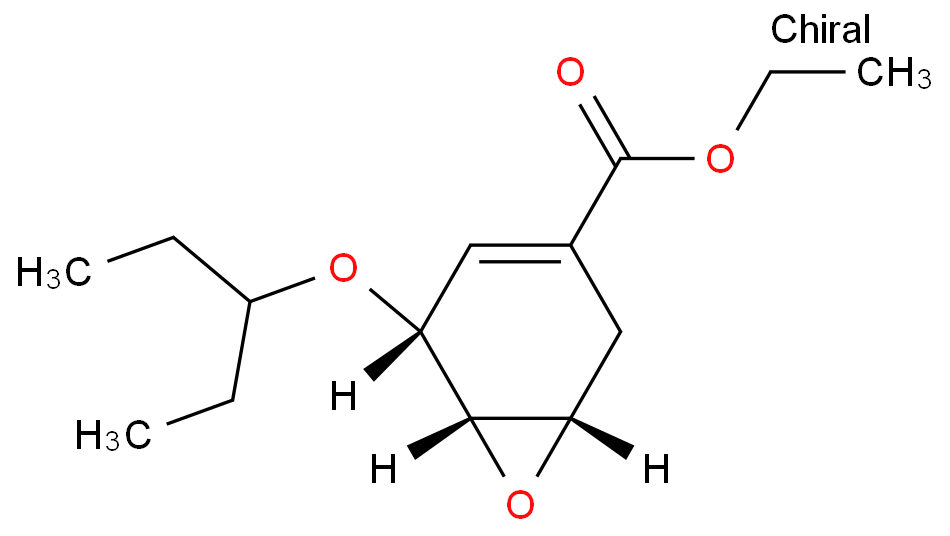
Ethyl (1S,5R,6S)-5-(1-ethylpropoxy)-7-oxabicyclo[4.1.0]hept-3-ene-3-carboxylate (CAS 204254-96-6) is a chiral cyclohexene epoxide ester with a nominal molecular weight of 254.32 g/mol, a pentan-3-yloxy substituent at C5 and an ethyl ester conjugated to the ring alkene. It carries three contiguous stereocentres on a rigid bicyclic framework and is supplied as a pale, low-melting oil handled cold, dry and protected from light. The substance is an intermediate, not an API or finished drug product, and has no approved therapeutic indication of its own; it is not for human or veterinary use.
Its significance comes from its position as the classic key chiral intermediate of the oseltamivir supply chain, an API whose demand has been reshaped twice: first by the 2005-2006 shortage of star-anise-derived shikimic acid, which pushed the industry onto fermentation-derived shikimate and non-shikimate routes, and later by pandemic stockpiling and capacity normalisation in China and India. Buyers are licensed pharmaceutical manufacturers and their CDMO partners, and supply is governed by qualification depth rather than by spot price.
This white paper centres on the technical issue that decides qualification: chiral purity, meaning enantiomeric and diastereomeric impurity control, with validated chiral methods and a defensible specification. Around that core it covers route classes at route-class level only, the epoxide's alkylating reactivity and ICH M7-style reasoning with occupational banding, thermal-stability screening, ICH Q7/Q11/Q1A/Q3C/Q3D, DMF and CEP support, GMP audit readiness, controlled distribution and cold-chain logistics.
II. Product Deep Dive: Molecular Mechanisms and Production Evolution
2.1 Physicochemical Properties and Mechanisms
The molecule's behaviour follows from two structural facts: the strained epoxide fused to a cyclohexene, and the conjugated ester that turns the ring alkene into a Michael-acceptor system. Together these make it both a versatile chiral building block and a reactive electrophile, so specification and containment are inseparable from synthetic utility.
- Three Contiguous Stereocentres and Diastereomer Risk: The (1S,5R,6S) configuration places three stereocentres on adjacent ring carbons, so any step that forms or inverts one risks generating diastereomers that are difficult to purge downstream. Enantiomeric impurity is inherited from the step that sets the ring; diastereomeric impurity is largely set at epoxidation face selectivity. That distinction determines which control point matters most.
- Epoxide Strain and Electrophilic Reactivity: Epoxide ring strain makes the material a competent alkylating electrophile, and the conjugated ester adds a second electrophilic site. Both motifs are structural alerts in the ICH M7 sense, which is why the substance is handled as a potentially genotoxic compound for impurity and containment purposes. The same reactivity is what makes it a useful intermediate: ring opening installs functionality with defined stereochemistry.
2.2 Synthesis and Manufacturing Technologies
At route-class level, two families of approach exist and both are commercially relevant. The shikimate family starts from (-)-shikimic acid and converts it through esterification, ketal protection and epoxide formation into this intermediate; the non-shikimate family builds the cyclohexene core by cycloaddition or related chemistry and sets chirality by asymmetric catalysis, enzymatic resolution or chiral-pool auxiliaries.
- Shikimate Supply History and Route Substitution: During the 2005-2006 shortage, star-anise-derived shikimic acid could not support global demand, and the industry moved toward fermentation-derived shikimate from engineered microbial strains and toward routes that avoid shikimate altogether. That episode permanently changed sourcing logic: buyers now qualify at least one non-shikimate route to decouple supply from a single agricultural feedstock, even when the shikimate route remains cost-competitive.
- Purification Strategy and Chiral Resolution Options: Because the intermediate is typically an oil, purification leans on chromatography, distillation or diastereomeric resolution rather than crystallisation, each with different cost and waste implications. Resolution can upgrade enantiomeric purity but sacrifices yield, so manufacturers prefer to control stereochemistry upstream and polish only where specifications demand.
2.3 Core Application Matrix
- Neuraminidase-Inhibitor API Intermediate Supply: The dominant use is as a key chiral intermediate in manufacture of the oseltamivir API by licensed manufacturers, where the epoxide is opened later to install remaining functionality with defined stereochemistry. Supply is project-based and tied to filed routes, so changing supplier triggers regulatory variation work rather than a purchase-order switch.
- Chiral Building Block for Medicinal-Chemistry Programmes: Research quantities go to medicinal-chemistry and process-research groups exploring functionalised cyclohexane scaffolds, where the epoxide and ester offer two orthogonal handles. Such material is supplied research-use-only for laboratory use by qualified institutions, with no therapeutic claim attached and no human or veterinary application.
- Reference and Impurity Standards for QC: Qualified lots serve as reference standards and characterised impurity markers in the chromatographic methods controlling the API. In this role the value lies less in quantity than in certification: identity, chiral purity, assay, residual solvents and a documented impurity profile with traceable batch records.
III. Global Market Supply-Demand Landscape and Export Trends
3.1 Demand Drivers and Market Shifts
Demand is unusually discontinuous because it is driven by public-health stockpiling policy rather than by steady prescription consumption. National preparedness programmes procure in lumpy campaigns then destock for years, so plants see extreme utilisation swings. The lasting shift was structural: supply chains diversified away from a single botanical feedstock, and stockpile-driven overcapacity has normalised into a smaller, compliance-driven supplier base.
3.2 Capacity Distribution and Export Flows
Capacity is concentrated where chiral intermediate and API chemistry overlap. Chinese producers in the Zhejiang, Jiangsu and Shandong pharmaceutical-chemical parks supply both shikimate-derived and non-shikimate material, increasingly using fermentation-derived shikimic acid. Indian manufacturers around Hyderabad and Bengaluru combine cost-competitive intermediate synthesis with strong DMF-filing and regulatory-submission capability. Europe and Japan retain audit-ready capacity close to innovator quality organisations, while North America concentrates analytical and procurement activity.
3.3 Market Bifurcation and Pricing Dynamics
Pricing reflects qualification status more than commodity fundamentals. Material offered without a chiral method package, impurity profile and GMP-aligned documentation competes only at research-grade level. Qualified intermediate supplied under DMF or ASMF support with validated chiral methods and audit-ready records commands a premium and is contracted rather than spot-purchased. Stockpile cycles amplify this: in a procurement surge qualified capacity becomes the binding constraint, while in destocking years marginal producers exit.
IV. In-depth Analysis of Global Compliance and Regulatory Barriers
Because this is a pharmaceutical intermediate, the binding obligations are quality-system obligations rather than only chemical-registration ones. REACH, CLP and TSCA still apply to the substance, but market access is decided by ICH guidelines, by the documentation that supports the customer's regulatory filing, and by demonstrated GMP and containment competence.
4.1 European Market: REACH, CLP, and Sector-Specific Directives
- ICH Q7, Q11 and GMP Expectation for Intermediates: ICH Q7 defines the GMP expectations applying from the point where the material becomes an API intermediate, while ICH Q11 governs route selection and starting-material justification. European customers audit against those expectations and require written confirmation of GMP compliance for imported active-substance manufacture. A supplier without audit-ready documentation cannot enter a filed route.
- REACH, CLP and ASMF or CEP Support: The substance requires REACH registration appropriate to its tonnage, and CLP classification must address the reactivity of the epoxide, with mutagenicity and target-organ effects assessed rather than assumed. For the customer's filing, suppliers provide ASMF or open-part and closed-part documentation, and where applicable CEP support, giving the applicant a defined chain of starting-material justification, impurity data and manufacturing description without disclosing proprietary process detail.
4.2 North American Market: TSCA, EPA, and FDA Regulations
- FDA DMF Support and TSCA Status: North American customers expect a Type II drug master file covering the intermediate, with a letter of access for the applicant. TSCA status, GHS-aligned hazard communication and accurate safety data sheets are baseline; FDA review focuses on the impurity control strategy in the filing.
- ICH M7 Genotoxic-Impurity Reasoning and Occupational Banding: Because the epoxide and conjugated ester are structural alerts, the material is assessed under ICH M7 logic: the impurity is classed, a compound-specific acceptable intake or threshold of toxicological concern derived, and analytical control set accordingly. The same reasoning drives occupational handling, where a health-based exposure limit is translated into an exposure band, containment class and cleaning limits.
4.3 The Critical Hurdle: Quality Control and Safety Limits
Compliance Warning: Chiral purity is the specification attribute that most often decides whether this intermediate qualifies. Enantiomeric and diastereomeric impurities are set at different points in the route, behave almost identically in achiral assays, and are notoriously difficult to purge once formed, so a supplier quoting only achiral assay and appearance is not offering a controllable specification. Buyers should require validated chiral HPLC or GC with resolution from each plausible stereoisomer and individually stated limits rather than a single total-purity figure. Specifications should also cover related substances from epoxide hydrolysis or rearrangement, ICH Q3C solvents, ICH Q3D elements, water and assay. Because the epoxide is a structural alert, carry-over must be controlled to an ICH M7-derived intake and occupational exposure banded from a health-based exposure limit. Stability must be established under ICH Q1A conditions, since strained epoxides can rearrange on storage.
V. Green Trade Barriers and ESG in Manufacturing
Environmental performance in this chemistry is dominated by solvent intensity and by the waste generated in chromatographic purification. Buyers increasingly ask for process mass intensity and solvent-recovery data during supplier selection, both because they carry real cost and because they sit inside corporate Scope 3 reporting. Suppliers that can document solvent selection against ICH Q3C classes and show recovery rates compete more effectively for long-term contracts.
5.1 Carbon Footprint and Circular Economy
Multi-step chiral synthesis with chromatographic polishing carries a high process mass intensity that dominates the cradle-to-gate footprint. Credible reporting requires metered energy data and a solvent mass balance, with Scope 3 covering purchased intermediates and solvents. For European customers, energy-cost exposure under the EU Emissions Trading System makes plant-level efficiency a commercial argument, and ISO 14001 certification with documented solvent-recovery performance is now a baseline qualification item.
5.2 Sustainable Sourcing and Traceability
Traceability here means both chemical and regulatory provenance. Chemically, buyers need the route family declared, since shikimate-derived material depends on a fermentation feedstock with its own supply risk, while non-shikimate material may depend on chiral catalysts or enzymes. Regulatorily, the chain must run from the declared starting material through each isolated intermediate, because a route change propagates into the applicant's filing.
VI. Supply Chain Resilience and Export Logistics
This is a low-volume, high-value, temperature-sensitive intermediate rather than a bulk chemical. Shipments are kilogram to tens-of-kilogram scale in insulated containers, and the risk lies less in freight cost than in an excursion that ruins an expensive lot. Buyers should specify the temperature range, the logger requirement and the excursion-handling procedure contractually.
6.1 Packaging Standards and Moisture/Contamination Control
- Cold, Dry, Light-Protected and Inert Packaging: Standard packing is amber glass or compatible lined containers under nitrogen, sealed with desiccant and shipped at 2-8 °C or frozen depending on the stability data, with light excluded because the conjugated system and the epoxide are both light-sensitive. Headspace inerting limits oxidative degradation and moisture ingress, and each container should be individually identified to preserve batch genealogy through sampling and re-testing.
- Thermal-Stability Screening and Shelf-Life Assignment: Before scale-up the material should be screened by DSC and adiabatic calorimetry to establish onset temperature and decomposition energetics, since a strained epoxide can release significant energy. Those data set storage class, transport temperature and package size, and feed into the ICH Q1A stability protocol.
6.2 Dangerous Goods Identification and Transit Protocols
Transport classification must be determined from measured data on the specific lot rather than inferred from structural analogy, and many shipments move as non-hazardous or as low-class dangerous goods with appropriate documentation. Air freight requires validated cold-chain packaging and loggers with a defined excursion protocol; sea freight demands container qualification against actual transit profiles. Import documentation should include end-use declaration and consignee licensing evidence.
VII. Enterprise Global Expansion Strategy Guide
The commercial logic is to compete on qualification depth rather than unit price, since a failed regulatory variation dwarfs any saving on the intermediate.
- Lead with the Chiral Method and Impurity Package: Build a validated chiral HPLC or GC method with resolution from every plausible stereoisomer and publish individual limits, paired with a related-substances profile, ICH Q3C solvents and ICH Q3D elements. Add DSC and calorimetry data and an ICH Q1A protocol. This package is what converts a quotation into a qualification.
- Support Filings and Accept Controlled Distribution: Maintain DMF or ASMF documentation with clean open and closed parts, run change control on anything that could shift the impurity profile, and keep audit-ready records under ICH Q7 and Q11. Pair that with know-your-customer screening and written end-use declarations, restricting supply to licensed pharmaceutical manufacturers and their appointed partners.
- Qualify Two Routes and Contract for Volatility: Qualify at least one shikimate and one non-shikimate source to decouple supply from a single feedstock, and treat stockpile-driven demand as a capacity-reservation problem rather than a spot-purchase problem. Negotiate reserved campaign slots, agreed change-notification periods and shared safety stock, since a destocking cycle is the point at which marginal suppliers quietly exit.
VIII. Conclusion
This chiral epoxide ester occupies a sensitive position: a single intermediate whose supply history has twice been rewritten by forces outside the chemical industry, first by a botanical feedstock shortage and later by pandemic stockpiling. Volume is modest, qualification cost is high, and selection turns on stereochemical and documentary rather than economic attributes, which is why the supplier base has narrowed to manufacturers able to sustain audit-ready quality systems.
For buyers, specify chiral purity explicitly with validated methods and individual stereoisomer limits, and treat the genotoxic-impurity assessment, thermal-stability data and DMF or ASMF support as prerequisites. For suppliers, defensible position comes from route diversification, containment competence grounded in a health-based exposure limit, and controlled distribution with end-use declaration. Those that combine stereochemical control with filing support will remain qualified suppliers long after stockpile cycles have normalised.
IX. Industry Resource Connection and Supplier Ecosystem
Powered by Guidechem
This white paper is exclusively compiled by the Guidechem Intelligence Team based on global customs data, regulatory databases, and industry research. Guidechem is a leading global B2B chemical platform, dedicated to connecting global buyers with verified, high-quality manufacturers.
Relying on Guidechem's extensive global database, we have mapped the core participants in the current global Ethyl (1S,5R,6S)-5-(1-ethylpropoxy)-7-oxabicyclo[4.1.0]hept-3-ene-3-carboxylate supply chain:
- China: Shikimate and Non-Shikimate Intermediate Capacity: Chinese producers in the Zhejiang, Jiangsu and Shandong pharmaceutical-chemical parks supply both shikimate-derived and non-shikimate material, increasingly using fermentation-derived shikimic acid rather than botanical extraction. This corridor covers research-grade through multi-tonne qualified supply and has absorbed most of the capacity built during the stockpiling years, with the stronger plants now competing on chiral-purity documentation and audit readiness.
- India: Filing-Led CDMO and API-Intermediate Base: Indian manufacturers around Hyderabad and Bengaluru combine cost-competitive chiral intermediate synthesis with mature regulatory capability, including DMF preparation, impurity qualification and support for customer variations. Their strength is in taking a qualified route and running it at scale under GMP-aligned systems, which makes them the natural second source for buyers diversifying away from single-region dependence.
- Europe and North America: High-Specification, Analytical and Procurement Hub: European and Japanese producers retain high-specification, audit-ready capacity close to innovator quality organisations, while North America concentrates reference-standard preparation, analytical-method development and the stockpile procurement that drives lumpy demand. Participants here compete on specification depth, filing support and controlled distribution rather than on synthesis cost, and they set the qualification bar against which Asian capacity is measured.
Disclaimer: The content of this white paper is compiled based on public market data and regulatory information available as of 2026. Global chemical regulations are subject to dynamic adjustments. In actual export operations, enterprises must consult professional regulatory advisors or relevant competent authorities to obtain the latest compliance guidance.



 EN
 Agricultural News
 Food News
 Industrial News
 Cosmetic News
 Pharmaceutical News
 Science News


 14YRS

