-
We detected your language preference as English. Would you like to switch to the English version for a better experience?
Switch to English
Stay here


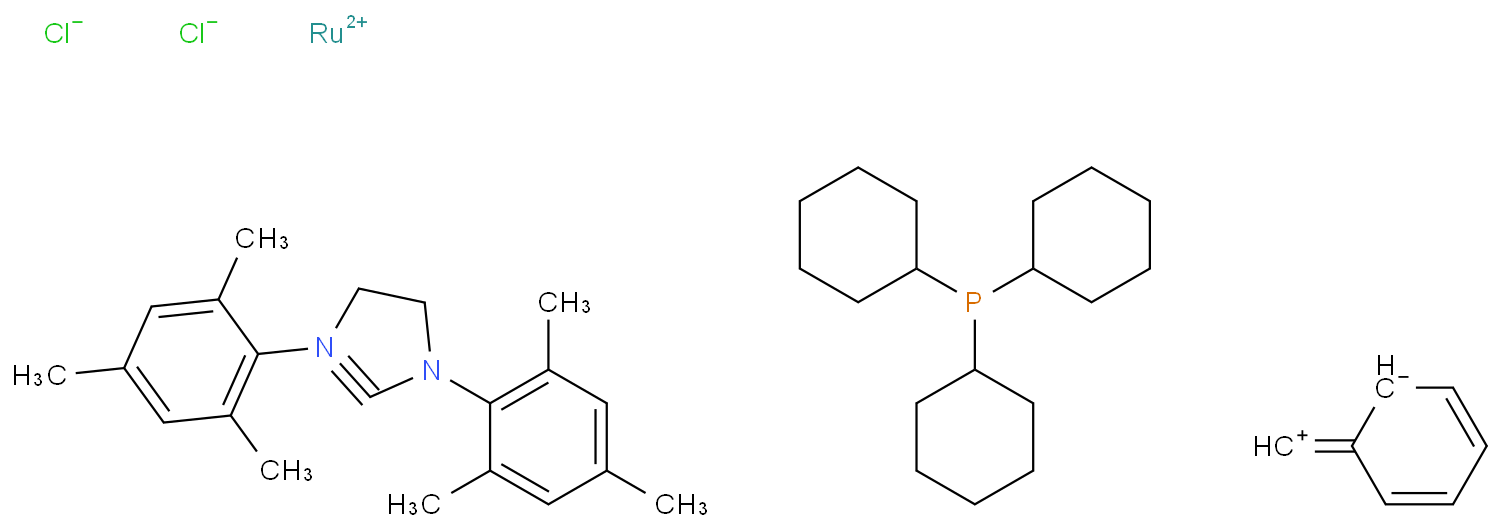
Grubbs second generation catalyst (CAS 246047-72-3), formally dichloro(1,3-dimesitylimidazolidin-2-ylidene)(phenylmethylene)(tricyclohexylphosphine)ruthenium(II), is the benchmark ruthenium carbene for olefin metathesis. Its molecular formula C46H65Cl2N2PRu corresponds to a molar mass close to 829 grams per mole and a theoretical ruthenium content near 12.2 percent by mass. The first-generation precursor carried two tricyclohexylphosphine ligands; replacing one with a strong sigma-donating, sterically demanding saturated N-heterocyclic carbene produced a complex that initiates faster, tolerates more functional groups and delivers far higher turnover numbers in ring-closing metathesis, cross metathesis and ring-opening metathesis polymerization. It appears as a pink to purple-red or brown microcrystalline solid, readily handled in chlorinated and aromatic solvents, and permanently damaged by protic or strongly coordinating media.
Three features separate this purchase from an ordinary reagent buy. First, ruthenium is a platinum group metal whose mine supply comes from a handful of deposits and whose price is set as much by electronics, chlor-alkali and hard-coating demand as by catalysis, so quotations move independently of manufacturing cost. Second, activity is not visible on inspection: it must be measured by a benchmark metathesis reaction and supported by ruthenium assay by inductively coupled plasma optical emission spectroscopy or mass spectrometry after closed-vessel digestion. Third, the metal does not disappear after use. Residual ruthenium must be scavenged and documented against ICH Q3D expectations in pharmaceutical work, and recovered economically in polymer and fine chemical work.
This white paper treats the catalyst as a total cost of ownership problem for 2026 sourcing decisions: how the metal position is created and refined, how the complex is assembled and purified under inert conditions, how activity and purity are specified, how oxygen and water destroy activity in practice, where the applications sit in macrocyclic pharmaceutical intermediates and specialty polymers, how ruthenium residues are removed and reported, and how closed-loop refining converts spent catalyst into a negotiated credit rather than waste.
The catalyst is a fourteen-electron precursor resting state in which a ruthenium carbene, two chlorides, a tricyclohexylphosphine and the N-heterocyclic carbene occupy the coordination sphere. Catalysis begins when phosphine dissociates to give the active twelve-electron species, which binds olefin, forming a metallacyclobutane that cycloreverses to swap alkylidene partners. Because propagation is reversible and every step is in equilibrium, conversions in ring-closing metathesis are driven by release of volatile ethylene and by ring strain, which is why dilute conditions and inert sparging or vacuum are standard operating practice on scale.
Manufacture begins with ruthenium, normally as refined ruthenium trichloride or a chloride-containing oxide derived from refining, and proceeds to a benzylidene ruthenium intermediate carrying labile phosphine ligands. The N-heterocyclic carbene is then generated by deprotonating the corresponding imidazolinium salt with a strong alkoxide base and introduced by ligand exchange. The sequence is run entirely under dry inert gas, and the final complex is isolated by precipitation or recrystallisation and drying under vacuum before being packed under argon or nitrogen.
Consumption follows two engines. Pharmaceutical pipelines consume grams to kilograms at high specification, sensitive to macrocyclic drug candidates in development and to generic entry for the products already made by metathesis. Materials and oleochemical users consume larger masses where the catalyst replaces multiple synthetic steps, and here adoption depends on whether the metal recovery economics justify the unit cost. Both segments are simultaneously attracted by cheaper and more active alternatives, including ruthenium complexes with modified N-heterocyclic carbenes or chelating ether ligands, as well as academically established molybdenum and tungsten imido alkylidene systems for difficult or stereoselective cases.
Metal comes from a very small number of primary producers, with mine supply concentrated in the Bushveld complex of South Africa and the Norilsk deposits, supplemented by Chinese secondary refining and Indian recoveries. Conversion into finished catalyst is done by a limited set of Western and Asian manufacturers and toll finishers, with European sites typically closest to regulated pharmaceutical customers and Chinese producers delivering cost-competitive equivalents for research and polymer use. Flows therefore move metal, not just finished catalyst, and every participant tracks returns of spent material.
The market splits into catalog research grades and audited production grades. Research material is quoted per gram, moves quickly and is judged on delivery time. Production material is quoted against a metal-linked formula, sometimes with a metal account rather than a fixed price, and is judged on certificate content, change-control notification, campaign-to-campaign consistency and whether the supplier accepts spent catalyst back for refining credit. Buyers comparing offers must normalise to contained gram ruthenium, since actual assay, residual solvent and moisture all change the real cost of the active metal purchased.
Three regimes govern the material. Chemical inventory and classification law covers the complex itself; pharmaceutical impurity guidance covers the ruthenium that follows the catalyst into a drug substance; and precious-metal controls cover the movement, accounting and return of a strategically constrained metal. Because these operate independently, a perfectly legal consignment can still fail incoming inspection if its elemental impurity documentation or its metal accountability does not satisfy the customer's quality agreement.
Platinum group metals sit at the centre of circular-economy reporting. Because ruthenium is mined at low concentration alongside other metals, its primary production carries a large environmental signature, and even modest recycling rates change the cradle-to-gate figures materially. Customers compiling Scope 3 inventories therefore ask their catalyst supplier for refined secondary content, return rates and third-party verification.
Emissions are dominated by mining, concentrating and refining rather than by synthesis of the complex itself. The practical consequence is that closed-loop recovery matters more than energy-efficiency measures at the finishing plant. Mature programmes route spent catalyst, filtration residues, spent silica and distillation bottoms back to a refiner, usually by either alkaline digestion with oxidative volatilisation of ruthenium tetroxide into an absorbing solution, or by pyrometallurgical collection followed by dissolution and selective separation, with refined metal credited back to the customer's metal account.
Traceability expectations come from both sides of the value chain. Downstream, pharmaceutical and electronics customers request ISO 14001 certification, Responsible Care or Together for Sustainability assessment records, and increasingly conflict-aware due diligence on primary metal origin. Upstream, refiners expect accurate and removal declarations of what they will receive, which means spent catalyst streams must be segregated, labelled and accompanied by analysis before shipment.
Resilience against ruthenium price shocks looks different from resilience against freight disruption. Because the contained metal represents most of the invoice, hedging through a metal account or a return-and-refine agreement protects budgets better than holding inventory. Because the complex loses activity on storage, however, very large safety stocks also carry a technical penalty, particularly where cold storage is interrupted.
Transport classification differs between suppliers and between physical forms, so it must always be read from the consignor's current safety data sheet and dangerous goods declaration rather than inferred: some shipments move as ordinary goods on the strength of test data and sealed packaging, whereas solvent-wet or finely divided forms may attract entries relating to flammability or water reactivity. Because air freight is often preferred for the highest value consignments, IATA Dangerous Goods Regulations apply where any classification attaches, and IMDG Code or ADR RID rules apply by modal route. Consistent practice for high-activity lots means cold-chain monitoring, mechanical protection to avoid septum creep, and clear segregation from oxidisers and from volatile olefin monomers that could polymerise exothermically on contact with active metal.
Effective procurement combines metallurgical thinking with process chemistry. The following actions consistently produce better outcomes than unilateral unit price negotiation in this category.
Ruthenium metathesis has moved from novelty to established unit operation, and with it the catalyst has become a managed asset rather than a consumable. Its technical position rests on a rare convergence: enough reactivity to close rings that other methods cannot reach, enough functional group tolerance to run late in a synthesis, and enough stability to be weighed in air for short periods. Its commercial position rests on metal supply and recovery economics that no catalyst manufacturer controls alone.
For 2026, buyers should assume continued price volatility, continued tightening of elemental impurity documentation, and continued expansion of lower-cost alternatives. Those who specify activity explicitly, who recover metal through a contracted refiner, and who maintain two qualified sources with harmonised analytical protocols will convert this volatility from a risk into a managed cost line.
Powered by Guidechem
This white paper is exclusively compiled by the Guidechem Intelligence Team based on global customs data, regulatory databases, and industry research. Guidechem is a leading global B2B chemical platform, dedicated to connecting global buyers with verified, high-quality manufacturers.
Relying on Guidechem's extensive global database, we have mapped the core participants in the current global Grubbs Second Generation Catalyst supply chain:
Disclaimer: The content of this white paper is compiled based on public market data and regulatory information available as of 2026. Global chemical regulations are subject to dynamic adjustments. In actual export operations, enterprises must consult professional regulatory advisors or relevant competent authorities to obtain the latest compliance guidance.
|
 |
 |
 |
 EN
 Agricultural News
 Food News
 Industrial News
 Cosmetic News
 Pharmaceutical News
 Science News


 5YRS

