
I. Executive Summary
Sodium levothyroxine (CAS 25416-65-3), the sodium salt of L-thyroxine, is among the highest-volume and most tightly controlled prescription active pharmaceutical ingredients in world commerce and the textbook narrow-therapeutic-index drug substance: doses are measured in micrograms. Procurement is a qualification exercise in which potency, hydration state, enantiomeric purity and containment history decide whether a batch may enter a licensed formulation train.
Demand is large and price-inelastic, since thyroid hormone replacement is lifelong and levothyroxine ranks among the most-dispensed molecules in North America and Europe; at tens to a few hundred micrograms per tablet, one kilogram represents several million finished units, so continuity is a patient-safety matter. Supply is concentrated: a limited number of Drug Master File and Certificate of Suitability holders carry most regulated-market volume. Post-2020 disruptions have raised expectations on dual sourcing and safety stock.
The technical core is dose-criticality. Assay, the pentahydrate versus lower-hydrate and anhydrous forms, control of D-thyroxine, liothyronine and iodotyrosine-related substances, and health-based exposure limits in the microgram-per-day range define market access. Manufacture must run under ICH Q7 with ICH M7, Q3C and Q3D control, in containment suites whose cleaning limits derive from a permitted daily exposure. Nothing here is therapeutic, dosing, diagnostic or patient advice.
II. Product Deep Dive: Molecular Mechanisms and Production Evolution
2.1 Physicochemical Properties and Mechanisms
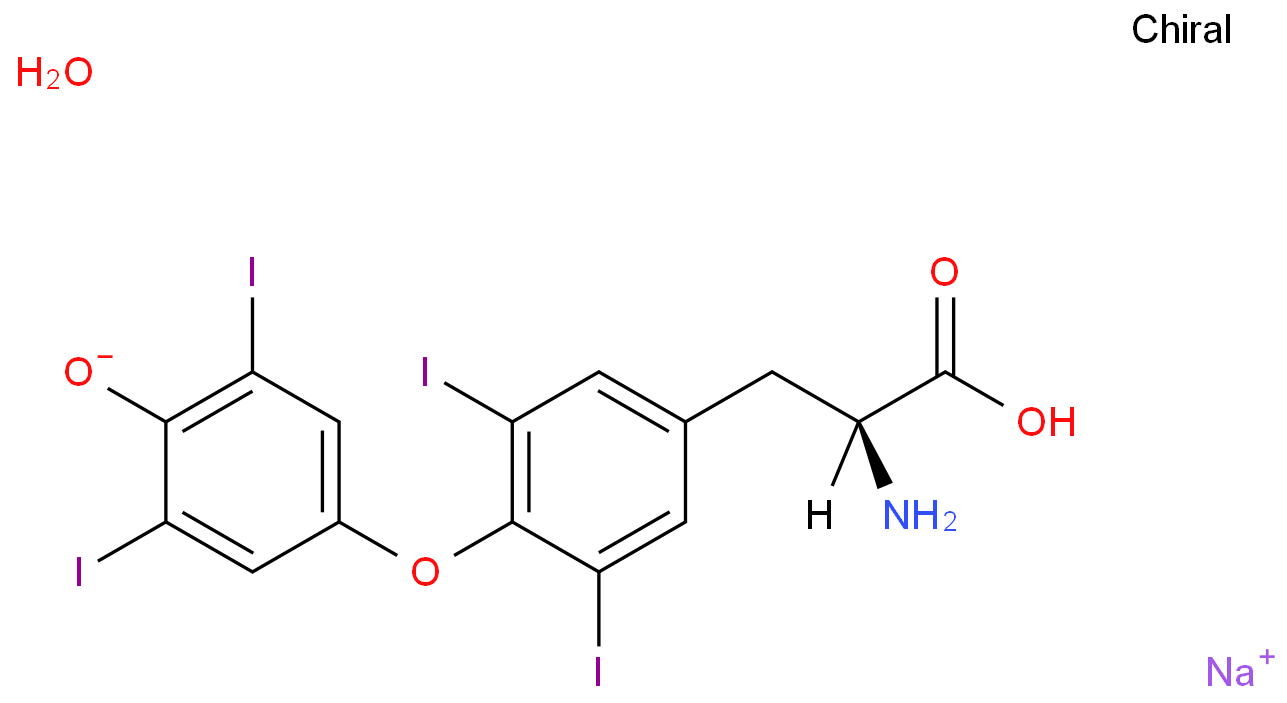
Pharmacologically the molecule is a prodrug: peripheral deiodinases convert it to triiodothyronine, which engages nuclear thyroid hormone receptors. What governs manufacture is that it is a chiral, amphoteric, tetra-iodinated diphenyl ether, poorly soluble at neutral pH, sensitive to light and oxygen, and prone to deiodination.
- Architecture and the potency ceiling: The substance is C15H10I4NO4Na, with an anhydrous molecular weight near 798.9 grams per mole and a pentahydrate near 888.9; iodine is roughly two thirds of the mass. It is practically insoluble in water at neutral pH, dissolves in alkaline media, and is released against an assay window typically in the order of 97.0 to 103.0 per cent. Because the dose is micrograms, the error budget on assay and water content must be far tighter than usual.
- Solid-form and stereochemical sensitivity: The traded pentahydrate can convert to lower hydrates, the anhydrate or disordered material during drying, milling or storage, and hydration state changes the mass basis for potency. Solid form is controlled by X-ray powder diffraction, differential scanning calorimetry, thermogravimetry and Karl Fischer titration. D-thyroxine is controlled by chiral chromatography or specific rotation, alongside related substances including liothyronine and the iodotyrosines.
2.2 Synthesis and Manufacturing Technologies
Manufacture is a chiral-pool exercise: building the L-configured alpha centre de novo is uneconomic, so routes start from L-tyrosine and protect it throughout. The real problem is constructing a congested tetra-iodinated biaryl ether without racemisation, deiodination or phenol oxidation, then isolating a defined hydrate.
- Iodination and diaryl ether construction: L-tyrosine is iodinated to 3,5-diiodo-L-tyrosine with iodine, iodide or N-iodosuccinimide-type systems under controlled stoichiometry. The ether bridge follows by classical oxidative coupling or, in modern routes, by copper-mediated O-arylation of the Chan-Lam class with a di-iodinated arylboron partner. Both demand metal control, since copper and any palladium become ICH Q3D elemental impurities, and both generate iodide-rich streams needing recovery.
- Salt formation, hydration crystallisation and contained micronisation: The free acid is converted with sodium hydroxide under nitrogen and crystallised to a defined hydrate, with the drying trajectory validated to a target diffraction pattern. Milling to a specified D10, D50 and D90 is not cosmetic, since dissolution and blend uniformity in microgram tablets are particle-size driven. Charging, sampling and packing run in isolators or glove boxes with high-efficiency particulate air filtration.
2.3 Core Application Matrix
- Licensed commercial manufacture: The principal outlet is finished-dosage production by marketing-authorisation holders, covering immediate-release tablets across several strengths, oral liquids and parenteral hospital forms. Supply requires a registered specification, a valid Drug Master File, Certificate of Suitability or Active Substance Master File, a qualified impurity profile and change-control commitments. This paper addresses neither product selection nor administration.
- Generic development and bioequivalence: As a narrow-therapeutic-index drug, levothyroxine attracts heightened bioequivalence expectations, including replicate designs with baseline correction and, in United States practice, reference-scaled criteria with tightened limits. Particle-size distribution, solid form, potency and dissolution must therefore be locked across clinical, exhibit and commercial batches, and any change triggers a comparability question.
- Reference standards and analytical research: A smaller but strategic outlet supplies primary and secondary standards, impurity markers such as liothyronine and the iodotyrosines, and material for forced-degradation, photostability and extractables work. This channel values structure confirmation, quantitative nuclear magnetic resonance or mass-balance content assignment and ICH Q1A stability data more than tonnage.
III. Global Market Supply-Demand Landscape and Export Trends
3.1 Demand Drivers and Market Shifts
Demand is demographically anchored: therapy is lifelong and prevalence rises with age, so volume tracks population ageing rather than the economic cycle. Three shifts mark 2026. Buyers are moving from spot purchasing to multi-year contracts with iodine-linked price adjustment, because failure in a narrow-therapeutic-index product is a regulatory event. Formulation mix is diversifying into oral solutions and unit-dose presentations. And tighter scrutiny of generics lengthens qualification.
3.2 Capacity Distribution and Export Flows
Qualified capacity is concentrated. Chinese producers anchor the upstream through iodine chemicals and fermentation-derived L-tyrosine plus a growing base of Certificate-of-Suitability and Drug-Master-File plants in the eastern coastal provinces. Indian manufacturers around Hyderabad and Gujarat pair synthesis with export formulation operations, giving them pull-through advantage and dense filings. European and North American sites hold the legacy innovator and specialist containment positions.
3.3 Market Bifurcation and Pricing Dynamics
The market is bifurcated. Regulated-market material, backed by a filing, an audited high-containment site and a documented solid-form package, commands a premium and multi-year contracts; loosely documented tender material is effectively unqualifiable for regulated finished products. In between, price reflects iodine availability, amortised containment capital, cleaning validation and analytical burden, and dossier maintenance.
IV. In-depth Analysis of Global Compliance and Regulatory Barriers
Sodium levothyroxine sits where pharmaceutical law meets chemical law. As an active substance it is governed by drug legislation and by ICH Q7, Q11, Q6A, Q1A, Q3A, Q3C, Q3D and M7. As a chemical it is subject to REACH and CLP in the European Union and to TSCA and Environmental Protection Agency effluent rules in the United States, with the obligation turning on whether a consignment is destined for medicinal use.
4.1 European Market: REACH, CLP, and Sector-Specific Directives
- Certificate of Suitability or Active Substance Master File and import control: European supply requires either a Certificate of Suitability from the European Directorate for the Quality of Medicines or an Active Substance Master File submitted through the finished-product authorisation, with good manufacturing practice documented in EudraGMDP. Importing active substances made outside the Union also requires a written confirmation from the exporting authority that the site meets equivalent standards.
- REACH and CLP, where relief is narrower than it looks: European chemicals legislation relieves registration, authorisation and restriction duties for substances used in authorised medicinal products, but the relief is use-specific, so material placed for reagent or analytical-standard purposes loses it. CLP classification and safety data sheet duties apply to chemical shipments, endocrine-disruptor scrutiny of thyroid-active substances continues, and iodinated effluent is permitted under adsorbable organic halogen limits.
4.2 North American Market: TSCA, EPA, and FDA Regulations
- Type II Drug Master File, cGMP and narrow-therapeutic-index bioequivalence: United States supply runs through a Type II Drug Master File referenced by an application, with current good manufacturing practice under 21 CFR Parts 210 and 211 for finished product and ICH Q7 for the active substance, and pre-approval inspection exposure at the active-substance site. Because levothyroxine is on the Food and Drug Administration's narrow-therapeutic-index list, abbreviated applications face replicate-design bioequivalence studies with baseline correction.
- TSCA, FDA-regulated status and EPA effluent control: Under TSCA, a substance distributed for drug use falls within the Food and Drug Administration-regulated exclusion from certain inventory and reporting duties, but material sold into research or reagent channels does not, so inventory status must be confirmed before shipment. Pharmaceutical effluent is separately regulated under Environmental Protection Agency effluent guidelines.
4.3 The Critical Hurdle: Quality Control and Safety Limits
Compliance Warning: Two failure modes dominate. The first is potency drift masquerading as compliance: a batch can meet every chromatographic criterion and still deliver the wrong dose if its hydration state shifted or its particle-size distribution moved after re-milling, because dose is mass multiplied by assay on a defined basis. The second is containment: with health-based exposure limits in the microgram-per-day range, conventional ten parts per million cleaning limits are often unachievable in open plant, so production must be dedicated or campaigned in isolator suites with limits derived from the permitted daily exposure. This paper offers no dosing, prescribing or patient guidance.
V. Green Trade Barriers and ESG in Manufacturing
Environmental performance is now a qualification criterion rather than a communications topic. Manufacture is iodine-, solvent- and water-intensive and generates iodinated effluent with a high adsorbable organic halogen load that is costly to treat. Buyers running Scope 1 to 3 programmes request energy, solvent and water intensity per kilogram of active substance.
5.1 Carbon Footprint and Circular Economy
The footprint concentrates in multi-step synthesis with large solvent inventories, in energy for drying and milling under containment, and in treatment or incineration of iodinated waste. Levers include solvent recovery by distillation with defined reuse specifications, iodide recovery from mother and scrubber liquors, substitution of halogenated solvents with ICH Q3C Class 3 alternatives, and halogen-tolerant incineration with acid gas abatement. Energy procurement and European Union Emissions Trading System exposure belong in the same cost model.
5.2 Sustainable Sourcing and Traceability
Traceability starts with iodine, whose supply is concentrated in Chilean caliche and Japanese brine production, so credible suppliers document origin, grade and change control and qualify a second source. L-tyrosine is typically fermentation-derived from carbohydrate feedstock, supporting a transmissible spongiform encephalopathy-free declaration but requiring traced inputs. Buyers expect ISO 9001 and ISO 14001 certification, a nitrosamine risk assessment, and auditable qualification records.
VI. Supply Chain Resilience and Export Logistics
Physically this is a small, high-value, light- and heat-sensitive consignment. Logically it is a controlled-temperature pharmaceutical movement that must arrive with an unbroken documentary and environmental record, because any excursion becomes a quality event. Consignments are measured in single-digit kilograms and move by air.
6.1 Packaging Standards and Moisture/Contamination Control
- Light and oxygen barrier primary packaging: Material is packed in amber Type III glass or in aluminium or high-density polyethylene containers with an ultraviolet-blocking liner, closed under nitrogen or argon headspace with oxygen scavenger and desiccant, low-permeability closures and tamper-evident seals. Pack sizes are small, typically half a kilogram to five kilograms, because one pack represents a very large number of doses.
- Hydration-state and moisture control: Because potency depends on specified water content, the pack must preserve crystallisation water rather than strip it. That means sealed moisture-barrier liners, controlled internal water activity, desiccant sized to the headspace, and instructions against re-drying or repacking at destination. Water content is verified on receipt by Karl Fischer titration and solid form confirmed by diffraction.
6.2 Dangerous Goods Identification and Transit Protocols
Most safety data sheets carry acute oral toxicity and systemic or developmental hazard statements, so labelling and occupational hygiene duties apply even though the active substance is not normally a regulated dangerous good under ADR, IMDG or IATA. Transport is temperature-controlled, refrigerated at 2 to 8 degrees Celsius or controlled ambient at 15 to 25 degrees Celsius according to the registered condition, with calibrated data loggers and predefined excursion procedures.
VII. Enterprise Global Expansion Strategy Guide
For a producer seeking regulated-market volume, sequence matters: dossier first, containment second, commercialisation third. Buyers qualify evidence rather than intentions, and the qualification clock runs for years.
- Build the dossier before the commercial offer: A Type II Drug Master File, a Certificate of Suitability or Active Substance Master File and a complete ICH M4 module 3 package are entry tickets, not differentiators. What differentiates is ICH Q12 lifecycle discipline: a registered starting-material justification, an impurity and degradation narrative, a defined solid form with an attached change-control protocol, and photostability and forced-degradation data.
- Treat containment and cleaning validation as a commercial asset: A toxicologist-signed health-based exposure limit, a documented occupational exposure band of four to five, isolator-based charging and milling, dedicated or campaigned trains, operator training and health surveillance, and cleaning validation with limits derived from the permitted daily exposure are exactly what auditors ask to see. Building this before the first audit converts capital cost into qualification advantage.
- Dual-source, regionalise and contract for resilience: Expect buyers to demand a second qualified source and six to twelve months of safety stock. The supplier answer is regional warehousing under good distribution practice in the European Union and North America, vendor-managed inventory, and long-term agreements with volume bands and iodine-linked price adjustment.
VIII. Conclusion
Sodium levothyroxine is not difficult to describe and not easy to supply. Its chemistry converts ordinary manufacturing variables into clinical ones: water content becomes dose, particle size becomes dissolution, a drying curve becomes a bioequivalence question, and a shared equipment train becomes a cross-contamination risk.
Three developments will shape the cycle. Scrutiny of narrow-therapeutic-index generics will keep tightening, raising the evidentiary bar on comparability. Sustainability requirements will move from questionnaires into contracts, with solvent, water and iodine-recovery performance becoming scored tender criteria. And resilience will keep being priced in through dual sourcing, regional inventory and iodine hedging.
IX. Industry Resource Connection and Supplier Ecosystem
Powered by Guidechem
This white paper is exclusively compiled by the Guidechem Intelligence Team based on global customs data, regulatory databases, and industry research. Guidechem is a leading global B2B chemical platform, dedicated to connecting global buyers with verified, high-quality manufacturers.
Relying on Guidechem's extensive global database, we have mapped the core participants in the current global Sodium levothyroxine supply chain:
- China — iodine chemistry and a growing filing base: Chinese producers combine upstream strength in iodine chemicals and fermentation-derived L-tyrosine with an expanding set of Certificate-of-Suitability and Drug-Master-File plants in the eastern coastal provinces. The advantage is vertical integration and cost; the improvement areas are containment and documentation depth.
- India — formulation-integrated production and high filing density: The Hyderabad, Bengaluru and Gujarat ecosystem is distinctive because active-substance manufacture is frequently tied to large export-oriented finished-dose operations, giving suppliers visibility into formulation behaviour and bioequivalence risk. It offers dense filings and cost competitiveness, constrained by imported iodine dependence.
- European Union and North America — high-compliance incumbents: These sites hold the legacy innovator position and the specialist high-containment contract manufacturing position, with short auditable chains into regulated markets and mature ICH Q12 practice. They price at a premium justified by inspection history, proximity and dossier depth.
Disclaimer: The content of this white paper is compiled based on public market data and regulatory information available as of 2026. Global chemical regulations are subject to dynamic adjustments. In actual export operations, enterprises must consult professional regulatory advisors or relevant competent authorities to obtain the latest compliance guidance.


 EN
 Agricultural News
 Food News
 Industrial News
 Cosmetic News
 Pharmaceutical News
 Science News


 2YRS

