-
We detected your language preference as English. Would you like to switch to the English version for a better experience?
Switch to English
Stay here


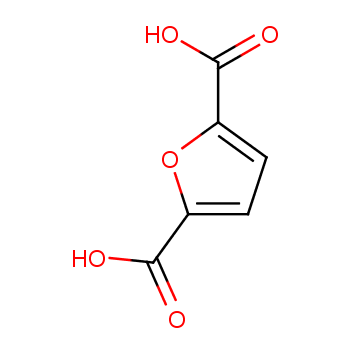
2,5-Furandicarboxylic acid (FDCA, CAS 3238-40-2, C6H4O5, MW 156.09) has moved from laboratory curiosity to become the anchor molecule of the bio-based aromatic polyester chain. As the diacid monomer for poly(ethylene 2,5-furandicarboxylate), or PEF, it is the only bio-based platform chemical positioned to challenge a petro-aromatic of terephthalic-acid scale. In 2026, sourcing turns on polymer-grade consistency, documented carbon performance and survival of brand-owner qualification cycles lasting 18 to 36 months.
The dominant paradigm is oxidation of 5-hydroxymethylfurfural (HMF) or of its stabilised ether derivatives, with aerobic heterogeneous catalysis over supported gold, platinum and palladium on oxide carriers displacing stoichiometric permanganate, hypochlorite and nitric-acid routes. Yield is no longer the differentiator; impurity architecture is. Residual FFCA, HMFCA, DFF and humins-derived colour bodies act as chain terminators or chromophores during melt polycondensation, so specifications are converging on parts-per-million limits rather than percentage purity.
On compliance, FDCA sits where the European Green Deal, the Packaging and Packaging Waste Regulation, bio-based content metrology under EN 16640 and ASTM D6866, food-contact authorisation under Regulation (EU) No 10/2011 and the United States notification system, and carbon-footprint accounting under ISO 14067 intersect. Buyers who specify assay alone will find PEF resin failing colour and barrier targets. This paper sets out the technical, regulatory and logistics variables that determine whether an FDCA supply programme is bankable.
FDCA is a planar heteroaromatic diacid whose furan ring replaces the para-disubstituted benzene ring of terephthalic acid. The ring dipole introduced by the oxygen atom reduces chain symmetry and restricts ring flipping, and that single substitution produces the barrier and thermal signature of the resulting polyester. Two property clusters dominate discussion between monomer suppliers and resin producers.
Two route families compete. The first, far the more widely practised, is carbohydrate dehydration to HMF followed by oxidation. The second is the furan carboxylation family, historically Henkel-type disproportionation and more recently catalytic carboxylation and chloromethylfurfural chemistry, which avoids HMF instability altogether. Within the HMF family the decisive question is whether to oxidise HMF itself or a stabilised derivative.
Demand is pulled rather than pushed. Recycled-content and design-for-recycling obligations under the Packaging and Packaging Waste Regulation, product-design requirements flowing from the Single-Use Plastics Directive, and corporate Scope 3 targets have created a queue of converters needing a bio-based high-barrier polymer that runs on modified PET equipment. Each validated application is a multi-year, high-switching-cost relationship, so volumes look modest against terephthalic-acid capacity yet prove sticky once qualified. The second shift is structural: offtake agreements financing new plants are ESG-linked, tying price or volume to a verified carbon footprint and ISCC PLUS mass-balance documentation, so commercial contract and sustainability dossier are negotiated in the same room.
Capacity is concentrated. A flagship plant at Delfzijl in the Netherlands anchors the European position on licensed YXY technology, while a chloromethylfurfural-based platform operates in Sarnia, Ontario with FDCA and PEF integration. In China, HMF and FDCA lines have been built in eastern and central provinces close to corn-derived fructose and glucose, largely as multi-hundred-tonne to kilotonne demonstration capacity feeding domestic resin, film and fibre trials. Japanese and Korean participation is downstream: converters and beverage brand owners qualifying rather than owning oxidation capacity. Flows therefore run from the Netherlands and China into European, Japanese, Korean and North American programmes, mostly in 25 kg drums and 500 to 1000 kg bulk containers.
Pricing is bifurcated. Technical grades at 98 to 99 percent trade on a small-volume, quote-driven basis with wide spreads and are consumed by catalyst screening, polymer trials and derivative synthesis. Polymer-grade material at 99.9 percent and above, with a full metals and colour dossier, commands a large premium and is almost never spot-traded; it moves under multi-year contracts with take-or-pay features and indexation to carbohydrate feedstock and monoethylene glycol. Buyers should expect the gap to purified terephthalic acid to remain material and should model qualification cost rather than monomer price alone, because a failed 24-month bottle trial is the costliest line item in any PEF business case.
FDCA is not a substance of very high concern and is not on the REACH Authorisation List, but it is no regulatory lightweight. As an intermediate in food-contact polymers and the carrier of a bio-based content claim in packaging placed on the EU market, it attracts the full weight of food-contact, packaging-waste, inventory and carbon-accounting rules. The burden falls on the dossier: specification, impurity identification, migration data and chain-of-custody evidence for renewable content.
FDCA is sold, in the end, on its carbon story, and that story must now survive third-party verification. The proposition rests on biogenic carbon uptake plus lower process energy than purified terephthalic acid; the reviewer's counter-argument concerns feedstock origin, fertiliser and land-use effects, and the energy intensity of HMF purification and isolation. A credible 2026 supplier produces an ISO 14040, ISO 14044 or ISO 14067 conformant study and translates it into Scope 1 to 3 disclosure under the GHG Protocol.
Three levers dominate: feedstock, oxidation selectivity and isolation. First-generation sugars from corn, wheat or beet carry fertiliser, nitrous-oxide and land-use-change burdens that consume much of the theoretical saving; lignocellulosic or residue-derived sugars certified under ISCC PLUS or REDcert improve the result. Every point diverted into FFCA, humins or over-oxidation is embedded carbon in a waste stream, as is the neutralisation salt load from acidification. Crystallisation, washing and drying can rival the reaction in energy demand, making renewable electricity and heat integration the fastest lever.
Because few PEF value chains are physically segregated at commercial scale, most bio-based claims travel through a mass-balance chain of custody. Require ISCC PLUS or equivalent certification at both the FDCA plant and the polymerisation step, with transaction certificates per shipment and audited allocation windows. The EU Deforestation Regulation imposes origin due diligence on covered commodities, and brand owners now extend equivalent traceability expectations to carbohydrate feedstock. Qualification should therefore include a feedstock origin map, third-party audit reports and a commitment to notify changes in feedstock, site or certification scope.
FDCA ships as a free-flowing to slightly cohesive crystalline powder, and the dominant logistics risk is quality drift rather than hazard. Because polymer-grade material is bought against colour and metals limits, packaging and transit are part of the specification. Moisture ingress promotes caking and complicates drying before polycondensation, while trace iron or chromium from contact surfaces or a poorly cleaned container can breach ICP-MS limits and trigger rejection.
FDCA is not classified as dangerous for transport under ADR, IMDG or ICAO and IATA rules, and most Safety Data Sheets carry no UN number. That simplifies export but removes a useful discipline, since shippers sometimes omit handling controls when no dangerous-goods declaration is required. Standard practice is to treat polymer-grade FDCA as controlled cargo: temperature-moderated or, on long equatorial legs, temperature-controlled containers held at roughly 15 to 25 °C, desiccant and humidity indicator cards, no deck stowage, container-integrity inspection before stuffing, and contractual limits on transit time and transhipment count. Air freight suits qualification samples below roughly 100 kg.
For producers and traders, the strategic problem is that the market is small, concentrated and qualification-gated. Volume is not won on price. It is won by surviving the customer's audit and by holding a specification constant for three years while that customer's bottle or film trial runs.
FDCA in 2026 is a polymer-grade specialty chemical wearing the costume of a commodity. The value proposition is proven, since PEF's barrier and thermal profile has been reproduced across independent converters, and European policy is unusually supportive. What remains unresolved is cost, recycling-stream compatibility at scale, and the pace at which brand owners convert pilot trials into contracted volume. Winners will hold parts-per-million impurity limits across years, document renewable carbon with audited chain of custody, and price agreements that survive sugar-price volatility.
For buyers, treat qualification as two tracks. Secure development-grade supply for internal resin and application trials under a short technical specification, and in parallel negotiate a polymer-grade contract with change-control, audit rights, retained samples and indexed pricing. Dual-source across at least one European and one Asian producer to hedge policy and logistics risk. Write colour, metals and monofunctional-impurity limits into the contract as acceptance criteria, because those, rather than assay, decide whether the resin plant accepts the lot.
Powered by Guidechem
This white paper is exclusively compiled by the Guidechem Intelligence Team based on global customs data, regulatory databases, and industry research. Guidechem is a leading global B2B chemical platform, dedicated to connecting global buyers with verified, high-quality manufacturers.
Relying on Guidechem's extensive global database, we have mapped the core participants in the current global 2,5-Furandicarboxylic acid supply chain:
Disclaimer: The content of this white paper is compiled based on public market data and regulatory information available as of 2026. Global chemical regulations are subject to dynamic adjustments. In actual export operations, enterprises must consult professional regulatory advisors or relevant competent authorities to obtain the latest compliance guidance.
|
 |
 |
 |
 EN
 Agricultural News
 Food News
 Industrial News
 Cosmetic News
 Pharmaceutical News
 Science News


 3YRS

