
I. Executive Summary
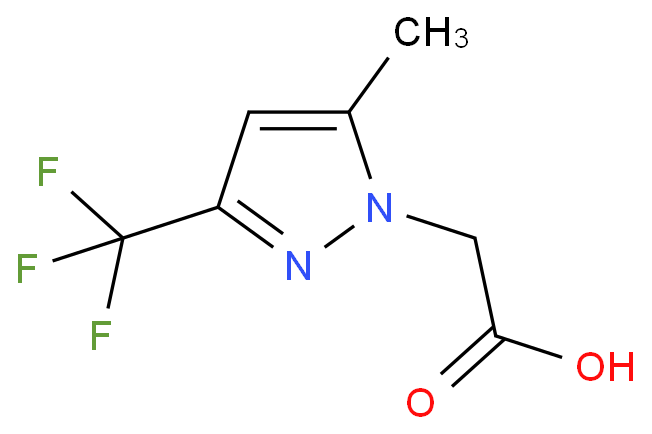
(5-Methyl-3-(trifluoromethyl)pyrazol-1-yl)acetic acid, CAS 345637-71-0, is a fluorinated heteroaromatic building block combining a trifluoromethyl pyrazole with a carboxylic acid tethered through ring nitrogen. The CF3 group supplies lipophilicity and metabolic blocking, the methyl tunes sterics, and the acetic acid arm gives a handle for amide and ester coupling. It serves agrochemical and pharmaceutical discovery and process chemistry and is also bought in small quantities as a characterised metabolite and impurity reference. Supply runs from gram research lots to multi-tonne campaigns.
The central quality issue is regioisomerism. Alkylation of a 3(5)-trifluoromethyl pyrazole can occur at either ring nitrogen, giving two constitutionally different acetic acid products that differ in polarity, acidity, crystal form and downstream reactivity. They are not variants of one impurity but different molecules, and a buyer receiving the wrong one builds the wrong registered substance. Suppliers must resolve the pair, assign structure unambiguously and hold a specification on the unwanted regioisomer rather than a combined total.
The second defining issue is PFAS adjacency. A single trifluoromethyl group on a heteroaromatic ring is generally outside the OECD perfluoroalkyl-core definition and outside the core scope of the European universal PFAS restriction proposal, yet the substance is routinely captured by buyer questionnaires, by restriction scoping and by United States reporting obligations. Documented positioning is now part of the product: fluorine mass balance, trifluoroacetate degradation data and a definitional analysis travel with the quotation rather than arriving later as a problem.
II. Product Deep Dive: Molecular Mechanisms and Production Evolution
2.1 Physicochemical Properties and Mechanisms
The molecule is a crystalline carboxylic acid, soluble in polar organic solvents and only sparingly soluble in water at low pH, with solubility rising sharply once converted to a salt. Behaviour is dominated by the inductive withdrawal of the CF3 group, by the tautomeric character of the parent pyrazole, and by the freedom of the acetic acid arm to rotate. The acid is the functional handle: the site of amide coupling, its pKa governing extraction during work-up and salt formation on isolation.
- Tautomerism and the N1/N2 Regioisomer Problem: The parent 3(5)-trifluoromethyl pyrazole exists as tautomers placing the substituent formally at C-3 or C-5, so the two ring nitrogens are inequivalent and N-functionalisation gives two constitutional isomers. They differ in dipole, acidity and crystal packing, which makes them separable, and in the spatial relationship between CF3 and the acid arm, which makes them functionally different downstream. Control starts at the alkylation step and is confirmed by unambiguous structural assignment, not a retention-time match.
- Electronic Effect of the Trifluoromethyl Group: The CF3 group withdraws electron density strongly, lowering the pKa of the tethered acid and increasing lipophilicity while blocking the oxidation a methyl group would suffer. It is also a powerful NMR and mass-spectrometric tag, simplifying impurity identification. Practically, acidity and extraction windows shift relative to non-fluorinated analogues, so conditions copied from a methyl-pyrazole campaign need re-optimisation.
2.2 Synthesis and Manufacturing Technologies
Industrial supply follows a cyclocondensation to build the pyrazole core then N-functionalisation to install the acetic acid arm, discussed here at route-class level only. The competitive question is no longer whether the core can be made, since CF3-pyrazole chemistry is mature, but how cheaply the fluorinated 1,3-dicarbonyl equivalent is sourced and how tightly the regioisomer pair is resolved at scale.
- Cyclocondensation Route Class and Core Formation: The pyrazole is built by condensing a trifluoromethylated 1,3-dicarbonyl equivalent with hydrazine, regioselectivity governed by the more electrophilic carbonyl terminus, solvent and temperature. Principal impurities are the regioisomeric pyrazole, uncyclised hydrazones and hydrolytic by-products from the fluorinated precursor. Because hydrazine chemistry is involved, the containment and residue-purge discipline applied to aryl hydrazines applies here, and residual fluorinated precursor is tracked as both a cost item and a related-substance liability.
- N-Alkylation and Regioisomer Management: The acetic acid arm is installed by alkylating the pyrazole nitrogen with a haloacetate equivalent followed by ester hydrolysis. This step creates the regioisomer pair, and the ratio is influenced by counter-ion, base, solvent polarity and leaving group. Manufacturers favour one nitrogen, then reject the other by crystallisation or pH-controlled extraction, and specify the unwanted isomer individually against a qualified standard. Residual alkylating agent is assessed under the mutagenic-impurity framework with a purge argument.
2.3 Core Application Matrix
- Agrochemical Discovery and Process Chemistry: Trifluoromethyl pyrazoles are an established motif in herbicidal, fungicidal and insecticidal programmes, the acetic acid arm providing the attachment point for amide or ester linkages into final actives. Buyers scale from grams to tonnes as a candidate advances and value suppliers who hold the same regioisomer specification across that range.
- Pharmaceutical Discovery and Registered-Intermediate Supply: In pharmaceutical programmes the fragment contributes metabolic blocking and lipophilicity, and the acid is coupled to amines. Where material feeds a regulated substance, campaigns run under GMP-aligned systems with fuller documentation; earlier-stage material is supplied research-use-only with a lighter package, and the boundary is stated explicitly at quotation.
- Metabolite, Impurity and Analytical Reference Use: Because the fragment can arise as a metabolite or process impurity in fluorinated pyrazole programmes, it and its regioisomer are bought as analytical standards for method validation and residue work. This segment requires the highest characterised purity, full structural assignment and certified content, in gram quantities.
III. Global Market Supply-Demand Landscape and Export Trends
3.1 Demand Drivers and Market Shifts
Demand is driven by continuing appetite for fluorinated heterocycles in crop-protection and pharmaceutical pipelines, where CF3 reliably raises lipophilicity and blocks oxidative metabolism. What has changed is the overlay of per- and polyfluoroalkyl scrutiny: chemists still want the group, but procurement and stewardship functions demand documentation first. The result is stable-to-rising technical demand alongside a shrinking set of suppliers able to satisfy the documentation burden.
3.2 Capacity Distribution and Export Flows
China is the centre of gravity for fluorinated heterocycle building blocks, backed by integrated fluorspar, hydrogen fluoride and trifluoromethylation reagent capacity, supplying both fluorinated dicarbonyl precursors and finished pyrazole acids. India has grown strong in documented custom synthesis, often importing the fluorinated precursor and finishing it under GMP-aligned systems. European producers retain fluorination and analytical development capability for development-scale and low-volume commercial demand. Flows run from Chinese intermediates into Indian and European finishing and onward to end customers.
3.3 Market Bifurcation and Pricing Dynamics
Pricing bifurcates by campaign type. Research-use-only lots with a short certificate and an isomer ratio rather than an isomer specification are cheap and quick. GMP-aligned or fully documented campaigns, with the regioisomer resolved and specified, residual alkylating agent justified, heavy metals and residual solvents controlled and fluorine mass-balance data supplied, carry a substantial premium. Underlying both is fluorinated raw-material cost and, increasingly, stewardship documentation cost, so the cheapest quotation is usually the one that has priced neither.
IV. In-depth Analysis of Global Compliance and Regulatory Barriers
Two regulatory layers apply. The first is ordinary chemical law: registration, classification, labelling and inventory status, demanding but familiar for a fluorinated heterocycle. The second is the per- and polyfluoroalkyl layer, evolving quickly, where commercial risk lies as much in questionnaire-driven exclusion as in formal legal obligation.
4.1 European Market: REACH, CLP, and Sector-Specific Directives
- REACH Registration and CLP Classification: European supply at or above one tonne per year requires registration addressing fluorinated aromatic toxicology and environmental fate; intermediates may qualify for reduced requirements only where strictly controlled conditions are demonstrable. Classification reflects the acidic function and fluorinated heteroaromatic, with aquatic hazard receiving particular attention because fluorinated fragments can persist. Suppliers should expect questions on degradation and terminal breakdown products.
- PFAS Definition and Restriction Scoping: A single trifluoromethyl group on a heteroaromatic ring is generally outside the OECD perfluoroalkyl-core definition and is not the core target of the European universal restriction proposal, which focuses on fully fluorinated carbon chains. That does not prevent commercial capture: buyer questionnaires frequently apply a total-fluorine screen, and scoping keeps evolving. Responsible suppliers therefore provide a written definitional analysis, fluorine mass balance and available trifluoroacetate degradation data rather than a bare out-of-scope assertion.
4.2 North American Market: TSCA, EPA, and FDA Regulations
- TSCA Inventory and PFAS Reporting: United States supply requires correct TSCA inventory positioning, with a pre-manufacture notice or exemption before import where the substance is not listed. Alongside that, PFAS reporting obligations have made fluorinated substances a documentation exercise in their own right, and fluorinated building blocks attract attention even where the structure falls outside the perfluoroalkyl core. Importers should verify inventory identity carefully, since naming variants are common for pyrazole acids.
- ICH Q7, Q11 and Q3D Across Campaign Types: Where material supports a regulated substance, manufacture follows API good-manufacturing-practice principles with a development narrative on route selection and impurity fate, and elemental impurities are assessed against permitted daily exposure by route of administration. Where material is research-use-only, requirements are lighter, but the supplier is expected to say so explicitly, label accordingly and keep the two campaign types separated in scheduling, documentation and ideally equipment.
4.3 The Critical Hurdle: Quality Control and Safety Limits
Compliance Warning: Regioisomer control is the decisive acceptance criterion. Purchasers should require the unwanted N-isomer specified individually against a qualified standard with unambiguous structural assignment by NMR and, where needed, single-crystal confirmation, rather than a combined isomer total. Assay should be by HPLC confirmed by neutralisation equivalent, and the specification must also cover cyclocondensation related substances, residual alkylating agent assessed as a potentially genotoxic species with a purge argument and validated trace method, heavy metals, residual solvents by GC and water content, since the acid is hygroscopic and water corrupts assay and coupling stoichiometry.
V. Green Trade Barriers and ESG in Manufacturing
For a fluorinated heterocycle, ESG review has shifted from generic carbon accounting to fluorine stewardship. Customers ask what happens to fluorine atoms across the process and after the product's life, whether trifluoroacetate arises on degradation, and how fluorinated waste streams are treated. Suppliers answering with data rather than assurances keep their place on approved-vendor lists.
5.1 Carbon Footprint and Circular Economy
Fluorination chemistry is energy-intensive upstream, since hydrogen fluoride and fluorinated reagents carry substantial embedded energy that lands in Scope 3 for the building-block maker. Within the plant, levers are solvent recovery from cyclocondensation and alkylation, recovery of unreacted fluorinated precursor, heat integration around distillations, and destruction rather than dilution of fluorinated waste. Credible reporting separates Scope 1 and 2 emissions from purchased fluorinated precursors and quantifies fluorine mass balance.
5.2 Sustainable Sourcing and Traceability
Traceability now means fluorine traceability. Buyers request the origin of the trifluoromethylation reagent, the fluorine mass balance across the campaign and available data on terminal degradation products, particularly trifluoroacetate, since that is what their stewardship teams are asked. Lot genealogy linking the fluorinated precursor, cyclocondensation and alkylation campaign to the finished lot supports both questionnaires and later specification investigations.
VI. Supply Chain Resilience and Export Logistics
The material is a stable crystalline solid whose logistics risk is hygroscopicity and labelling coherence rather than acute transport hazard. Resilience rests on keeping water out, on documentation clearing both customs and the customer's stewardship review, and on storage preserving the specified regioisomer ratio and assay through the retest period.
6.1 Packaging Standards and Moisture/Contamination Control
- Moisture-Barrier, Light-Protected Primary Packaging: Material is packed in moisture-barrier liners with desiccant, sealed under nitrogen and placed in opaque outers, stored cool, dry and light-protected. Water uptake biases dry-basis assay and can drive partial salt behaviour that changes dissolution in the coupling step, so packaging should state maximum water uptake over the retest period.
- Segregated Outers with Coherent Documentation: Outers are dedicated and cleaned, identified as a fluorinated organic acid intermediate and segregated from basic or odorous cargo. Because stewardship questionnaires often follow the shipment, despatch documentation should already carry the fluorine-content statement and reference the stewardship dossier, so receiving quality and sustainability functions can clear the lot without further correspondence.
6.2 Dangerous Goods Identification and Transit Protocols
Most consignments are non-dangerous goods, but classification must be confirmed for the supplied form, since acidic solids can attract an irritant or corrosive classification, and where one applies the declaration follows ADR, the IMDG Code or IATA. Transit within the validated temperature range, with monitoring and a defined excursion procedure, preserves assay and regioisomer specification. Shorter routings and avoidance of peak-summer container legs are standard for hygroscopic acids.
VII. Enterprise Global Expansion Strategy Guide
Suppliers and buyers should sequence three workstreams: regioisomer resolution first, stewardship documentation second, scale-up capacity third. Each is cheaper in that order, and reversing it is the usual cause of a stalled fluorinated-pyrazole programme.
- Lead with Regioisomer Resolution and Specification: Demonstrate that the two N-isomers are separated, structurally assigned and individually specified, with a qualified standard for the unwanted isomer and data showing the specification holds from gram to tonne scale. This is the most persuasive technical differentiator in this chemistry.
- Prepare the PFAS-Adjacency Documentation Pack: Issue a written definitional analysis against the OECD perfluoroalkyl-core definition and European restriction scoping, a fluorine mass balance for the process and available trifluoroacetate degradation data, so buyer questionnaires are answered at quotation rather than discovered late.
- Separate RUO and GMP Campaigns and Dual-Source: Keep research-use-only and GMP-aligned campaigns distinct in scheduling and documentation, and pair a cost-competitive Chinese fluorinated source with an Indian or European partner providing audit-ready capacity and analytical development. The second source protects the programme through stewardship changes and scale-up transitions.
VIII. Conclusion
(5-Methyl-3-(trifluoromethyl)pyrazol-1-yl)acetic acid is a mature fluorinated building block whose commercial outcome is decided by two things: whether the supplier truly controls the N1/N2 regioisomer pair, and whether it can position the substance with data in a market that increasingly screens on fluorine. Price and capacity matter after those two, because neither a low quotation nor a large plant rescues a lot built around the wrong isomer or excluded by a stewardship questionnaire.
The outlook is continued demand from fluorinated-heterocycle pipelines, continued concentration of fluorinated precursor capacity in China, and stewardship documentation rising as a selection criterion. Suppliers investing in isomer-resolution analytics, fluorine mass-balance reporting and clean separation of research and regulated campaigns will qualify into long programmes, while those relying on a bare out-of-scope assertion will be screened out earlier each year.
IX. Industry Resource Connection and Supplier Ecosystem
Powered by Guidechem
This white paper is exclusively compiled by the Guidechem Intelligence Team based on global customs data, regulatory databases, and industry research. Guidechem is a leading global B2B chemical platform, dedicated to connecting global buyers with verified, high-quality manufacturers.
Relying on Guidechem's extensive global database, we have mapped the core participants in the current global (5-Methyl-3-(trifluoromethyl)pyrazol-1-yl)acetic acid supply chain:
- China Fluorinated Heterocycle Cluster: The dominant base, backed by integrated fluorspar, hydrogen fluoride and trifluoromethylation reagent capacity, supplying fluorinated precursors and finished pyrazole acids. Strengths are cost and scale-up speed; qualification focuses on regioisomer specification and fluorine mass balance.
- India Documented Custom-Synthesis Ecosystem: Strong in GMP-aligned finishing of imported fluorinated precursors, with experience of impurity packages, residual alkylating agent assessment and audit, often preferred once a programme moves into development.
- European Fluorination and Analytical Development Network: Smaller, costlier capacity retaining fluorination expertise and advanced structural and trace analysis, serving development campaigns, reference standards and stewardship documentation, often as the technical arm of an eventual Asian chain.
Disclaimer: The content of this white paper is compiled based on public market data and regulatory information available as of 2026. Global chemical regulations are subject to dynamic adjustments. In actual export operations, enterprises must consult professional regulatory advisors or relevant competent authorities to obtain the latest compliance guidance.



 EN
 Agricultural News
 Food News
 Industrial News
 Cosmetic News
 Pharmaceutical News
 Science News


 5YRS

