-
We detected your language preference as English. Would you like to switch to the English version for a better experience?
Switch to English
Stay here


Adenosine 3',5'-cyclic monophosphate sodium salt (CAS 37839-81-9), the sodium salt of cyclic adenosine monophosphate (cAMP), holds a narrow but strategically important position in the global research-reagent supply chain. It is the canonical second messenger used to interrogate cAMP-dependent signalling in vitro, and it is purchased almost exclusively by academic laboratories, CROs, assay-kit manufacturers and biotech process-development groups. As supplied by manufacturers and distributors, this material is Research Use Only (RUO). It has no approved therapeutic indication, it is not a finished medicinal product, and it is not a consumer, food or dietary product. Any offer, listing or dossier that implies diagnostic or therapeutic use is a compliance failure, not a marketing choice.
Commercially, the differentiating variables are not price but specification discipline: the water of crystallisation of the hydrate, the sodium counter-ion assay, the related-substance profile (principally 5'-AMP and free adenosine arising from hydrolysis or incomplete cyclisation), residual solvent and inorganic salt load, and - for molecular-biology grades - endotoxin, bioburden and DNase/RNase-free status. Buyers increasingly request a full certificate of analysis with chromatogram, a validated stability-indicating HPLC method, and a declaration of the route class used, because nucleotide salts are hygroscopic and the hydrate form drifts if packaging or cold chain is weak.
For sourcing managers the practical message is to treat CAS 37839-81-9 as a CDMO-managed project material rather than a catalogue commodity. Define the grade (RUO versus ISO 9001 or GMP-aligned campaign), lock the hydrate specification and water-content method, fix the packaging configuration with desiccant and amber barrier, and secure a cold-chain lane with documented temperature excursion handling before the first shipment. Suppliers able to offer route transparency, method validation and reference-material documentation capture the higher-value repeat business.
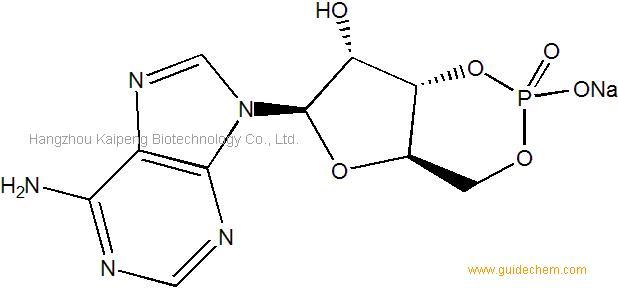
cAMP is adenosine in which a single phosphate diester bridges the 3'- and 5'-hydroxyls of the ribose, forming a six-membered cyclic phosphate ring. The free acid has the formula C10H12N5O6P (relative molecular mass 329.21); the monosodium salt is C10H11N5NaO6P, and commercial lots are usually supplied as a hydrate. The cyclic phosphate removes one ionisable proton relative to a monoester, so the molecule carries a single negative charge and one sodium counter-ion across the physiological pH range, and that charge state governs both its chromatographic behaviour and its very high aqueous solubility.
Two route families dominate legitimate industrial supply, and mature programmes run both depending on the required grade. In each case the sodium salt and hydrate form are set deliberately in the final isolation step, not left to chance, because the counter-ion and water content are the first items a buyer's QC laboratory will challenge.
Demand tracks research spending rather than industrial consumption: GPCR drug discovery, immuno-oncology and cell-therapy programmes all use cAMP measurement as a functional read-out, and the growth of outsourced screening at CROs has shifted purchasing from individual laboratories to centralised procurement teams that qualify vendors once and then buy repeatedly. Kit manufacturers and reagent repackers now absorb a rising share of volume and negotiate annual contracts, which pushes suppliers toward documented change control, lot reservation and scheduled campaigns instead of spot production.
Nucleotide fermentation and enzymatic-conversion capacity is concentrated in China and Japan, with China supplying both bulk nucleotide intermediates and finished RUO-grade cAMP sodium salt, and Japan retaining high-purity biochemical-reagent capability built on decades of nucleotide fermentation know-how. North America and Europe hold comparatively small synthesis footprints but dominate distribution, branding, kit integration and reference-material certification, so the physical trade flow runs East-to-West while the specification and documentation flow runs West-to-East.
The market splits sharply into catalogue RUO material sold in vials at high unit price, and project volumes produced under ISO 9001 or GMP-aligned quality systems where price per gram falls but qualification cost rises. Hydrate versus lyophilised form, molecular-biology grade with nuclease and endotoxin limits versus general laboratory grade, and the presence or absence of a reference-material certificate each create distinct price tiers, and the spread between tiers is far wider than any movement in raw adenosine or ATP cost.
Because the material is supplied RUO, the regulatory burden sits on chemical-inventory and workplace rules rather than on marketing authorisation. Nevertheless, the commercial perimeter is strict: no therapeutic or diagnostic claim may be attached to a RUO biochemical, and the dossier must also address the impurity and microbiology questions that buyers apply internally.
ESG pressure on biochemical reagents arrives through customer procurement questionnaires rather than through legislation. Assay-kit manufacturers and pharmaceutical buyers now ask for solvent-reduction commitments, energy disclosures and waste-water treatment data, and suppliers who cannot answer lose tender slots even when their chemistry is sound.
The carbon profile of cAMP sodium salt is dominated less by the reaction than by isolation and distribution: preparative HPLC and lyophilisation are energy-intensive, fermentation downstream processing consumes steam and large water volumes, and refrigerated or frozen air freight multiplies the footprint per gram. Credible programmes report Scope 1 and 2 energy, measure Scope 3 logistics emissions, and reduce solvent load through aqueous enzymatic conversion and resin-based capture instead of large-volume solvent chromatography.
Buyers increasingly require an animal-origin-free and non-GMO statement for the adenosine or ATP feedstock, ISO 14001-certified sites, and documented waste-water treatment for phosphate-containing streams. Traceability also means analytical traceability: retained samples, a documented lot genealogy from nucleotide feedstock to finished vial, and a certificate that identifies the route class, counter-ion and hydrate form, so that any future investigation can be closed quickly.
Nucleotide salts are hygroscopic solids whose value is destroyed by moisture ingress and by repeated freeze-thaw handling, so logistics design is a quality function, not a freight-afterthought. The commercial specification must therefore be written together with the packaging bill of materials and the temperature lane.
cAMP sodium salt is generally shipped as non-hazardous for transport, but the cooling regime creates its own regulated elements: dry ice is UN1845, Class 9, and air shipments must follow IATA packing instruction 954 with correct net-mass marking, while gel-pack refrigerated lanes need validated 2-8 °C qualification for the lane and season. Frozen shipments should specify -20 °C, define acceptable excursions, use data loggers with a documented excursion investigation procedure, and avoid ADR or IMO complications by confirming the SDS transport section for every lot before booking.
Suppliers entering Western RUO channels win through documentation discipline and service responsiveness rather than through price leadership. The following three moves are the ones that change qualification outcomes in practice.
Adenosine 3',5'-cyclic monophosphate sodium salt is a specification-driven research material whose commercial value is created downstream of the chemistry: in hydrate and counter-ion control, in related-substance and endotoxin discipline, in cold-chain execution and in the credibility of the RUO perimeter. Suppliers who present it as a commodity salt compete on price and lose on qualification; suppliers who present it as a managed biochemical with a validated method set and a documented quality system build multi-year relationships with CROs, kit manufacturers and biotech customers.
Through 2026 the decisive capabilities will be enzymatic route competence, ISO 9001 with optional ISO 17034 reference-material framing, refrigerated and frozen logistics reliability, and the willingness to say no to non-qualified end uses. Those four elements, rather than nominal capacity, determine who participates in the higher-value tiers of this market.
Powered by Guidechem
This white paper is exclusively compiled by the Guidechem Intelligence Team based on global customs data, regulatory databases, and industry research. Guidechem is a leading global B2B chemical platform, dedicated to connecting global buyers with verified, high-quality manufacturers.
Relying on Guidechem's extensive global database, we have mapped the core participants in the current global Adenosine 3',5'-cyclic monophosphate sodium salt supply chain:
Disclaimer: The content of this white paper is compiled based on public market data and regulatory information available as of 2026. Global chemical regulations are subject to dynamic adjustments. In actual export operations, enterprises must consult professional regulatory advisors or relevant competent authorities to obtain the latest compliance guidance.
|
 |
 |
 |
 EN
 Agricultural News
 Food News
 Industrial News
 Cosmetic News
 Pharmaceutical News
 Science News


 12YRS

