-
We detected your language preference as English. Would you like to switch to the English version for a better experience?
Switch to English
Stay here


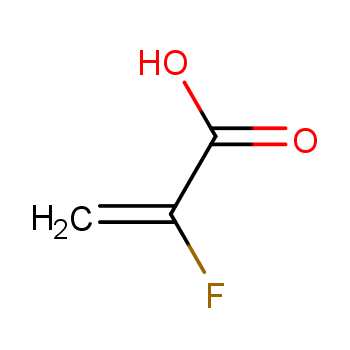
2-Fluoroacrylic acid (CAS 430-99-9, C3H3FO2, molecular weight 90.05), the alpha-fluoro substituted acrylic acid, is a fluorinated monomer and building block supplied in small volumes at high unit value. It is a low-melting crystalline solid, reported to melt in the low-50s °C with a boiling point around 170 °C, and it is strongly acidic and corrosive. Two properties dominate its commercial handling: the electron-withdrawing fluorine makes the double bond highly susceptible to polymerisation, and the acid function makes it corrosive to skin and to many metals.
Supply rests on two route classes. One hydrolyses a 2-fluoroacrylate ester obtained from fluorinated C3 chemistry; the other eliminates hydrogen halide from a saturated fluorinated propionic acid derivative. Both are run at small scale under inhibition, and both converge on the same finishing problem: managing the polymerisation inhibitor, excluding initiators and controlling residual fluoride. Because the product polymerises exothermically, thermal safety data — onset temperature, adiabatic temperature rise and self-accelerating polymerisation temperature — is the first document a serious buyer asks for.
Three questions shape 2026 sourcing. Compliance comes first: fluorine chemistry is under intense regulatory attention, and although a monofluorinated vinyl acid falls outside the per- and polyfluoroalkyl definitions used by OECD and by EPA's TSCA reporting rule, that position must be verified against current lists and proposals and documented for customers. Second is stability: inhibitor type and level, oxygen in the headspace, temperature and maximum package size determine whether a shipment arrives usable. Third is corrosive classification and controlled-temperature transport in limited packaging.
The molecule combines an acrylic double bond with a fluorine on the alpha carbon, and that combination is unusually reactive: fluorine withdraws electron density strongly, making the double bond electron-poor and susceptible to nucleophilic and radical attack, while the acid group activates it through conjugation and provides a site for salt formation. The practical consequences are a strong tendency to homopolymerise, a tendency to undergo Michael-type addition with amines and thiols, and acidity comparable to other halogenated acrylic acids, which is what drives the corrosive classification.
Both route classes are run with continuous inhibition, under controlled atmospheres, and with strict limits on batch size and thermal exposure, because the hazard profile is set by the polymerisation exotherm rather than by the chemistry of the individual steps.
Demand is small, specialised and project-driven, tied to fluoropolymer development, membrane and battery programmes and pharmaceutical discovery rather than to general industrial production. Two forces shape the 2026 picture. The first is the regulatory debate on per- and polyfluoroalkyl substances, which has raised customer due diligence even for molecules outside the definitions and has pushed some formulators to evaluate non-fluorinated alternatives. Suppliers therefore face longer qualification cycles but higher value per kilogram.
Capacity is concentrated where fluorochemical infrastructure exists. Japanese producers with integrated fluorine chemistry lead in specialty fluorinated monomers and set specifications for electronics applications. Chinese fluorochemical parks in Jiangxi, Zhejiang and Shandong supply research and development quantities and increasingly development-scale volumes. Flows move from Japan and China to Europe and North America in small packages rather than bulk.
Price reflects hazard management more than raw material cost. Small batch sizes, inhibition and inhibitor certification, controlled-temperature packaging, thermal safety testing and small-package dangerous-goods handling all add cost that does not scale down with volume. Material with a documented inhibitor level, a stated self-accelerating polymerisation temperature from adiabatic calorimetry, metal-ion data and a full certificate of analysis commands a large premium over catalogue material offering an assay and nothing else.
Two compliance layers must be handled separately. The first is the ordinary chemical-control layer: REACH registration or Only Representative coverage, active TSCA inventory status, correct CLP classification and a transport description derived from the actual safety data sheet. The second is the fluorine-specific layer, where the correct technical position is that a monofluorinated vinyl compound lies outside the current per- and polyfluoroalkyl definitions, but where the definitional landscape continues to move.
Fluorinated monomers attract scrutiny regardless of their regulatory status, because many customers apply fluorine screens that do not distinguish molecular structure. The defensible response is data: a structural statement showing the absence of perfluoroalkyl moieties, total organic fluorine and adsorbable organic fluorine results where requested, and transparent reporting of fluoride in effluent. Producers that volunteer this information shorten customer review cycles substantially, while those that simply assert an exemption are asked the same questions repeatedly.
Emissions are dominated by the fluorochemical chain upstream, by the energy used in small-batch distillation and crystallisation, and by controlled-temperature logistics. Because batch sizes are small, energy intensity per kilogram is high, so realistic levers are solvent and inhibitor recovery, heat integration on the finishing step and consolidated cold shipments. European customers increasingly request cradle-to-gate product carbon footprints aligned to ISO 14067.
Traceability expectations combine the ordinary — manufacturing site, route class, and solvent and reagent disclosure for ICH Q3C assessment where pharmaceutical customers are involved — with fluorine-specific items: the fluorination source, the inhibitor supply chain, and analysis of fluoride and adsorbable organic fluorine in effluent. Where the material supports electronics or battery programmes, customers also want metal-ion data and confirmation that no class 1 metals are used without declaration.
The logistics chain exists to prevent one event: a self-sustaining polymerisation during storage or transit. Everything else — package size, temperature control, inhibitor management, oxygen in the headspace and segregation from initiators — follows from that single risk, layered on top of ordinary corrosive-goods practice.
Classification follows the actual safety data sheet and thermal data. Many shipments move as UN 3261, corrosive solid acidic organic, Class 8; where polymerisation drives classification, the Class 4.1 polymerising-substance entries for stabilised solids apply, and if the measured self-accelerating polymerisation temperature requires it, transport must be temperature-controlled with control and emergency temperatures declared. Air freight under IATA imposes strict quantity and packing requirements and often excludes the material from passenger aircraft, so sea freight or specialist couriers are frequently the practical route.
Three moves determine success: make thermal safety a product feature, make the fluorine position explicit, and manage package size conservatively. All three cost less than a single polymerisation incident.
2-Fluoroacrylic acid is a high-value, high-hazard monomer whose commercial success depends on discipline rather than scale. It offers fluoropolymer performance, a reactive handle for medicinal and agrochemical chemistry, and entry into membrane and battery material programmes. It also polymerises readily and corrodes, so the supplier's real product is not the molecule itself but the assurance that it will arrive inhibited, cool and unreacted.
The 2026 outlook is positive but conditional. Battery, membrane and specialty coating programmes continue to create demand, and the regulatory debate on per- and polyfluoroalkyl substances keeps raising due-diligence expectations even for molecules outside the definitions. Suppliers who publish thermal safety data, document the fluorine position and ship conservatively sized, temperature-controlled packages will hold premium positions; those treating the material as an ordinary acrylic monomer will eventually ship a polymerised drum.
Powered by Guidechem
This white paper is exclusively compiled by the Guidechem Intelligence Team based on global customs data, regulatory databases, and industry research. Guidechem is a leading global B2B chemical platform, dedicated to connecting global buyers with verified, high-quality manufacturers.
Relying on Guidechem's extensive global database, we have mapped the core participants in the current global 2-Fluoroacrylic Acid supply chain:
Disclaimer: The content of this white paper is compiled based on public market data and regulatory information available as of 2026. Global chemical regulations are subject to dynamic adjustments. In actual export operations, enterprises must consult professional regulatory advisors or relevant competent authorities to obtain the latest compliance guidance.
|
 |
 |
|
 EN
 Agricultural News
 Food News
 Industrial News
 Cosmetic News
 Pharmaceutical News
 Science News


 2YRS


