
I. Executive Summary
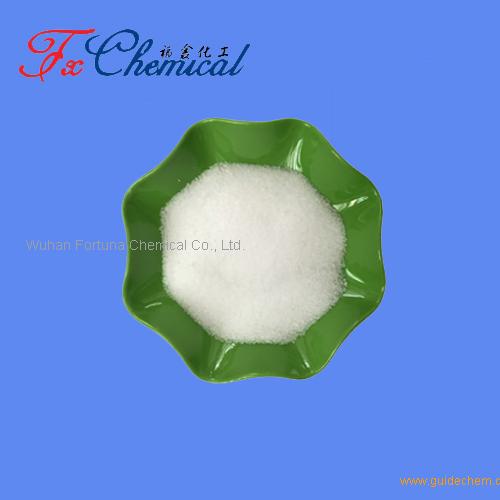
Dimethylolpropionic acid (DMPA, CAS 4767-03-7, C5H10O4, MW 134.13), systematically 2,2-bis(hydroxymethyl)propionic acid, is a white crystalline solid melting near 180-187 °C, freely soluble in water, dimethylformamide and N-methylpyrrolidone, and sparingly soluble in ketones and esters. Its structure carries two primary hydroxyls and one carboxylic acid on a quaternary carbon, giving a theoretical hydroxyl number near 836 mg KOH/g and an acid value near 418 mg KOH/g. That combination — difunctional reactivity plus a pendant neutralisable acid — is what makes it the dominant hydrophilic chain extender for self-emulsifying waterborne polyurethane dispersions.
Industrial manufacture begins with the base-catalysed hydroxymethylation of propionaldehyde with formaldehyde to give 2,2-bis(hydroxymethyl)propanal, followed either by oxidation to DMPA with hydrogen peroxide or oxygen, or by Cannizzaro disproportionation, which yields DMPA together with trimethylolethane. The same aldehyde intermediate hydrogenates to trimethylolethane, so DMPA and TME are co-routes sharing one intermediate. Route choice determines the residual aldehyde and formaldehyde profile, colour and ash, all of which matter more to dispersion formulators than nominal assay.
In 2026 the market is being pulled by waterborne conversion rather than by new chemistry. Decorative and industrial coatings, adhesives, textile and leather finishes and ink systems are moving from solvent-borne to waterborne under volatile organic compound regulation and corporate decarbonisation commitments, and each kilogram of waterborne polyurethane dispersion carries a small but non-negotiable loading of DMPA. Compliance work centres on REACH and TSCA status, dust and eye irritation classification, combustible-dust control, moisture-proof packaging and, increasingly, on bio-based or mass-balance certified grades.
II. Product Deep Dive: Molecular Mechanisms and Production Evolution
2.1 Physicochemical Properties and Mechanisms
The molecule's usefulness follows from three properties: the two primary hydroxyls react with isocyanate at rates comparable to conventional chain extenders, the carboxylic acid (pKa near 4.6) can be neutralised with tertiary amines to give a carboxylate, and the quaternary carbon prevents the acid from participating in side reactions that would build gel.
- Self-emulsification mechanism: When DMPA is built into the polyurethane backbone and its acid groups are neutralised, typically with triethylamine or dimethylaminoethanol before or during dispersion in water, the polymer becomes its own surfactant. The result is a stable, solvent-free anionic dispersion whose particle size, viscosity and film properties depend directly on DMPA loading and on the degree of neutralisation.
- Sensitivity to impurities: Formulators care about more than assay. Residual formaldehyde and free aldehyde consume amine neutraliser and cause odour and discolouration; iron and other metals catalyse oxidation and shift colour; water shifts stoichiometry in isocyanate reactions and affects hydroxyl number accuracy; and insoluble matter gives haze and filtration problems in dispersion manufacture. Specifications therefore pair assay with hydroxyl value, acid value, residual aldehyde, water, ash, iron and colour.
2.2 Synthesis and Manufacturing Technologies
All commercial routes pass through the same hydroxymethylated aldehyde intermediate; the differentiator is how that aldehyde is converted and how thoroughly the by-products are removed.
- Aldol hydroxymethylation and oxidation: Propionaldehyde is condensed with two equivalents of formaldehyde under base catalysis to give 2,2-bis(hydroxymethyl)propanal, which is then oxidised to the acid with hydrogen peroxide or with oxygen under catalytic conditions. Oxidation gives the cleanest acid profile and the highest yield of DMPA, but demands tight control of peroxide dosing, temperature and metal contamination, and generates a formaldehyde-containing aqueous stream that must be treated or recycled.
- Cannizzaro disproportionation and co-product integration: Under strongly alkaline conditions the aldehyde intermediate undergoes Cannizzaro disproportionation, producing dimethylolpropionic acid and trimethylolethane in the same vessel. This avoids an oxidant but halves the atom efficiency to DMPA and leaves a salt load, so it is attractive mainly where the producer has a market for trimethylolethane or where the shared intermediate plant already supplies both products. Purification relies on acidification, ion exchange, crystallisation and careful drying, since the acid is hygroscopic and retains water tenaciously.
2.3 Core Application Matrix
- Waterborne polyurethane dispersions: The core outlet. DMPA is incorporated as a hydrophilic chain extender in dispersions for coatings, adhesives, textile and leather finishes, glass fibre sizing and paper treatment, typically at a few percent of polymer solids. Buyers specify hydroxyl value, acid value and very low residual aldehyde, because these set neutralisation stoichiometry and dispersion stability.
- Resin modification, powder coatings and photopolymers: DMPA introduces acid functionality into polyester and alkyd resins, into carboxylated powder-coating binders and into hyperbranched and dendritic polymers, and serves as a building block for urethane acrylate and photoresist oligomers. In these uses colour, iron and insolubles frequently matter more than absolute assay.
- Adhesives and speciality formulations: Waterborne laminating and footwear adhesives absorb growing volumes as solvent-borne systems are phased out, and the same neutralisable-acid chemistry supports pigment dispersants, emulsifiers and neutralising-agent-free systems where low volatile amine content is required.
III. Global Market Supply-Demand Landscape and Export Trends
3.1 Demand Drivers and Market Shifts
Waterborne conversion is the single dominant driver. Volatile organic compound limits under the EU Decopaint framework, United States state and regional rules, and Chinese national standards for coatings and adhesives continue to move formulators away from solvent-borne polyurethanes, and every converted formulation adds structural demand for DMPA. Secondary drivers include footwear, automotive interior and textile finishing demand in Asia, and the shift towards dispersions with lower co-solvent content, which increases DMPA loading per kilogram of polymer.
3.2 Capacity Distribution and Export Flows
Dedicated DMPA capacity is concentrated in a small number of Western plants and a growing East Asian base. European production is anchored in Scandinavia and Germany, North American supply by speciality chemical producers, and Chinese capacity in the polyol and coating-resin corridor of Shandong, Jiangsu and Zhejiang, where propionaldehyde and formaldehyde are available at scale. Bulk material moves in 25 kg bags and 500-1000 kg big bags to dispersion plants in Europe, North America and increasingly South and Southeast Asia.
3.3 Market Bifurcation and Pricing Dynamics
Pricing tracks propionaldehyde and formaldehyde, both petrochemical and energy-sensitive, but the market is not commoditised. Standard grade competes on hydroxyl value and price; low-aldehyde, low-colour and low-metal grades for high-clarity dispersions, and mass-balance certified bio-based grades, carry clear premiums. Because DMPA is a small percentage of formulation cost but a large determinant of dispersion quality, formulators qualify conservatively and switch suppliers slowly, which makes documented consistency more valuable than spot discounting.
IV. In-depth Analysis of Global Compliance and Regulatory Barriers
DMPA itself is a comparatively benign industrial organic acid, and its regulatory burden sits less on the substance than on what its customers must prove: registration coverage, classification consistency, industrial hygiene for dust, and downstream clearances for the articles made from it.
4.1 European Market: REACH, CLP, and Sector-Specific Directives
- REACH registration and CLP classification: The substance must be covered by a REACH registration reaching the importer's tonnage band, with an extended safety data sheet where classification triggers one. Practically, suppliers classify it for serious eye irritation and often skin irritation, and dust exposure is the exposure route of concern; the classification used must be consistent across the safety data sheet, label and customs documentation, and verified against the latest harmonised entries.
- Downstream product rules: DMPA's customers face their own gates. Volatile organic compound limits under the Decopaint framework and national rules, the EU microplastics restriction adopted in 2023 which has prompted dispersion producers to re-examine particle definitions and derogations, food-contact clearances under Regulation (EU) 10/2011 for coatings that contact food, and toy safety and packaging rules all flow back to the chain extender through declarations and migration testing. DMPA has no automatic clearance; each use must be checked against the relevant positive list.
4.2 North American Market: TSCA, EPA, and FDA Regulations
- TSCA inventory and reporting: The substance is listed on the TSCA inventory; importers should confirm active designation for their use and check Chemical Data Reporting obligations for the relevant cycle. It is not a per- or polyfluoroalkyl substance and is not subject to PFAS reporting, which is a meaningful commercial advantage over fluorinated surfactants used in the same formulations.
- VOC rules and food-contact clearance: Coatings and adhesives sold into the United States must meet state and regional volatile organic compound limits, including California air district rules and OTC model rules, and formulators therefore document low co-solvent and low residual formaldehyde content. Where a dispersion contacts food, clearance under FDA food additive regulations such as the resinous and polymeric coatings provisions must be confirmed for the specific polymer, since the chain extender is not cleared in isolation.
4.3 The Critical Hurdle: Quality Control and Safety Limits
Compliance Warning: The recurring failures in this trade are stoichiometric and hygienic rather than regulatory. First, hydroxyl value and water: because DMPA is dosed to a precise isocyanate stoichiometry, an inaccurate hydroxyl number or absorbed moisture silently changes the NCO/OH ratio and produces off-specification dispersions; hydroxyl value, acid value and water must be certified per lot and packaging must protect against moisture uptake. Second, residual formaldehyde and free aldehyde: they consume amine neutraliser, generate odour and can breach downstream formaldehyde emission limits for coatings, panels and textiles, so a low, certified residual aldehyde limit is essential. Third, dust: the product is an irritant, combustible dust, and requires dust hazard analysis, explosion prevention under ATEX or NFPA 652, and exposure control at every transfer point. Contracts should fix all three, plus colour, iron, ash and insolubles, with change control over any route change between oxidation and Cannizzaro processing.
V. Green Trade Barriers and ESG in Manufacturing
DMPA benefits from being an enabling chemical for lower-emission coatings, but it is still a petrochemical-derived molecule made from propionaldehyde and formaldehyde, and customers now ask both questions at once.
5.1 Carbon Footprint and Circular Economy
Cradle-to-gate emissions are driven by the petrochemical feedstocks and by energy for concentration, crystallisation and drying, with hydrogen peroxide oxidation adding an upstream burden that Cannizzaro processing avoids at the cost of salt load. Producers with heat integration, mother-liquor recycling and formaldehyde recovery hold a real advantage. The larger story is use-phase: waterborne polyurethane dispersions enabled by DMPA displace solvent-borne systems, so a product-level carbon assessment under ISO 14067 or the GHG Protocol increasingly credits the customer's Scope 1 and Scope 3 reduction.
5.2 Sustainable Sourcing and Traceability
Bio-based DMPA is the active frontier: routes using fermentation-derived propionic acid or propionaldehyde, or bio-based formaldehyde, are being qualified, usually sold on a mass-balance basis certified under schemes such as ISCC PLUS rather than as physically segregated product. Buyers should insist on a clear statement of whether a grade is physically bio-based or mass-balance allocated, because the two support different downstream claims. ISO 9001 and ISO 14001 certification, formaldehyde emission data and, in Europe, alignment with packaging and end-of-life policy expectations round out the file.
VI. Supply Chain Resilience and Export Logistics
The substance is not regulated as a dangerous good for transport, and the operational risks are moisture uptake, caking, dust generation and contamination. Shipments fail far more often through poor bag integrity and humid warehouses than through chemistry.
6.1 Packaging Standards and Moisture/Contamination Control
- Moisture barrier and packaging format: Standard export packing is a polyethylene liner inside a multiwall paper sack or a foil-laminate bag within a carton, palletised and stretch-wrapped, with bulk shipments in big bags with intact liners. Because the acid is hygroscopic, low-humidity filling, intact seals, desiccant where appropriate and a certified water value at release are the operative controls.
- Dust and contamination control: Fine dust is both an irritant and a combustible-dust hazard, so transfer points need local exhaust, antistatic and grounded equipment, and housekeeping regimes consistent with NFPA 652 or ATEX guidance. Segregation from isocyanates, amines and strong oxidisers during storage and transport prevents both contamination and uncontrolled reaction.
6.2 Dangerous Goods Identification and Transit Protocols
Consignments normally travel as non-hazardous cargo under IMDG, ADR and IATA rules, but that conclusion must be confirmed against the current safety data sheet and classification rather than assumed, since particle size and formulation can affect dust hazard assessments. Transit is ambient and dry: sealed, ventilated containers away from water ingress, no deck stowage, palletised and wrapped to prevent bag abrasion, with arrival inspection of seal integrity and water value. Where material is transferred into silos at destination, the receiving site should apply the same dust-hazard controls as the producer.
VII. Enterprise Global Expansion Strategy Guide
Three moves define competitive position in this family.
- Sell formulation certainty: Certify hydroxyl value, acid value, water, residual aldehyde and formaldehyde, colour, iron and insolubles per lot, and publish the methods. Because formulators qualify slowly and value reproducibility, a supplier that removes stoichiometric uncertainty wins business that price competition cannot.
- Build a bio-based and low-emission tier: Develop mass-balance certified grades with auditable chain-of-custody, state clearly whether the allocation is physical or book-and-claim, and pair the offer with formaldehyde emission and product carbon footprint data. This is where European and brand-owner demand is heading.
- Industrialise dust and hygiene management: Complete a dust hazard analysis, apply NFPA 652 or ATEX controls, and document occupational hygiene and explosion prevention, then maintain REACH and TSCA coverage and downstream declarations for food-contact, toy and packaging uses. Compliance infrastructure is what converts a regional producer into a qualified global supplier.
VIII. Conclusion
Dimethylolpropionic acid is a small-volume molecule with disproportionate leverage over the waterborne coatings and adhesives transition. Its difunctional-plus-acid architecture is not easily replaced, demand is structurally linked to volatile organic compound regulation rather than to fashion, and the substitution options — dimethylolbutyric acid, sulfonate diols and non-ionic hydrophilic polyethers — compete on niches rather than displacing it broadly. Capacity remains concentrated, and the competitive frontier has moved from price to consistency, low aldehyde and certified bio-based content.
For buyers, the working guidance is to contract on function rather than on assay: fix hydroxyl value, acid value, water and residual aldehyde with validated methods and change control, confirm REACH and TSCA coverage for the importing entity, and require clear statements on bio-based allocation. For suppliers, the opportunity is to become the qualified reference source for waterborne formulators — an outcome decided by analytical rigour, dust and hygiene discipline and honest sustainability documentation rather than by tonnage.
IX. Industry Resource Connection and Supplier Ecosystem
Powered by Guidechem
This white paper is exclusively compiled by the Guidechem Intelligence Team based on global customs data, regulatory databases, and industry research. Guidechem is a leading global B2B chemical platform, dedicated to connecting global buyers with verified, high-quality manufacturers.
Relying on Guidechem's extensive global database, we have mapped the core participants in the current global Dimethylolpropionic acid (DMPA) supply chain:
- Northern Europe: Speciality Polyol Producers: Scandinavian and German producers operate dedicated, integrated dimethylolpropionic acid plants supplying global dispersion manufacturers, with the strongest positions in low-aldehyde, low-colour and bio-based mass-balance grades and in long-term qualification agreements.
- North America: Speciality Chemical and Coating Resin Suppliers: US producers and resin companies serve domestic waterborne coatings, adhesives and photopolymer demand, combining manufacture with technical service, regional warehousing and regulatory support for state volatile organic compound rules.
- East China: Polyol and Coating Resin Corridor: Shandong, Jiangsu and Zhejiang host producers with captive propionaldehyde and formaldehyde, supplying domestic dispersion plants and exporting standard grade competitively. Quality convergence in residual aldehyde and colour is the current investment theme in this cluster.
Disclaimer: The content of this white paper is compiled based on public market data and regulatory information available as of 2026. Global chemical regulations are subject to dynamic adjustments. In actual export operations, enterprises must consult professional regulatory advisors or relevant competent authorities to obtain the latest compliance guidance.



 EN
 Agricultural News
 Food News
 Industrial News
 Cosmetic News
 Pharmaceutical News
 Science News


 3YRS


