-
We detected your language preference as English. Would you like to switch to the English version for a better experience?
Switch to English
Stay here


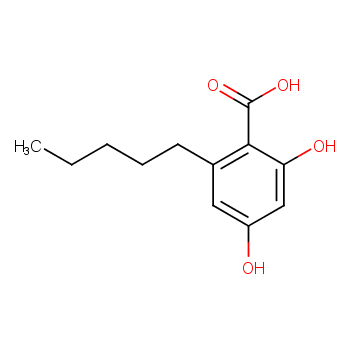
Olivetolic acid (CAS 491-72-5), systematically 2,4-dihydroxy-6-pentylbenzoic acid, is a resorcylic acid derivative of formula C12H16O4 and molecular weight approximately 224.3 Da, carrying a dihydroxybenzoic acid core substituted with an n-pentyl chain. Chemically it is unremarkable among alkylated aromatic acids; legally it is exceptional, because it occupies a defined position in the cannabinoid biosynthetic pathway. In Cannabis sativa, a type III polyketide synthase together with a cyclase assembles the resorcylic acid skeleton from a short-chain acyl-CoA starter and malonyl-CoA units, and the resulting acid is the substrate for the prenyltransferase step that generates cannabigerolic acid — the branch-point intermediate from which the major plant cannabinoid acids derive. That position makes it a cannabinoid-pathway-related compound in the eyes of regulators, not another fine-chemical intermediate.
The practical consequence is that this is not a commodity trade. Legitimate commerce is confined to licensed channels: licensed research institutions and universities, licensed industrial hemp and cannabinoid programmes, registered analytical and reference-standard laboratories, and licensed precursor manufacturers operating under permit. Every transaction must be preceded by destination-country legality verification, buyer qualification and, where applicable, import and export licences. Suppliers who treat this molecule like a catalogue item risk seizure, prosecution and loss of market access. This white paper discusses chemistry only at the level of route class and purification strategy: it provides no synthetic procedure, no quantities, no yields, no equipment list and no precursor sourcing guidance, and it is not a manufacturing manual. The material must never be supplied for any unlawful purpose.
The compliance perimeter is unusually wide. Cannabis, cannabis resin and cannabis extracts and tinctures are controlled internationally under the 1961 Single Convention on Narcotic Drugs as amended, with tetrahydrocannabinol itself scheduled, while national implementations diverge sharply — the United States operates a hemp exclusion keyed to a Δ9-THC threshold with state programmes layered on top, European member states apply national narcotics legislation supplemented by EU drug-precursor controls, and China licenses industrial hemp provincially while treating cannabinoid intoxicants as controlled narcotics. Overlaying all this are ordinary chemical obligations: REACH, CLP, TSCA and GHS. Compliance, not chemistry, determines whether a shipment can lawfully move.
The molecule combines three functional elements that define its handling behaviour: a resorcinol-type dihydroxy aromatic ring, a carboxylic acid ortho to one phenolic hydroxyl, and a lipophilic pentyl substituent. The ortho-hydroxy acid motif supports strong intramolecular hydrogen bonding, influencing acidity, solubility and chelation; the phenol pair makes the ring electron-rich and oxidation-sensitive; the alkyl chain confers solubility in moderately polar organic media while limiting water solubility. For the buyer the reading is straightforward: a phenolic aromatic acid that discolours on oxidation and decarboxylates under heat, so cool, dark, inert-handled storage is a quality requirement rather than a precaution.
Two route classes are discussed in the literature and in licensed industrial practice, and the choice between them is primarily a question of licensing, feedstock legitimacy and capital rather than of chemistry. Both are described here only at the level of principle; no quantities, yields, conditions, equipment specifications or procurement guidance are given, and any licensed operator must develop and validate its own process under its own permits and quality system.
Demand is a function of law, not of industrial output. Where a jurisdiction licenses hemp cultivation, cannabinoid research or pharmaceutical cannabinoid development, licensed laboratories and research groups consume pathway-related reference materials; where it does not, lawful demand is effectively zero. Three trends follow. First, demand is geographically discontinuous — one legislative change can create or extinguish an entire customer segment. Second, buyers consolidate toward audited, licensed suppliers because an unverifiable supply chain is itself a legal liability. Third, research interest has shifted toward engineered microbial production as an alternative to agricultural extraction, raising demand for characterised analytical standards and licensing expectations together.
Lawful capacity exists only where it is licensed. North American supply is concentrated in federally or state-licensed hemp and cannabis research programmes in the United States and in Canada's federally licensed system, together with DEA-registered or equivalent laboratories. In Europe, capacity sits with licensed operators in member states whose national narcotics law permits supervised cannabis or hemp research — the Netherlands, Czechia, Switzerland, Portugal and Germany among them — supported by established reference-standard houses. China contributes provincially licensed industrial hemp systems in Yunnan and Heilongjiang under cultivation and processing licences and THC limits, alongside a fine-chemical base whose participation in this chemistry is gated by Chinese controlled-substance rules and destination-country legality. There are no ordinary open-market export flows; movement is permit-based and documented.
The market divides into two almost unrelated worlds. Reference-standard quantities — milligram to gram scale — are priced on characterisation cost, uncertainty budgets, accreditation and stability programmes, sold with a certificate of analysis underpinned by quantitative NMR or mass-balance assignment. Licensed programme quantities price on a different basis: licensing, legal review, insurance, security, chain-of-custody administration and specialised testing dominate, with the chemical a minor line item. In both worlds the price of non-compliance dwarfs the price of the molecule, which is why responsible suppliers quote only after legality is established.
Compliance here is not a documentation exercise appended to a transaction; it is the precondition for the transaction. Before quoting, the exporter must establish that the substance and its intended end use are lawful in the destination jurisdiction, that the buyer holds the licences required to receive it, and that precursor-control obligations, where applicable, are satisfied. Shipment without that foundation is an unlawful act, not a remediable lapse.
For a controlled-substance-adjacent compound, ESG begins with legality and transparency. Environmental performance matters to licensed customers and their investors, but a supplier with excellent energy metrics and an unverifiable chain of custody is not a viable counterparty; a licensed, auditable supplier with modest environmental performance is.
The two route classes have materially different footprints. Fermentation-based production shifts impact toward sterilisation energy, downstream separation and aqueous waste treatment, while chemical routes concentrate impact in solvent use, chromatographic purification and solvent disposal. In both cases purification dominates: preparative chromatography is solvent- and energy-intensive, and solvent recovery by distillation with a shift toward crystallisation-driven purification usually delivers the largest reduction in process mass intensity. Licensed facilities should be able to report Scope 1 and 2 emissions, solvent recovery rates and waste disposition routes, and demonstrate that no process stream leaves the site without documented treatment or licensed destruction.
Traceability is the substance of ESG here. Licensed operators maintain batch genealogy linking starting materials, process records, analytical results and disposition, and make it available to auditors and competent authorities on request. ISO 9001 and ISO 14001 provide the management-system frame; reference-material producers align to ISO 17034 and accredited laboratories to ISO 17025, while licensed agricultural programmes add pesticide, heavy-metal and microbial scrutiny. Documented destruction or return of unused material, access control and incident reporting complete the programme.
Logistics for this material are designed around custody rather than speed. Because a diverted or undocumented parcel is a legal event, packaging, carrier selection and documentation are chosen to make tampering evident, transfers auditable and paperwork inseparable from the goods.
The substance is not typically regulated as a dangerous good for transport, but that determination must be documented per consignment against the current IMDG Code, ADR and IATA DGR, supported by an SDS reflecting the best available data, since harmonised Annex VI entries are unavailable for many pathway-related compounds. Carrier selection matters more: general courier channels are inappropriate where licensed handling is required, and transhipment through jurisdictions where the substance or its relatives are controlled should be avoided. Transit should be direct, temperature-monitored where stability data require it, and covered by contingency arrangements providing for return or licensed destruction rather than local disposal.
Expansion in this field is measured in licences and approvals, not in customers won. Three disciplines determine whether a supplier remains in the market.
Olivetolic acid is a chemically ordinary resorcylic acid occupying an extraordinary legal position. Because it sits on the cannabinoid biosynthetic pathway, it attracts controlled-substance authorities, precursor regulators and licensing bodies in most jurisdictions; because enforcement and licensing differ sharply between — and often within — countries, no assumption about one market transfers safely to another. The survivable posture is to treat every enquiry as a compliance case until proven otherwise, and to decline business that cannot be fully documented.
For licensed participants, the opportunity is real and durable: research into cannabinoid biosynthesis, engineered microbial production and accredited analytical testing all require well-characterised, lawfully supplied material, and they reward suppliers combining rigorous characterisation with uncompromising licensing discipline. That combination — never scale-up instruction, never informal channels, never an undocumented parcel — is the only defensible way to operate here.
Powered by Guidechem
This white paper is exclusively compiled by the Guidechem Intelligence Team based on global customs data, regulatory databases, and industry research. Guidechem is a leading global B2B chemical platform, dedicated to connecting global buyers with verified, high-quality manufacturers.
Relying on Guidechem's extensive global database, we have mapped the core participants in the current global Olivetolic acid supply chain:
Disclaimer: The content of this white paper is compiled based on public market data and regulatory information available as of 2026. Global chemical regulations are subject to dynamic adjustments. In actual export operations, enterprises must consult professional regulatory advisors or relevant competent authorities to obtain the latest compliance guidance.
|
 |
 |
 |
 EN
 Agricultural News
 Food News
 Industrial News
 Cosmetic News
 Pharmaceutical News
 Science News


 11YRS


