Guideview >  Articles >  Trends  > Kojic acid:Exports & Compliance White Paper 2026

Kojic acid:Exports & Compliance White Paper 2026

A 2026 guide to Kojic acid (CAS 501-30-4) sourcing. Cosmetic-grade brightening ingredient with purity documentation, regulatory awareness and reliable supply for global skincare formulators. Isabel5 MIN READOctober 8, 2026
Kojic acid White Paper

I. Executive Summary

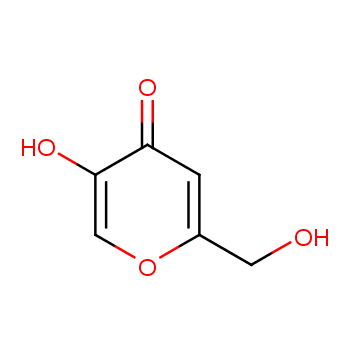
Kojic acid (CAS 501-30-4), chemically 5-hydroxy-2-(hydroxymethyl)-4H-pyran-4-one, is a gamma-pyrone produced industrially by aerobic carbohydrate fermentation with Aspergillus oryzae strains. With a molecular formula of C6H6O4 and a molecular weight of 142.11, it serves as a tyrosinase-inhibiting depigmenting active for cosmetics and as an antibrowning agent in selected foods.

The competitive position of kojic acid has strengthened as formulators move away from hydroquinone, which the European Union prohibited in cosmetics and the United States removed from the over-the-counter skin-lightening monograph. Demand is now driven by Asia-Pacific beauty and dermocosmetic markets, by Latin American and Middle Eastern brightening portfolios, and by fresh-cut produce processors seeking enzymatic-browning control. Substitution pressure remains real, however, from niacinamide, alpha-arbutin, tranexamic acid, ascorbyl derivatives and newer resorcinol structures.

This white paper analyses the chelation-based depigmenting mechanism, fermentation and downstream processing routes, and the application matrix spanning cosmetics, food and technical uses. It then examines regional capacity across China, Japan, Europe and North America, and reviews the compliance perimeter formed by REACH, CLP, the EU Cosmetics Regulation, MoCRA, TSCA and Asia-Pacific inventory rules. Quality thresholds, ESG expectations, packaging and transit requirements, and a staged global expansion playbook are presented in the following sections.

II. Product Deep Dive: Molecular Mechanisms and Production Evolution

2.1 Physicochemical Properties and Mechanisms

Kojic acid is a white to slightly yellow crystalline solid melting near 152 to 155 °C, moderately soluble in cold water and freely soluble in hot water, ethanol and ethyl acetate. Its 5-hydroxyl group behaves as a weak acid with a pKa close to 8, giving pH-dependent speciation and chelation behaviour across typical formulation ranges. The molecule is hydrophilic, poorly lipophilic and therefore shows limited passive skin penetration, which motivates esterification for cosmetic use. It is sensitive to light, heat and alkaline pH, and it forms intensely coloured complexes with ferric iron.

  • Tyrosinase Inhibition and Depigmentation: The enolic hydroxyl and the adjacent pyrone carbonyl chelate the binuclear copper centre of tyrosinase, suppressing both the monophenolase and diphenolase steps that convert L-tyrosine through L-DOPA to dopaquinone. Interrupting dopaquinone formation reduces downstream eumelanin and pheomelanin synthesis in the melanosome, producing gradual visible lightening over weeks of use.
  • Chelation, Stability and Formulation Consequences: Strong affinity for ferric and other transition-metal ions is chemically useful but cosmetically troublesome, because trace iron produces yellow to brown ferric kojate discoloration in finished formulations. Stability is therefore managed by sequestering metals with EDTA or etidronic acid, holding pH mildly acidic, adding antioxidants, and protecting the product from light and oxygen. Lipophilic derivatives, notably kojic dipalmitate, address both the penetration limit and the stability problem in oil-phase systems.

2.2 Synthesis and Manufacturing Technologies

Commercial kojic acid is overwhelmingly fermentation-derived, since the pyrone is a natural overflow metabolite of Aspergillus and related fungi grown on simple sugars. Production economics depend on strain productivity, substrate cost, aeration energy and the yield losses incurred during decolorisation and crystallisation. Reported chemical routes based on pyrone ring construction remain uncompetitive on cost and impurity profile.

  • Submerged Fermentation and Strain Development: Production uses aerobic submerged culture on glucose, sucrose, molasses or starch hydrolysate, with controlled pH, dissolved oxygen and carbon-to-nitrogen ratio to favour pyrone accumulation over biomass and organic acid byproducts. Productivity is raised through classical mutagenesis and selection, and where regulatory markets permit, through targeted pathway engineering, with non-toxigenic and non-recombinant status carefully documented for EU customers.
  • Downstream Recovery and Derivative Manufacture: Broth is clarified by filtration or centrifugation, decolorised with activated carbon, passed through chelating or ion-exchange media to strip metals, then concentrated under vacuum and crystallised from water or aqueous ethanol. Recrystallisation and low-temperature vacuum drying deliver cosmetic grade, while mother-liquor recovery improves overall yield.

2.3 Core Application Matrix

  • Cosmetic Depigmenting Systems: Kojic acid is formulated into serums, creams, lotions, masks, soaps and brightening cleansers, typically at fractions of a percent to about one percent in leave-on products. It is frequently combined with niacinamide, alpha-arbutin, tranexamic acid or vitamin C derivatives to attack melanogenesis at several points.
  • Food Antibrowning and Colour Retention: The compound inhibits polyphenol oxidase, and is used in certain markets to limit enzymatic browning in cut fruit and vegetables and to retard melanosis in crustaceans. Authorisation is jurisdiction-specific, so processors must confirm status before shipment rather than assume global acceptance.
  • Technical and Fine-Chemical Uses: Kojic acid serves as a metal-chelating reagent, a corrosion-inhibiting additive and a building block for heterocycles used in pharmaceutical and agrochemical synthesis. It is incorporated into chelating polymers and active packaging films where metal control and antioxidant behaviour are desired.

III. Global Market Supply-Demand Landscape and Export Trends

3.1 Demand Drivers and Market Shifts

Structural demand growth comes from Asia-Pacific beauty markets, where brightening remains a core category, and from the global retreat from hydroquinone in cosmetic formulations. Regulatory action on hydroquinone in both the European Union and the United States redirected formulation budgets toward alternatives, and kojic acid benefits from its long safety record and low cost.

3.2 Capacity Distribution and Export Flows

Fermentation capacity is concentrated in China, where corn and cassava-derived glucose supply supports large, cost-competitive plants, with legacy high-purity production retained in Japan. Europe and North America hold limited primary capacity and rely on imports, concentrating their activity in repackaging, quality control, formulation and distribution. Export flows therefore run from East Asia to European, North American and Indian cosmetic manufacturers, and increasingly to Latin American and Middle Eastern formulators.

3.3 Market Bifurcation and Pricing Dynamics

The market splits between technical grade, sold on assay alone, and cosmetic or food grade, sold on appearance, trace metals, microbial and mycotoxin documentation. Grade premiums reflect the cost of additional carbon treatment, recrystallisation and testing rather than any change in chemistry. Pricing follows glucose and energy input costs, since aeration, vacuum concentration and drying dominate the conversion cost, and it softens when several producers commission capacity in the same cycle.

IV. In-depth Analysis of Global Compliance and Regulatory Barriers

Kojic acid sits at the intersection of three regimes: general chemical control, cosmetic ingredient rules and food additive authorisation. Cosmetic use is the dominant commercial channel, and it is governed in the European Union by Regulation 1223/2009 with scientific assessment by the consumer safety committee, and in the United States by the Modernization of Cosmetics Regulation Act. Food uses are far more restricted, since the substance is absent from major food additive lists. Asia-Pacific markets add inventory, registration and labelling requirements that vary country by country.

4.1 European Market: REACH, CLP, and Sector-Specific Directives

  • REACH Registration and CLP Classification: Kojic acid is a phase-in substance manufactured or imported above one tonne per year, so registration with a tonnage-scaled data package is required, usually through an only representative for non-EU producers. Notifications in the ECHA classification and labelling inventory include suspected carcinogenicity and reproductive toxicity endpoints among member-state submissions, so self-classification must be reasoned and documented rather than assumed.
  • Cosmetics and Food Authorisation: Under Regulation 1223/2009 the ingredient is permitted subject to the general safety requirement, with a responsible person, product information file, CPNP notification, ISO 22716 manufacturing standard and substantiated claims. The consumer safety committee has assessed kojic acid and supported leave-on use at concentrations up to approximately one percent, which formulators should verify against the current opinion before fixing concentrations. Food use is a separate question, as the substance is not included in the Union list of authorised food additives under Regulation 1333/2008.

4.2 North American Market: TSCA, EPA, and FDA Regulations

  • TSCA and EPA Status: The substance is listed as active on the TSCA inventory for general commercial use, and importers should retain supplier confirmation of inventory status with their compliance records. Any claim of antimicrobial action on inanimate surfaces would move the product toward pesticide registration under FIFRA and should be avoided in cosmetic positioning.
  • FDA and MoCRA Cosmetic Obligations: Kojic acid may be used as a cosmetic ingredient without FDA pre-approval, but MoCRA now requires facility registration, product listing, adequate safety substantiation, serious adverse event reporting and compliant labelling. Claims must remain cosmetic in character, since disease or drug-type claims would render the product an unapproved drug. For food applications, the substance is not an approved food additive in the United States, so antibrowning use is not a lawful commercial channel there.

4.3 The Critical Hurdle: Quality Control and Safety Limits

Compliance Warning: Cosmetic and food grade specifications must be agreed before ordering and verified on receipt: assay of at least 99 percent by HPLC, loss on drying, sulfated ash, melting range, infrared identity, and tight limits on lead, arsenic, cadmium, mercury and especially iron, since ferric complexes discolour finished formulations immediately. Because the product is fermentation-derived, require documented evidence of a non-toxigenic production strain plus absence testing for aflatoxin and ochratoxin, together with microbial limits for total aerobic count, yeasts and moulds and specified pathogens. Verify residual solvent content where ethanol recrystallisation is used, and check appearance against a colour reference, because a pale yellow tint usually signals oxidation or metal contamination.

V. Green Trade Barriers and ESG in Manufacturing

Fermentation gives kojic acid a favourable bio-based narrative, but the downstream sequence of clarification, decolourisation, vacuum concentration and drying consumes substantial steam and power and generates high-COD effluent. Corporate buyers now request quantified environmental data during vendor qualification rather than accepting generic sustainability language. Certification to ISO 14001 and ISO 50001, and EcoVadis-style assessment scores, increasingly gate supplier approval in European cosmetic supply chains.

5.1 Carbon Footprint and Circular Economy

Emissions are split between agricultural Scope 3 emissions from glucose feedstock, Scope 1 steam generation, and Scope 2 electricity for aeration, refrigeration and drying. Mechanical vapour recompression, multi-effect evaporation and heat recovery cut the largest share of energy demand, while higher-yield strains reduce substrate and effluent load per kilogram. Spent biomass and clarified broth can be routed to anaerobic digestion with biogas recovery, converting a waste cost into circular energy. Credible reporting should present Scope 1, 2 and 3 figures against a defined baseline using ISO 14067 product carbon footprint methodology.

5.2 Sustainable Sourcing and Traceability

Traceability must extend from feedstock origin and grade through strain provenance, fermentation batch and crystallisation lot, with each link recorded in a batch dossier. Buyers should require confirmation that strain improvement was achieved without recombinant modification where EU customers demand it, alongside GMO-free, BSE/TSE-free, allergen, residual solvent and nanomaterial-free declarations. Voluntary certifications relevant to cosmetic buyers include natural-origin indexing under ISO 16128 and, where applicable, COSMOS or equivalent natural-cosmetic approval plus Halal and Kosher certification.

VI. Supply Chain Resilience and Export Logistics

Resilience planning should account for feedstock price exposure, campaign-based fermentation scheduling and the seasonal energy costs that affect drying. Buyers are advised to qualify at least two producers in different regions and to hold safety stock covering a full production cycle. Contractual specifications should mandate change-control notification for strain and process modifications.

6.1 Packaging Standards and Moisture/Contamination Control

  • Barrier Packaging and Metal Exclusion: Material should be packed in food-contact polyethylene liners inside fibre drums or aluminium foil bags, sealed with desiccant and, for premium lots, under nitrogen. Contact with carbon steel, iron or copper surfaces must be avoided throughout filling, since ferric complexes discolour the powder irreversibly. Warehousing should hold 15 to 25 °C with relative humidity below 60 percent and protection from light.
  • Grade Segregation and Labelling: Dedicated filling lines for cosmetic and food grades prevent cross-contamination from technical material and from metal-bearing equipment. Each package should carry grade, lot number, production date, retest date, storage conditions and a certificate reference traceable to the batch record.

6.2 Dangerous Goods Identification and Transit Protocols

Kojic acid is not assigned a UN number under GHS-based transport classification and generally ships as general cargo by sea, air, road and rail. Handlers should nonetheless assess combustible-dust behaviour for fine powder under NFPA 652 or ATEX guidance, since organic powders can form explosive atmospheres during conveying and filling. Ocean containers should be lined or palletised with desiccant and moisture barriers, because condensation during tropical transits causes caking and colour drift. Documentation should pair the commercial invoice and correct HS classification with a certificate of analysis, safety data sheet and grade declaration

VII. Enterprise Global Expansion Strategy Guide

Successful expansion depends on moving from commodity fermentation output toward certified, application-supported ingredient supply. Derivative portfolios offer the clearest margin uplift, since stability and penetration problems are the customer's principal pain points. The priorities below reflect observed qualification behaviour in the three major regions.

  1. Certify for Premium Channels: Implement ISO 9001, ISO 14001 and ISO 22716, and assemble cosmetic dossiers covering purity, trace metals, mycotoxins, microbial limits and stability data. Add natural-origin indexing and, where relevant, COSMOS, Halal and Kosher certification to unlock European and Middle Eastern formulators. Certification converts a commodity quotation into a qualified vendor listing.
  2. Move Up the Value Chain: Develop kojic dipalmitate and other lipophilic derivatives, ideally by solvent-free or enzymatic esterification, and supply formulation guidance on chelation, pH and light protection. Offering stabilised blends and application data raises switching costs and defends against substitution by rival actives. Technical service capability is now a decisive differentiator in brightening portfolios.
  3. Regionalise Market Entry and Inventory: In Europe, appoint a responsible person, complete CPNP notification and align concentrations with the current safety opinion. In the United States, register facilities under MoCRA, maintain product listings and discipline claims. Across Asia-Pacific, confirm inventory listing and cosmetic notification in China, Japan, Korea and India, and support entry with regional warehousing.

VIII. Conclusion

Kojic acid remains commercially relevant in 2026 because it combines a well-characterised tyrosinase mechanism, fermentation-based economics and a long regulatory record at a time when hydroquinone has receded. Its weaknesses are equally well defined: metal-induced discoloration, limited skin penetration and formulation instability. Producers who solve those weaknesses through derivative chemistry and application support capture disproportionate value. Those who sell only assay and price will remain exposed to substitution and margin compression.

The decisive capabilities are therefore purification consistency, heavy-metal and mycotoxin control, quantified carbon reporting and destination-specific cosmetic compliance. Companies that document Scope 1 to 3 emissions, maintain chain-of-custody records and hold current regulatory dossiers will qualify fastest with multinational buyers. Expect continued bifurcation between technical and cosmetic grades as documentation standards tighten.

IX. Industry Resource Connection and Supplier Ecosystem

Powered by Guidechem

This white paper is exclusively compiled by the Guidechem Intelligence Team based on global customs data, regulatory databases, and industry research. Guidechem is a leading global B2B chemical platform, dedicated to connecting global buyers with verified, high-quality manufacturers.

Guidechem Global Kojic acid Supplier Ecosystem List

Relying on Guidechem's extensive global database, we have mapped the core participants in the current global Kojic acid supply chain:

  • North America Ecosystem: This tier is primarily import-dependent, concentrating on distribution, repackaging, analytical release and formulation support for cosmetic and food customers. Participants operate under MoCRA facility registration and product listing obligations and apply strict heavy-metal and colour specifications.
  • Europe Ecosystem: European participants emphasise REACH and CLP compliance, ISO 22716 manufacturing and SCCS-aligned formulation practice, supported by limited local purification and repackaging. Buyers apply rigorous traceability, carbon disclosure and chain-of-custody requirements during qualification.
  • Asia-Pacific and China Ecosystem: This tier holds the bulk of fermentation capacity, supported by corn and cassava-based glucose supply, skilled strain development and integrated downstream purification. Japanese producers retain a reputation for high-purity cosmetic grades, while Chinese plants compete on scale, cost and increasingly on certification.

Disclaimer: The content of this white paper is compiled based on public market data and regulatory information available as of 2026. Global chemical regulations are subject to dynamic adjustments. In actual export operations, enterprises must consult professional regulatory advisors or relevant competent authorities to obtain the latest compliance guidance.

Make Guideview Preferred Source on Google
  Kojic acid          
Related News