-
We detected your language preference as English. Would you like to switch to the English version for a better experience?
Switch to English
Stay here


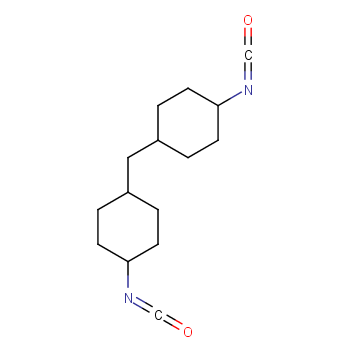
Hydrogenated MDI (H12MDI; 4,4'-diisocyanatodicyclohexylmethane; CAS 5124-30-1) is the cycloaliphatic analogue of aromatic 4,4'-MDI, made by hydrogenating methylenedianiline and phosgenating the resulting diamine. Removing the aromatic chromophore is the whole proposition: polyurethanes built on H12MDI do not yellow under ultraviolet light, so colour, gloss and mechanical properties survive in exterior topcoats, optical encapsulants and light-coloured elastomers. Volume is small beside commodity aromatic MDI but unit value several times higher, and qualification runs long because the material enters automotive clearcoats, weatherable industrial coatings, waterborne polyurethane dispersions, synthetic leather finishing, radiation-curable resins and thermoplastic polyurethane. Buyers select on specification stability and documentation, not spot price.
The decisive change this decade is regulatory. Regulation (EU) 2020/1149 inserted Entry 74 into Annex XVII of REACH, restricting diisocyanates as a family: substances and mixtures above 0.1 percent by weight of diisocyanate may not be used unless packaging states "Contains isocyanates. May produce an allergic reaction." and industrial and professional users hold documented adequate training. Labelling applied from 24 August 2022, training from 24 August 2023, with refresher training every five years. Because the entry covers the whole group, H12MDI monomer and prepolymers retaining monomer above the threshold fall inside it, and enforcement since 2024 has made missing training evidence the most common cause of blocked European isocyanate shipments.
This paper maps what a sourcing or compliance evaluation must settle: stereoisomer distribution and its effect on reactivity and crystallisation; the specification quartet of NCO content, hydrolysable chlorine, colour and viscosity; route economics behind the premium over aromatic MDI; sensitisation classification with exposure control and monitoring; the hydrogen and energy footprint; moisture exclusion and heated nitrogen-blanketed logistics; and a supplier strategy that treats Entry 74 documentation as a deliverable shipped with every drum.
Two structural facts separate H12MDI from aromatic MDI. The isocyanate groups sit on saturated cyclohexane rather than benzene rings, so the resulting urethane and urea linkages contain no chromophore that oxidises to a yellow quinone-imide species: light stability is structural, not additive-dependent. And the cycloaliphatic secondary NCO group is less electrophilic, so polyol reactions need catalysts and heat, while the competing reaction with water releases carbon dioxide and builds urea, making moisture a formulation hazard as well as a storage hazard.
Industrial H12MDI is built around a hydrogenation and a phosgenation. The dominant sequence hydrogenates methylenedianiline to bis(4-aminocyclohexyl)methane over a supported noble metal catalyst, then converts the diamine to the diisocyanate; hydrogenating pre-formed MDI is rarely practised at scale because the isocyanate group is not indifferent to those conditions. Non-phosgene chemistry is the main development frontier, since phosgene handling defines the capital cost, safety profile and environmental scrutiny of every plant making this molecule.
Four demand pools set the tone. Light-stable coatings remain the anchor, and within them the shift to waterborne and high-solids systems moves volume toward low-free-monomer prepolymers that cut solvent emissions and residual monomer. Synthetic leather for footwear, automotive interiors and furniture is the fastest-growing Asian outlet and pulls waterborne dispersion demand with it. Electrification adds a higher-value niche in potting and conformal coating of battery modules and displays. The European restriction is itself a demand shaper, since formulators are moving to prepolymers whose residual monomer sits below the 0.1 percent threshold.
Supply is concentrated among few integrated producers. Western Europe holds the technology core, with German and French plants supplying monomer plus prepolymer and hardener ranges to regional coatings and exporting globally. Japan and Korea run the high-purity, electronics-oriented end where colour, chloride and metal limits and small-lot consistency matter more than tonnage, much of it captive. China has moved from importer to producer, with integrated aniline, MDA and hydrogenation assets feeding coatings, synthetic leather and elastomer clusters in Shandong, Zhejiang, Jiangsu and Guangdong, and exporting to India, Türkiye and Southeast Asia.
Quotations bifurcate by grade. Monomer-grade H12MDI reflects the hydrogenation step, noble metal catalyst inventory, hydrogen, phosgene infrastructure and purification, so buyers should expect a multiple of aromatic MDI rather than a small premium. Prepolymers add a reaction and stripping stage and are priced on NCO content and viscosity. Input sensitivity runs through benzene, aniline and hydrogen, and European compliance cost is now routinely passed through. Electronics grades sit in a tier where qualification, not indexation, sets price.
H12MDI sits inside one of the most consequential downstream-use restrictions in European chemicals law and simultaneously inside the ordinary registration, classification and transport framework. A chemically perfect shipment can still be refused if the label statement, training evidence or exposure scenario is incomplete, and a documentation-perfect shipment can be rejected at goods-in if NCO content has drifted.
Pressure concentrates in the manufacturing route rather than the product in use. Hydrogenation consumes hydrogen whose carbon intensity depends on whether it is grey, blue or green; phosgenation carries process safety and community risk that must be demonstrated; and the catalyst inventory ties the plant to responsible platinum group metal sourcing. Downstream the product is an enabler, since waterborne systems cut customer solvent emissions and durable light-stable coatings extend service life.
A credible product carbon footprint is built from hydrogenation outward. Hydrogen supply is the largest lever: grey reformer hydrogen carries a heavy upstream burden, electrolytic hydrogen shifts it to electricity, and suppliers able to document the source or a mass-balance allocation differentiate. Steam and power for phosgenation and vacuum finishing add the next block, and European producers price Emissions Trading System allowance cost into conversion even where the molecule lies outside Carbon Border Adjustment Mechanism scope.
Traceability here is process safety and catalyst stewardship as much as origin. Platinum group metal catalysts are high-value, tightly controlled inventories, and responsible sourcing and recovery documentation is now standard in Together for Sustainability audits. Phosgene operations must demonstrate layered safeguards, inventory minimisation and emergency response under Responsible Care or equivalent programmes, with ISO 9001, ISO 14001 and ISO 45001 as baseline evidence.
H12MDI is a moisture-reactive, moderately viscous liquid with a freezing point near ambient. Water is the enemy from the reactor onward, because reaction with moisture generates carbon dioxide and insoluble urea and degrades NCO content; cold is the second enemy, because material below its crystallisation range solidifies and must be melted under control. Every packaging and transit decision is therefore about excluding water and holding temperature.
Transport classification must be confirmed against the current safety data sheet and the live IMDG, ADR and IATA DGR editions, because it is grade-dependent: many monomer grades travel as non-regulated liquids, while grades meeting acute inhalation toxicity criteria fall into the toxic isocyanate entries of Class 6.1 with full dangerous goods documentation and segregation. Where heated isotanks move bulk, the heating medium must be controlled rather than direct steam, and temperature loggers should record the voyage. Spill response is isocyanate-specific: contaminated material is treated with a neutralising decontamination solution and inert absorbent, never with water.
Commercially, H12MDI rewards suppliers and buyers who treat compliance and technical service as one package. The priorities below reflect where deals are won or lost in European, North American and Asian qualification programmes.
H12MDI is a small-tonnage, high-value, regulation-intensive molecule whose logic rests on one structural fact, the absence of an aromatic chromophore, and one regulatory fact, that diisocyanates are restricted as a family in the European Union. Buyers who grasp both stop treating it as an expensive aromatic MDI substitute and specify it as a performance material with its own system: isomer distribution, NCO content, hydrolysable chlorine, colour and viscosity, each with a named method. Suppliers then compete on documentation, exposure science and formulation support rather than price per kilogram.
The outlook points to growth in waterborne dispersions, synthetic leather and electronics encapsulation, price pressure from Chinese aliphatic capacity, and tighter occupational health expectations in Europe and North America. The practical response is to convert the restriction into routine quality practice: verified training, isocyanate-specific monitoring, sealed nitrogen-blanketed containers, temperature-logged transit and a certificate stating the four figures that determine whether a drum performs.
Powered by Guidechem
This white paper is exclusively compiled by the Guidechem Intelligence Team based on global customs data, regulatory databases, and industry research. Guidechem is a leading global B2B chemical platform, dedicated to connecting global buyers with verified, high-quality manufacturers.
Relying on Guidechem's extensive global database, we have mapped the core participants in the current global Hydrogenated MDI (H12MDI) supply chain:
Disclaimer: The content of this white paper is compiled based on public market data and regulatory information available as of 2026. Global chemical regulations are subject to dynamic adjustments. In actual export operations, enterprises must consult professional regulatory advisors or relevant competent authorities to obtain the latest compliance guidance.
|
 |
|
|
 EN
 Agricultural News
 Food News
 Industrial News
 Cosmetic News
 Pharmaceutical News
 Science News


 6YRS


