
I. Executive Summary
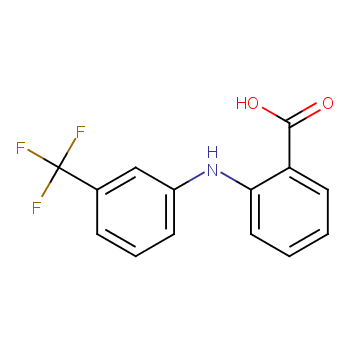
Flufenamic acid (CAS 530-78-9), N-(3-trifluoromethylphenyl)anthranilic acid, is a fenamate-class non-steroidal anti-inflammatory drug substance. Its formula weight is 281.23 g/mol. The commercial profile is now defined less by volume than by regulatory status: authorisation differs by country and some fenamate products have been withdrawn or restricted. Demand is concentrated among holders of valid marketing authorisations, and supply is made strictly to licensed manufacturers and their authorised agents.
Manufacturing is a classic Ullmann-type copper-mediated aryl amination: coupling 2-chlorobenzoic acid with 3-(trifluoromethyl)aniline, or the equivalent coupling of an anthranilic acid derivative with a trifluoromethyl-substituted aryl halide, followed by isolation through salt formation and recrystallisation. The technically decisive issues are polymorphism, control of aromatic amine impurities under ICH M7, control of copper and other elemental impurities under ICH Q3D, and residual solvent control under ICH Q3C. Solid-form control is not an academic concern for this molecule: it has a rich polymorphic landscape.
Export success depends on the regulatory file rather than on the reaction. Buyers require ICH Q7 cGMP manufacture, an open DMF or a European ASMF or CEP, and a specification justified against ICH Q6 with stability under ICH Q1. Veterinary use adds a separate track under Regulation (EU) 2019/6 with residue considerations for food-producing species. This paper addresses API buyers, regulatory teams and CDMO partners, and contains no dosage, prescribing or self-medication guidance.
II. Product Deep Dive: Molecular Mechanisms and Production Evolution
2.1 Physicochemical Properties and Mechanisms
Flufenamic acid is an N-aryl anthranilic acid: a benzoic acid bearing a secondary anilino nitrogen substituted with a 3-trifluoromethylphenyl group. The trifluoromethyl substituent raises lipophilicity and influences both potency and metabolic behaviour, while the anthranilic acid carboxyl provides the acidic function responsible for the compound's physicochemical handling.
- Polymorphism and solid-form control: Flufenamic acid is a well-documented polymorphic system with numerous reported forms and solvates, differing in melting point, habit, flow and dissolution. A manufacturing change that alters crystallisation solvent, cooling profile or drying can therefore shift the form without changing chemical purity, with consequences for downstream processing and bioequivalence.
- Solubility, stability and handling properties: The API is poorly soluble in water and more soluble in polar organic solvents and in alkaline media, with salt formation used in processing and formulation. It is chemically stable under ordinary storage but is handled as a potent compound with defined occupational exposure controls, and the trifluoromethyl aromatic structure places it within the scope of evolving scrutiny of fluorinated substances.
2.2 Synthesis and Manufacturing Technologies
The established route is a Ullmann-Goldberg condensation: copper-mediated coupling of 2-chlorobenzoic acid with 3-(trifluoromethyl)aniline under basic conditions in a high-boiling polar solvent, or the complementary coupling of an anthranilic acid with an activated trifluoromethyl-substituted aryl halide. The crude acid is isolated by salt formation, treated to remove copper, acidified and recrystallised from a defined solvent system to the target polymorph.
- ICH M7 control of aromatic amine impurities: Residual 3-(trifluoromethyl)aniline and related aromatic amines — including chloroaniline species such as 2,3-dichloroaniline where chlorinated aniline streams or side reactions are present — carry structural alerts for mutagenicity and must be assessed under ICH M7. The default control is a threshold of toxicological concern limit of 1.5 µg/day, or a compound-specific acceptable intake where data support it, with less-than-lifetime limits justified for shorter exposures. Practically this requires a sensitive, validated method — usually LC-MS/MS or GC-MS — and demonstrated purge through crystallisation, backed by spiking studies.
- Elemental impurities, solvents and polymorph control: Copper from the coupling step and any palladium or nickel from alternative catalytic routes must be controlled against ICH Q3D permitted daily exposures, with copper falling in the lower-concern class but still requiring route-specific justification. Residual solvents from the coupling and crystallisation steps, typically high-boiling polar aprotic solvents and recrystallisation alcohols, are controlled to ICH Q3C limits.
2.3 Core Application Matrix
- Human pharmaceutical API: The principal outlet is manufacture of finished dosage forms by holders of valid human marketing authorisations, where flufenamic acid is used as a prescription non-steroidal anti-inflammatory agent in the markets that retain it. Supply requires an open regulatory file, cGMP manufacture, defined polymorph and particle-size specification, and change control.
- Veterinary API: Flufenamic acid is also used as a veterinary active substance in certain jurisdictions, which is a separate regulatory track: in the EU, veterinary medicinal products are authorised under Regulation (EU) 2019/6, and use in food-producing species additionally requires maximum residue limits established under Regulation (EU) No 37/2010 with corresponding withdrawal periods. Veterinary and human dossiers must not be conflated, and veterinary-grade material may require its own specification and impurity justification.
- Analytical, reference and development supply: Reference-standard, analytical-standard and development-grade material is supplied to laboratories, generic developers and CDMOs for method development, validation and comparability studies, including polymorph screening. This segment needs extensive documentation — structure confirmation, impurity profile, residual solvent and elemental impurity data — but is supplied for laboratory and development use only. It is not a finished product and carries no therapeutic indication of its own.
III. Global Market Supply-Demand Landscape and Export Trends
3.1 Demand Drivers and Market Shifts
Demand is essentially replacement demand: it follows the marketing authorisations that remain in force and the generic products referencing them, rather than growth in prescribing. Three dynamics shape 2026: consolidation of API sourcing among fewer, better-documented manufacturers, ICH M7 aromatic amine control becoming a routine audit finding, and scrutiny of fluorinated aromatics under the broad PFAS policy debate.
3.2 Capacity Distribution and Export Flows
API capacity sits mainly in China and India, with additional EU and other producers holding regulatory files and serving regional customers. Because the molecule is off-patent and volumes are modest, capacity is not the constraint; the constraint is the maintenance of open DMFs, ASMFs and CEPs and the ability to pass increasingly detailed impurity audits.
3.3 Market Bifurcation and Pricing Dynamics
Flufenamic acid is priced on compliance as much as on chemistry. Generic API competition keeps base prices low, but material backed by an open US DMF or a European ASMF or CEP, ICH M7-compliant aromatic amine data and validated polymorph control commands a sustained premium. Cost drivers are the trifluoromethylaniline and chlorobenzoic acid starting materials, copper and ligand costs, solvent recovery and the analytical burden of impurity testing.
IV. In-depth Analysis of Global Compliance and Regulatory Barriers
API export is a regulated activity in which the marketing authorisation holder, not the API supplier, carries the product licence, and the API supplier's obligations are set by good manufacturing practice and by the regulatory file it supports. The practical perimeter is ICH Q7 for manufacture, ICH Q11 for development and lifecycle, ICH Q6 for specifications, ICH Q1 for stability, and ICH M7, Q3C and Q3D for impurities.
4.1 European Market: REACH, CLP, and Sector-Specific Directives
- EU: ASMF, CEP and the imported API framework: Supply into the EU is documented either through an active substance master file submitted to the competent authorities and referenced by the marketing authorisation holder, or, where a European Pharmacopoeia monograph and a Certificate of Suitability are available, through the EDQM CEP route. Active substances manufactured outside the EEA are subject to the imported-API framework of Directive 2001/83/EC as amended, requiring a written confirmation from the exporting authority of GMP equivalence and, where applicable, inspection.
- Veterinary track under Regulation (EU) 2019/6: Veterinary medicinal products are governed by Regulation (EU) 2019/6, with separate dossier requirements and, for food-producing species, maximum residue limits under Regulation (EU) No 37/2010 that determine withdrawal periods. An API supplier serving both tracks must keep them distinct: different impurity justifications, different residue considerations and separate customer qualifications.
4.2 North American Market: TSCA, EPA, and FDA Regulations
- US DMF and FDA cGMP expectations: In the United States, API supply is documented through a Type II drug master file held at FDA and referenced by the applicant's application, with a letter of access to the authorised user. FDA expects ICH Q7 cGMP compliance, a validated manufacturing process, justified specifications, ICH Q1 stability data and full impurity qualification, and it inspects the API site.
- Impurity qualification and ICH M7 expectations: FDA and EMA both expect a complete impurity story: organic impurities identified and qualified against ICH Q3A and Q3B thresholds, mutagenic impurities assessed under ICH M7 with an acceptable intake or a threshold of toxicological concern justification, residual solvents against ICH Q3C and elemental impurities against ICH Q3D. For a copper-mediated coupling with aromatic amine starting materials, the aromatic amine assessment is the item most often challenged in review.
4.3 The Critical Hurdle: Quality Control and Safety Limits
Compliance Warning: Flufenamic acid is a prescription or veterinary active pharmaceutical ingredient, not a consumer product and not a supplement. It must be supplied only to holders of a valid marketing authorisation, to their authorised agents and manufacturers, or to laboratories and CDMOs for documented development, analytical or reference use, and every enquiry should be subject to know-your-customer and end-use screening. No dosage, administration, prescribing, formulation instruction or self-medication guidance may be provided by the supplier, and no therapeutic claim may be made in commercial documentation beyond what the approved product information supports.
V. Green Trade Barriers and ESG in Manufacturing
ESG pressure on this API is concentrated in waste and fluorinated chemistry rather than in carbon volume. The Ullmann route generates copper-bearing and high-boiling solvent streams, and the trifluoromethyl aromatic structure places the molecule within the broad PFAS policy debate, so customers increasingly ask for solvent recovery rates, metal recovery and a documented position on fluorinated substance stewardship.
5.1 Carbon Footprint and Circular Economy
Production volumes are small, so absolute emissions are modest; the footprint sits in high-boiling solvent use and recovery, energy for the coupling and crystallisation steps, and the trifluoromethyl starting-material supply chain. The practical levers are solvent recovery by distillation, copper recovery or controlled treatment of metal-bearing streams, and process intensification that reduces solvent-to-product ratio.
5.2 Sustainable Sourcing and Traceability
Traceability in API supply is a GMP obligation: full batch records, defined starting-material sources with their own specifications, validated analytical methods, retained samples, and an audit trail linking each API lot to the customer's finished-product batch. Buyers should require ISO 9001 as a baseline, evidence of ICH Q7-aligned systems, environmental management under ISO 14001, occupational health and safety under ISO 45001, and, where potent-compound handling applies, documented containment with defined occupational exposure limits.
VI. Supply Chain Resilience and Export Logistics
Flufenamic acid is a stable crystalline solid and is not assigned a dangerous-goods classification for transport under ordinary circumstances, so the logistics risk is quality rather than hazard. It is shipped in fibre drums or high-density polyethylene drums with polyethylene liners, protected from moisture and light, at controlled room temperature, with tamper-evident seals and full GDP-compliant documentation.
6.1 Packaging Standards and Moisture/Contamination Control
- API-grade packaging and seal integrity: Standard presentation is a double polyethylene liner inside a fibre or plastic drum, closed with tamper-evident seals and labelled with API identity, batch, quantity, storage condition and the manufacturer's details. Liners must be pharmaceutical-grade and compatible with the solid form, and headspace should be minimised where the specification requires it.
- Containment, segregation and GDP controls: Handling should follow good distribution practice for active substances: segregated, access-controlled storage, documented cleaning and line clearance, containment appropriate to a potent compound with a defined occupational exposure limit, and environmental monitoring where required. Material must be segregated from non-pharmaceutical chemicals and from other APIs to prevent cross-contamination, with quarantine and release status clearly identified.
6.2 Dangerous Goods Identification and Transit Protocols
For transport, flufenamic acid is normally shipped as a non-dangerous, non-regulated solid under the UN Model Regulations, so the IMDG Code, ADR, RID and IATA Dangerous Goods Regulations do not impose hazard classification for the API itself; shippers should nevertheless confirm the SDS position for each lot. The operative requirements are pharmaceutical: GDP-compliant handling, controlled room temperature with documented excursion management, protection from moisture and light, sealed and tamper-evident drums, and a chain of custody that identifies every custodian.
VII. Enterprise Global Expansion Strategy Guide
Competing as a flufenamic acid API supplier is a documentation and reliability exercise; the chemistry is well known, and the differentiator is the file, the impurity story and the consistency of the crystal form.
- Invest in the file before the furnace: Maintain an open US DMF and a European ASMF or CEP where available, keep them current, and support the marketing authorisation holder with variation documentation. A supplier whose file is stale is unsellable regardless of plant capacity or price.
- Build the impurity story with data: Develop and validate sensitive methods for aromatic amine impurities, generate spiking and purge data under ICH M7, control copper and other elements under ICH Q3D, and justify residual solvents under ICH Q3C. Present the whole package at audit, not on request.
- Screen customers and control change: Apply know-your-customer and end-use screening, supply only to licensed manufacturers, authorised agents and documented development or analytical users, and never provide dosing or self-medication information. Notify any route, solvent or crystallisation change in advance so the authorisation holder can file the necessary variation.
VIII. Conclusion
Flufenamic acid is a mature API whose commercial future belongs to suppliers that can sustain regulatory files and impurity science rather than to those competing on kilogram price. The Ullmann route is well understood, but the combination of a polymorphic solid, aromatic amine mutagenic-alert impurities and elemental and solvent residues makes this a molecule where specification discipline is the product.
For buyers, the priorities are to qualify the file as carefully as the factory, to require complete ICH M7, Q3C and Q3D data, and to confirm marketing authorisation status in each target country before ordering. Flufenamic acid is a prescription and veterinary API: it must move only through licensed pharmaceutical channels, with no therapeutic promotion and no guidance of any kind on administration or self-use.
IX. Industry Resource Connection and Supplier Ecosystem
Powered by Guidechem
This white paper is exclusively compiled by the Guidechem Intelligence Team based on global customs data, regulatory databases, and industry research. Guidechem is a leading global B2B chemical platform, dedicated to connecting global buyers with verified, high-quality manufacturers.
Relying on Guidechem's extensive global database, we have mapped the core participants in the current global Flufenamic acid supply chain:
- China — API synthesis and DMF-holding exporters: Chinese API manufacturers combine anthranilic-acid and trifluoromethylaniline chemistry with Ullmann coupling at scale and supply most export volume, with the leading participants holding open US DMFs and European ASMFs and investing in ICH M7 aromatic amine method development. Their advantage is cost and starting-material integration; their challenge is sustained file maintenance and passing increasingly detailed impurity audits.
- India — generic API and regulatory-file capability: Indian API producers serve both domestic formulation and export markets, with strong capability in DMF and dossier preparation, analytical method validation and response to regulatory deficiency letters. Many operate multipurpose plants under ICH Q7 with dedicated containment and solvent recovery, and supply generic manufacturers in regulated and semi-regulated markets.
- Europe — ASMF/CEP holders and finished-dose integration: European participants include API manufacturers holding ASMFs and, where applicable, EDQM Certificates of Suitability, together with finished-dose manufacturers that integrate API sourcing with their own marketing authorisations. Closeness to EMA and national competent authorities, and to the veterinary framework under Regulation (EU) 2019/6, is the structural advantage.
Disclaimer: The content of this white paper is compiled based on public market data and regulatory information available as of 2026. Global chemical regulations are subject to dynamic adjustments. In actual export operations, enterprises must consult professional regulatory advisors or relevant competent authorities to obtain the latest compliance guidance.



 EN
 Agricultural News
 Food News
 Industrial News
 Cosmetic News
 Pharmaceutical News
 Science News


 14YRS


