-
We detected your language preference as English. Would you like to switch to the English version for a better experience?
Switch to English
Stay here


Poly(1,4-butanediol) bis(4-aminobenzoate) (CAS 54667-43-5) is the PTMEG-linked aromatic diamine curative widely referenced under P-1000-type designations. Supplied as a medium-viscosity liquid oligomer, it acts as a chain extender and curative for isocyanate-terminated MDI and TDI prepolymers in cast polyurethane elastomers, polyurea coatings and high-build linings. For purchasers the material is bought on processability as much as on chemistry: amine equivalent, viscosity at processing temperature and batch-to-batch molecular-weight consistency determine pot life, demould time and the final hard-segment morphology of the elastomer.
This white paper is written for sourcing managers, compliance officers and formulation teams at elastomer moulders, coating applicators and potting-compound producers. Its central theme is that the value proposition and the compliance burden of this curative derive from the same source: it is an aromatic diamine offered explicitly as a MOCA-free alternative, in a chemical class subjected to sustained regulatory attention, and it must therefore be sold with a toxicological and analytical dossier rather than with commodity documentation alone.
The note's commercial reality is straightforward. MOCA — 4,4'-methylenebis(2-chloroaniline) — is a substance of very high concern whose authorisation-relevant status has driven Western converting operations to reformulate, creating durable demand for alternatives based on sterically or electronically moderated aromatic diamines. Buyers evaluating this product must nevertheless apply the full aromatic-amine screening regime to it, control free p-aminobenzoate monomer residues, and satisfy downstream requirements from the EU Paints Directive and US VOC rules through to mining, potable-water and electronics potting end markets.
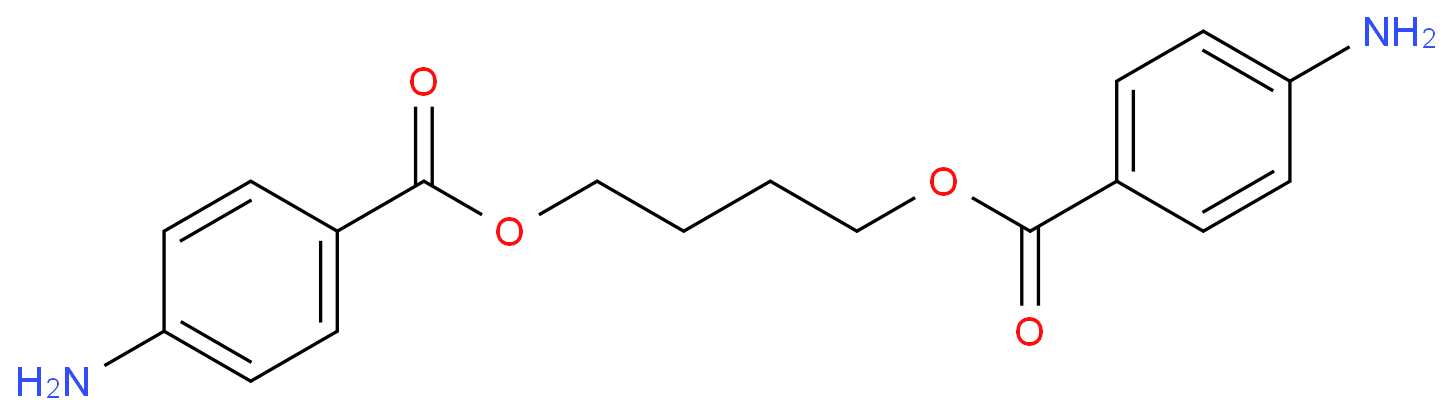
The molecule is a telechelic oligomer: a polytetramethylene ether glycol soft block terminated at both ends by p-aminobenzoate ester groups, giving a difunctional primary aromatic amine. When blended with an isocyanate-terminated prepolymer, each amine reacts with an NCO group to form a urea linkage rather than the urethane linkage produced by polyol chain extenders. Urea groups form stronger, more cohesive hydrogen-bonded hard domains, so diamine-extended systems achieve higher hardness, tensile strength and tear resistance at comparable hard-segment content. Because the amine is attached through an ester and sits on a flexible long-chain spacer, its reactivity is moderated relative to short aromatic diamines such as DETDA or MOCA, giving processors a workable pot life while retaining the performance advantage of urea hard segments.
Publicly available producer disclosures describe the manufacture only at route-class level. The established route is a transesterification between polytetramethylene ether glycol and an alkyl p-aminobenzoate ester, with removal of the liberated alcohol driving conversion, followed by catalyst removal and finishing. This class of process must be controlled tightly because the same chemistry that yields the product also governs residual aromatic amine content, colour body formation and the molecular-weight distribution inherited from the polyol feed. Buyers rarely see more than a summary, so the practical questions concern evidence rather than step details.
Three forces shape demand. The first is continued substitution away from MOCA across European and North American converters, which sustains demand for moderated aromatic diamines even where total elastomer volumes are flat. The second is infrastructure and mining capital expenditure, since screen media, wear panels and pipeline coatings represent the bulk of consumption. The third is regulatory pressure on volatile organic compounds, which favours 100 %-solids and high-solids plural-component systems and thereby rewards curatives that deliver low viscosity without solvent.
Installed capacity follows both polyurethane processing clusters and PTMEG availability. North American production, historically anchored by the Gulf Coast and Midwest speciality amine corridor, continues to supply branded and toll-manufactured grades into domestic elastomer moulders. European supply centres on Germany, the Netherlands and Italy, frequently as formulation houses rather than integrated producers. Chinese producers in Jiangsu, Shandong and Zhejiang have expanded capacity for P-1000-type curatives, exporting bulk drums and IBCs to converter markets in Asia, the Middle East and increasingly Latin America, while OEM-specified applications still tend to draw from Western-origin material.
Pricing tracks PTMEG feedstock, alkyl aminobenzoate ester and energy costs, together with MDI supply conditions that influence formulation economics as a whole. Relative to diethyltoluenediamine the product carries a premium justified by lower modulus control and MOCA-free positioning; relative to MOCA, western converters increasingly treat the regulatory and industrial-hygiene cost of MOCA as part of the true comparison. Because elastomer formulations are qualified by end users over long cycles, switching costs are high and price elasticity low once a formulation is locked, so exporters compete on consistency and documentation rather than on spot discounts.
Aromatic diamines are among the most closely examined classes in industrial chemicals regulation, and this product cannot be sold into regulated markets on generic assurances. European buyers interrogate registration status, classification and entry into the candidate-list process; North American buyers interrogate inventory status and exposure control; both then add end-market approvals such as potable-water or food-contact clearance. The items below recur most frequently in supplier questionnaires.
Sustainability arguments for this curative are genuinely favourable in one dimension and genuinely difficult in another. It enables solvent-free and high-solids systems that reduce formulation VOC dramatically, but the polyether backbone remains largely fossil-derived and cured polyurethane is difficult to recycle.
Cradle-to-gate impact is dominated by the PTMEG chain and by the energy used in catalyst removal and finishing, while the aminobenzoate portion contributes a smaller share. Exporters encountering European Union emissions trading exposure or customer Scope 3 questionnaires should prepare product carbon footprint figures with stated system boundaries, noting that commercially available bio-based PTMEG routes can reduce fossil content where the origin is certified. Circular-economy questions concern the cured article rather than the curative: chemical recycling of urea-containing polyurethane networks is technically possible but not yet routine, whereas mechanical regrind into lower-duty parts is the pragmatic route most converters describe.
Traceability expectations increasingly include ISO 9001 and ISO 14001 certification at the curative plant, IATF 16949 alignment where the elastomer serves transport applications, and documented absence of intentionally added MOCA. Mine operators and water utilities, as downstream asset owners, often extend these requirements into their own tenders. Buyers should therefore ask for lot genealogy back to polyol feed and for retained samples, so that a field failure years later can be traced to a specific campaign rather than argued about inconclusively.
Although the product is normally transported as a non-dangerous liquid, its handling properties rather than its hazard profile dictate most logistics decisions. It is hygroscopic towards both moisture and carbon dioxide, it thickens markedly at low temperature, and it is a reactive amine that must never share equipment with isocyanate or previous curative residues.
Most grades are not assigned a UN number, but certain classifications recorded in safety data sheets may bring packaging group and, where aquatic hazard endpoints apply, marine pollutant provisions under the IMDG Code, ADR or 49 CFR. Shippers must verify the classification from the current supplier SDS rather than from precedent, since aquatic classification practices have changed. Transport should keep the material above its pour point and below prolonged high-temperature exposure; heated containers or climate-controlled freight avoid cold-induced viscosity rise and crystallisation, while long holds above roughly 60 °C risk colour development and amine value drift.
Producers and exporters building positions outside their home market tend to succeed through technical substitution support rather than price, and three measures consistently decide outcomes.
Poly(1,4-butanediol) bis(4-aminobenzoate) occupies a stable and defensible niche: a PTMEG-linked aromatic diamine that delivers urea hard-segment performance with moderated reactivity, sold primarily as a MOCA-free route for high-duty cast elastomers and thick-film polyurea systems. Its technical story and its regulatory story are the same story, since both rest on how carefully the manufacturer controls free aromatic amine residues, molecular-weight distribution and industrial-hygiene practice.
Buyers should specify more than CAS and purity: amine equivalent with tolerance and method, viscosity at stated temperatures, GPC-based molecular-weight evidence, stated free aromatic amine limits, migration or extractables data appropriate to the end use, and change-control obligations covering polyol feed and route. Paired with realistic qualification lead times and, where the application is critical, dual sourcing, those requirements convert a substitution decision into a durable supply relationship.
Powered by Guidechem
This white paper is exclusively compiled by the Guidechem Intelligence Team based on global customs data, regulatory databases, and industry research. Guidechem is a leading global B2B chemical platform, dedicated to connecting global buyers with verified, high-quality manufacturers.
Relying on Guidechem's extensive global database, we have mapped the core participants in the current global Poly(1,4-butanediol) bis(4-aminobenzoate) supply chain:
Disclaimer: The content of this white paper is compiled based on public market data and regulatory information available as of 2026. Global chemical regulations are subject to dynamic adjustments. In actual export operations, enterprises must consult professional regulatory advisors or relevant competent authorities to obtain the latest compliance guidance.
|
 |
 |
|
 EN
 Agricultural News
 Food News
 Industrial News
 Cosmetic News
 Pharmaceutical News
 Science News


 3YRS

