
I. Executive Summary
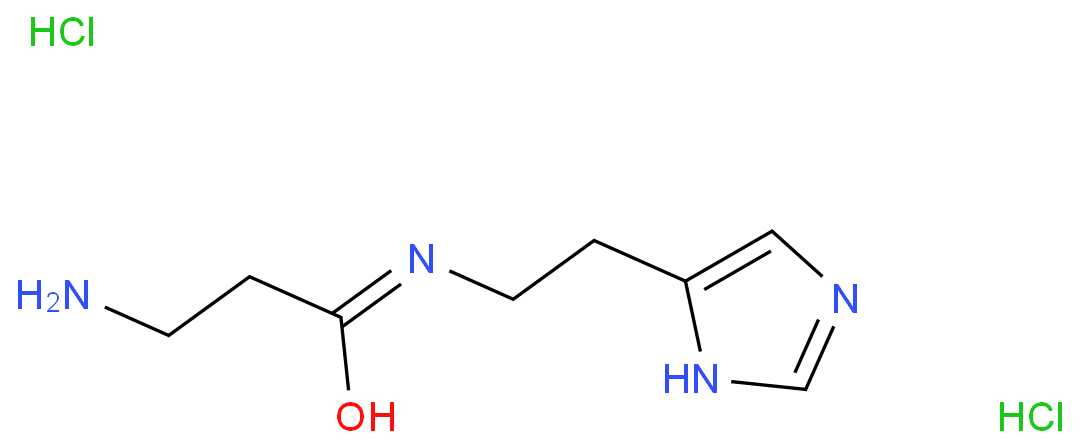
Decarboxy carnosine hydrochloride (CAS 57022-38-5), also known as carcinine or β-alanyl-histamine, is a carnosine-derived amide linking β-alanine to histamine, supplied commercially as the hydrochloride salt. It is a B2B material only: a cosmetic-ingredient candidate and a research biochemical. To be unambiguous at the outset, it has no approved therapeutic indication in any major jurisdiction, is not a finished consumer product, and is not intended for human or veterinary administration. Commercial activity therefore centres on custom synthesis, process development, analytical support and scale-up to industrial partners.
Two demand pools exist and they behave differently. Cosmetic formulators evaluate it as a water-soluble, low-colour ingredient for skincare and haircare, where histamine-related structures attract particular scrutiny from European safety assessors and where responsible-person obligations apply. Research buyers purchase gram to kilogram quantities under research-use-only terms for assay work and method development, where documentation, identity confirmation and impurity transparency matter more than volume pricing.
This review, written from a contract development and manufacturing organisation standpoint, covers the peptide-type coupling route class, purification and salt-form control, the specification attributes that determine acceptance, quality systems appropriate to research and higher grades, the EU, US and Chinese regulatory perimeter, cold-chain and moisture-controlled logistics, and the China, India and European supplier ecosystems mapped by Guidechem. No antioxidant, anti-glycation, anti-aging or disease claim is made for this material, and no dosage regimen is provided.
II. Product Deep Dive: Molecular Mechanisms and Production Evolution
2.1 Physicochemical Properties and Mechanisms
Carcinine is the amide formed between the carboxyl group of β-alanine and the primary amine of histamine, retaining the imidazole ring that dominates its physicochemical behaviour. In its hydrochloride salt form it is a water-soluble, hygroscopic solid whose solution behaviour is governed by the imidazolium pKa; this makes pH control central both to chromatographic purification and to finished-product formulation stability.
- Ionisation behaviour and hygroscopicity: The imidazole ring and the terminal amine give the molecule multiple protonation states, so the counter-ion stoichiometry, moisture uptake and apparent pH of a solution are coupled. Because the hydrochloride salt takes up water readily, water content determined by Karl Fischer titration is a primary specification attribute, and handling below controlled relative humidity is required to keep weighing and assay data reproducible.
- Stability profile: The amide bond is subject to hydrolysis under strongly acidic or basic conditions, while the imidazole ring is susceptible to oxidative attack catalysed by trace metals. Practically, degradation manifests as rising free histamine and β-alanine levels, so these are monitored both as related substances and as stability-indicating parameters in formal ICH-aligned programmes.
2.2 Synthesis and Manufacturing Technologies
Production belongs to the peptide-coupling route class: an N-protected β-alanine derivative is activated and coupled to histamine, then deprotected to give the free amide, which is converted to the hydrochloride salt. On an industrial CDMO scale the discussion is deliberately kept at route-class level — protecting-group strategy, activation chemistry and work-up sequences are selected for impurity control, operability and cost, and specific operating conditions remain proprietary to the manufacturing partner.
- Coupling strategy and impurity genesis: Choice among carbodiimide, uronium or phosphonium activation influences racemisation risk, by-product profile and cost, while incomplete coupling leaves the two starting amino components as the principal related substances. Route selection therefore aims for impurity profiles that subsequent purification can reliably clear, with reaction monitoring by HPLC used to fix end-points and define acceptable conversion windows.
- Purification and salt-form control: Crude material is typically taken through ion-exchange chromatography and preparative reversed-phase HPLC, followed by controlled salt formation with hydrochloric acid and isolation by crystallisation or lyophilisation. The target outcome is defined chloride stoichiometry, low residual solvent within ICH Q3C-inspired limits, low elemental impurity burden and a consistent solid form, attributes verified by ion chromatography, headspace GC and ICP-MS.
2.3 Core Application Matrix
- Cosmetic and personal-care ingredient supply: Supplied to cosmetic manufacturers as a water-soluble formulation ingredient for leave-on skincare and haircare systems. Supply accompanies safety-relevant impurity data rather than efficacy representations, since any finished-product claim belongs to the responsible person placing the product on the market, not to the ingredient producer.
- Research biochemical and assay reagent: Provided as a research-use-only material for in vitro work, receptor and enzyme assays, and analytical reference work. Buyers prioritise unambiguous identity by LC-MS and NMR, quantitative purity, stated impurity limits and a certificate of analysis that documents the methods actually used.
- Custom synthesis and process development: Engaged as CDMO work: route scouting, kilo-lab demonstration, non-GMP and GMP-aligned campaigns, analytical method development and validation, reference-standard preparation and technology transfer into the partner's own facility. Here the deliverable is knowledge and validated methods as much as material.
III. Global Market Supply-Demand Landscape and Export Trends
3.1 Demand Drivers and Market Shifts
Cosmetic-side interest derives from continuing formulation interest in dipeptide-like water-soluble actives, particularly in Asian markets where such ingredients enjoy strong consumer awareness. Because claims cannot attach to the ingredient supplier, demand translates into requests for better-characterised, better-documented material rather than marketing language. Research demand moves in step with academic and industrial interest in histaminergic and carnosine-related biochemistry, and is inherently lumpy, tender-driven and specification-sensitive rather than price-sensitive.
3.2 Capacity Distribution and Export Flows
There is no commodity market for this material. Capacity is distributed among peptide-specialist CDMOs in China and India, which combine protected-amino-acid supply, kilo-lab and pilot-plant chromatography with competitive operating cost, and European and North American specialists supplying pharmaceutical-grade campaigns under established quality systems. Shipments are made to order against purchase specification, typically small parcel consignments for research buyers and multi-kilogram validated batches for cosmetic and industrial customers, moving predominantly from Asia into Europe, North America, Japan and Korea.
3.3 Market Bifurcation and Pricing Dynamics
Pricing separates sharply by grade. Catalogue-scale research material competes on availability and analytical documentation. Above it sits validated cosmetic-grade material with defined microbial limits, heavy-metal results and full impurity disclosure. At the top sit GMP-aligned or qualified campaigns where methods are validated, impurity limits are justified and a regulatory-support package accompanies delivery. Since each campaign is essentially bespoke, quotations are driven by purification load, analytical scope and documentation depth rather than by kilogram price alone.
IV. In-depth Analysis of Global Compliance and Regulatory Barriers
Because the compound has no therapeutic indication and is not a medicine, the applicable regime is chemical and cosmetic rather than pharmaceutical. Suppliers must nonetheless operate to the discipline of the API world: documented route of synthesis, defined starting-material origin and validated analytical methods. The practical compliance boundary is that material is supplied as a research or industrial ingredient, not as a medicinal product or finished cosmetic.
4.1 European Market: REACH, CLP, and Sector-Specific Directives
- Cosmetics Regulation (EC) No 1223/2009: Where material is used in cosmetic products placed on the EU market, the finished product requires a responsible person, a product information file with a cosmetic product safety report and CPNP notification. Histamine-related substances attract particular attention from safety assessors, who expect full compositional disclosure, a justified impurity profile including residual solvents and heavy metals, and stability data supporting the claimed shelf life.
- REACH and CLP obligations: Import into the European Union above one tonne per year requires registration under Regulation (EC) No 1907/2006 with a technical dossier covering identity, physicochemical properties and endpoints, while classification, labelling and packaging follow Regulation (EC) No 1272/2008 with an extended safety data sheet. Below registration thresholds, importers still require the appropriate notification status, and only-representative arrangements are frequently used.
4.2 North American Market: TSCA, EPA, and FDA Regulations
- TSCA status: Commercial supply into the United States requires the substance to be appropriately listed or covered by an applicable exemption on the TSCA inventory, with any significant new use assessed before introduction. Importers must hold accurate certification records, and suppliers support customers with the identity, use and exposure information needed to substantiate those certifications.
- MoCRA and research-use positioning: Where cosmetic use is intended, the Modernization of Cosmetics Regulation Act requires facility registration, responsible-person product listing with ingredient statements and safety substantiation. Material sold for research is labelled research-use-only, not for human or veterinary use and not a finished consumer product, and responsible suppliers screen orders against intended use before shipment.
4.3 The Critical Hurdle: Quality Control and Safety Limits
Compliance Warning: The decisive specifications are the impurities, not the assay. Free histamine and free β-alanine carry toxicological and regulatory weight disproportionate to their concentrations, so they must be quantified by a validated HPLC method with demonstrated resolution rather than estimated from a mass-balance purity figure. Residual solvent related to purification, chloride counter-ion stoichiometry, water content driven by hygroscopicity and elemental impurities must each be verified by the stated method. Suppliers must also hold a clear boundary: no antioxidant, anti-glycation, anti-aging or disease-related claim may be made for this material, no dosage guidance given, and cosmetic-grade material must be distinguished in documentation from research-use-only lots. Because histamine-related and β-alanine-derived structures attract interest in sports-nutrition contexts, end-use declarations, customer screening and refusal of any performance-enhancement positioning are mandatory parts of a defensible supply arrangement.
V. Green Trade Barriers and ESG in Manufacturing
Peptide-type manufacture carries a solvent-intensive profile, so environmental performance and operating cost align unusually well. Chromatography generates the largest waste stream, and reducing its burden is both the most credible sustainability claim available to a CDMO and the most effective route to lower cost per kilogram of purified product.
5.1 Carbon Footprint and Circular Economy
Salt-free chromatography methods, solvent recovery by distillation and low-temperature lyophilisation with heat recovery are the principal levers, alongside substitution of hazardous solvents in line with ICH Q3C class thinking. Because campaigns are short and multi-purpose plants are shared, impacts are allocated per campaign, which is exactly why customers increasingly ask for a documented product or campaign footprint, ISO 14001-certified sites and solvent-recovery rates rather than generic green statements.
5.2 Sustainable Sourcing and Traceability
Traceability starts at the starting materials: documented origin and specification for protected β-alanine derivatives, histamine and process solvents, with animal-derived-material declarations since histamine itself is often sourced from animal-origin precursors. Buyers routinely request absence-of-TSE-risk statements, halal and kosher certification for cosmetic grades, vegan declarations, and documentary evidence that no material of animal origin enters the process where a vegan claim is made.
VI. Supply Chain Resilience and Export Logistics
Logistics is governed by two properties: the hydrochloride salt is hygroscopic, and the molecule is chemically labile enough to make heat and humidity significant over long transit legs. Neither converts into a dangerous-goods classification, but both convert into a quality deviation if packaging and routing are chosen casually.
6.1 Packaging Standards and Moisture/Contamination Control
- Moisture barrier and cold handling: Material ships in amber glass or HDPE bottles within sealed aluminium-foil or laminated barrier pouches, typically with desiccant and, where stability data support it, temperature-controlled packaging. Because water uptake changes both assay and chloride stoichiometry, the packaging specification — barrier material, desiccant quantity, seal integrity — is treated as part of the validated control strategy rather than as shipping consumables.
- Higher-grade handling: Lots destined for cosmetic or qualified campaigns are filled under controlled humidity, sometimes under nitrogen, with tamper-evident sealing, lot-level certificates of analysis and retained samples. Where endotoxin testing is required for higher grades, LAL testing is performed after packaging validation, and records are retained to support the customer's incoming-quality release decision.
6.2 Dangerous Goods Identification and Transit Protocols
The hydrochloride salt is not assigned a UN number and is transported as non-dangerous goods under IMDG, ADR, RID and IATA rules, with Section 14 of the safety data sheet stating that no transport classification applies. In practice consignments move by air express under temperature-controlled or cold-chain conditions with data loggers, since transit heat excursions are the most frequent cause of specification drift for research quantities, while larger industrial lots travel by sea with desiccant-protected, humidity-indicator-fitted packaging and reduced dwell at transhipment hubs.
VII. Enterprise Global Expansion Strategy Guide
A CDMO serving this molecule competes on trust and analytical credibility. Buyers cannot audit efficacy, because none may be claimed, so they audit everything else: method quality, impurity transparency, documentation discipline and consistency of supply across campaigns.
- Lead with validated analytics: Invest in a stability-indicating HPLC method with demonstrated resolution of the free amine and amino-acid impurities, supported by LC-MS identity confirmation, ion chromatography for counter-ion stoichiometry, Karl Fischer water determination and ICP-MS elemental screening. Publish the method principle and validation summary to customers; it shortens qualification more than any price concession.
- Sell campaigns, not kilograms: Package route scouting, kilo-lab demonstration, method development and validation, reference-standard supply and technology transfer into defined work packages. Revenue from development services carries higher margin than material sales, and it locks the subsequent supply relationship into the validated method that only the developing laboratory fully understands.
- Institutionalise compliance boundaries: Maintain documented end-use screening, research-use-only labelling aligned to ISO 9001 and ISO 22716 expectations where cosmetic grade is concerned, written refusal to support claims outside that boundary, and customer due diligence covering the sensitive positioning of histamine and β-alanine structures. Clear governance protects both the supplier and the legitimate customer.
VIII. Conclusion
For 2026 the realistic assessment is that this is a small, high-touch molecule rather than an emerging commodity. There is no approved therapeutic indication, so growth comes from better-characterised cosmetic-grade supply, research demand tied to histaminergic and carnosine-related investigation, and CDMO services around process development and analytics. Buyers qualifying supply should therefore weight method validation, impurity transparency and documentation discipline far above nameplate price.
The operating environment will also keep tightening: EU safety assessors scrutinise histamine-related cosmetic ingredients closely, MoCRA adds registration and substantiation duties in the United States, Chinese NMPA registration and inventory status gate cosmetic placement, and REACH, CLP and TSCA obligations apply to volume shipments. Suppliers able to combine validated analytics, salt-form control and strict claims governance will remain preferred partners. This document is provided for business-to-business research-supply and compliance planning only; the material is not a medicine, makes no antioxidant, anti-glycation or anti-aging claim, and carries no dosing guidance of any kind.
IX. Industry Resource Connection and Supplier Ecosystem
Powered by Guidechem
This white paper is exclusively compiled by the Guidechem Intelligence Team based on global customs data, regulatory databases, and industry research. Guidechem is a leading global B2B chemical platform, dedicated to connecting global buyers with verified, high-quality manufacturers.
Relying on Guidechem's extensive global database, we have mapped the core participants in the current global Decarboxy carnosine hydrochloride supply chain:
- China: Peptide-specialist CDMO clusters around Shanghai, Hangzhou, Nanjing and Chengdu combine protected amino-acid supply, kilo-lab capacity and preparative chromatography, offering rapid route scouting and cost-competitive campaigns at research through multi-kilogram scale. Chinese suppliers dominate catalogue-scale research material and increasingly supply cosmetic-grade lots with comprehensive impurity documentation.
- India: Hyderabad, Bengaluru and Ahmedabad host peptide and custom-synthesis organisations with strong process-chemistry depth and English-language regulatory documentation, offering route development, impurity synthesis for reference standards and pilot-scale purification. Indian partners are frequently selected where customers want development service bundled with later commercial supply under one quality agreement.
- Europe and North America: European and US specialists serve customers requiring established quality systems, ISO 22716 alignment for cosmetic-grade material and GMP-aligned campaigns with validated methods and regulatory-support packages. They typically produce smaller volumes at substantially higher unit cost, and are selected where documentation, auditability and responsible-person support outweigh material price.
Disclaimer: The content of this white paper is compiled based on public market data and regulatory information available as of 2026. Global chemical regulations are subject to dynamic adjustments. In actual export operations, enterprises must consult professional regulatory advisors or relevant competent authorities to obtain the latest compliance guidance.


 EN
 Agricultural News
 Food News
 Industrial News
 Cosmetic News
 Pharmaceutical News
 Science News


 1YR

