-
We detected your language preference as English. Would you like to switch to the English version for a better experience?
Switch to English
Stay here


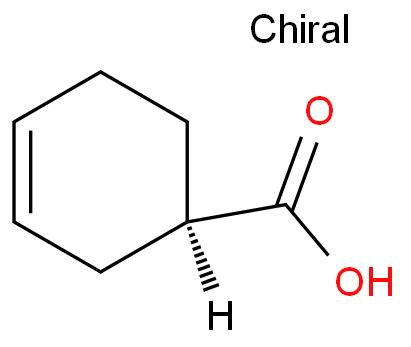
(R)-Cyclohex-3-ene-1-carboxylic acid (CAS 5709-98-8) is one of those deceptively small chiral building blocks whose commercial value is governed almost entirely by a single number: the enantiomeric excess. With the molecular formula C7H10O2 and a molecular weight of 126.15 g/mol, the substance combines a carboxylic acid function, a stereogenic C1 ring carbon and a beta,gamma-unsaturated alkene in a compact alicyclic frame. Buyers sourcing it are rarely buying commodity tonnage; they are buying stereochemical information that must survive every subsequent step of a multi-stage synthesis.
The 2026 sourcing environment is shaped by three forces. First, the migration of custom synthesis and process development work toward Asian CDMOs has widened the supplier base while compressing prices for racemic material, leaving enantiopure grades as the margin pool. Second, regulated-market buyers now require that the chiral analytical method be validated and transferred with the product rather than merely quoted on a certificate of analysis. Third, the impurity conversation has moved beyond assay to include double-bond positional isomers, residual solvents and elemental impurities under ICH Q3C and Q3D.
This white paper treats the molecule as what it is: a chiral, alkene-functionalised carboxylic acid building block supplied either as a research-grade material for route scouting or as a GMP-relevant intermediate for registered pharmaceutical and agrochemical programmes. Manufacturing chemistry is discussed only at route-class level, and the technical core is deliberately focused on enantiomeric excess control, how that excess is measured, and the mechanisms by which it is retained or eroded through downstream chemistry.
The commercial specification is unusually tight because three structural features interact: the ring alkene is both a synthetic handle and a latent impurity source, the carboxylic acid is the coupling point, and the C1 stereocentre is the reason the molecule is bought at all. Commercial grades are typically colourless to pale yellow liquids or low-melting solids with a boiling point near 238 °C, a density of roughly 1.09 g/cm3 at 20 °C, an acid pKa in the region of 4.6, and a specific rotation whose sign and magnitude must always be quoted together with the solvent, concentration and wavelength used.
Industrial supply is dominated by two strategic choices: build the ring and then create or resolve the stereocentre, or carry the stereocentre in from an enantiopure starting material. Both strategies converge on the same controlling operation, an enantiomeric purification step, and both generate the same characteristic impurity families that a buyer must specify against in the purchase agreement.
Demand tracks the broader shift toward saturated, three-dimensional scaffolds in drug discovery and the steady outsourcing of chiral route development to specialist CDMOs. Because the molecule is consumed early in a synthesis, order patterns are lumpy: a discovery-phase buyer takes tens of grams, a process-development buyer takes kilograms under a tech-transfer agreement, and a commercial campaign takes multi-kilogram quantities under a validated, change-controlled specification. That step-function demand profile makes capacity planning and inventory discipline more important than headline price.
Racemic cyclohex-3-ene carboxylic acid capacity is concentrated in China, where integrated fine-chemical producers can source acrylate and diene feedstocks locally and run the cycloaddition at scale. Enantiopure upgrading capacity is distributed differently: classical salt resolution is widely available in China and India, whereas enzymatic resolution and preparative chiral chromatography at multi-kilogram scale remain concentrated in European and a smaller number of Japanese and North American specialist houses. The practical result is a two-tier market in which racemate behaves like a commodity and ee-guaranteed material behaves like a project.
Price is best understood as a function of three variables rather than one: the ee level required, the analytical package attached to it, and the quality system standing behind it. A research grade at 98 percent assay with an unvalidated chiral method sits at the bottom of the range, while a GMP-made lot with full method validation, elemental-impurity data and dossier support can command a substantial multiple. Buyers who specify only an ee threshold without naming the method routinely find that two suppliers disagree by several percentage points.
For an intermediate of this type there is no single global approval. The compliance burden is the sum of chemical inventory registration, hazard communication, and the pharmaceutical quality expectations the buyer's own dossier imposes. Exporters who treat REACH and TSCA as paperwork rather than as market-access gates tend to lose tenders late in the qualification cycle, after the technical work has already been done.
Environmental, social and governance review of chiral intermediate supply is no longer a formality. Buyers compiling Scope 3 inventories ask for solvent-recovery rates, process mass intensity and waste-treatment routes, and they increasingly prefer upgrading technologies that avoid stoichiometric chiral auxiliaries and the salt waste those auxiliaries generate.
The dominant carbon and waste hotspots are the resolution step, the solvent volumes used in salt formation and liberation, and the energy consumed by the multiple distillations or chromatographic passes needed to upgrade the ee. Catalytic asymmetric and enzymatic routes cut process mass intensity sharply by eliminating the discarded enantiomer stream, which is why they are being adopted despite higher development cost and longer method-development timelines.
Traceability expectations now extend to the chiral auxiliary or enzyme origin, the metal catalyst supply chain and the solvent recovery loop. Documented change control, a full impurity genealogy from starting material to shipped lot, and auditable batch records are the practical deliverables buyers request during qualification, and suppliers who can produce them on demand shorten qualification cycles by months.
Physically the product is unremarkable; logistically the constraints concern stereochemical and chemical stability in transit. The alkene is oxidatively sensitive over long storage, the acid is hygroscopic enough to complicate assay-by-weight, and hot shipping containers accelerate double-bond migration and colour growth.
Where the classification in force is corrosive, the substance ships as a Class 8 acidic organic liquid or solid with the corresponding UN number, packing group and packing instruction; where it is classified irritant only it may travel as a non-regulated good under limited-quantity provisions. Either way, exporters should supply a sealed container with temperature-indicator evidence for long sea legs, and the transport documentation should identify the material as a chiral intermediate with a stated ee so that substitution disputes at destination can be resolved quickly.
Three moves consistently separate successful chiral sourcing programmes from failed ones: writing the analytical method into the contract, qualifying a second source before the first one fails, and matching the quality system to the development phase instead of over-specifying early or under-specifying late.
(R)-Cyclohex-3-ene-1-carboxylic acid is a small molecule whose commercial difficulty is concentrated in stereochemistry and in the honesty of the number attached to it. Suppliers who can demonstrate a validated chiral method, genuine positional-isomer control and a documented control strategy will keep winning programmes even as racemic capacity continues to commoditise.
For buyers, the 2026 agenda is straightforward: specify the method, specify the isomers, fix the solvent and elemental impurity limits, and qualify two sources before volume arrives. For producers, the complementary agenda is to move from stoichiometric salt resolution toward catalytic or enzymatic upgrading, publish real process mass intensity data, and build the quality documentation that converts an intermediate into a qualified supply position.
Powered by Guidechem
This white paper is exclusively compiled by the Guidechem Intelligence Team based on global customs data, regulatory databases, and industry research. Guidechem is a leading global B2B chemical platform, dedicated to connecting global buyers with verified, high-quality manufacturers.
Relying on Guidechem's extensive global database, we have mapped the core participants in the current global (R)-Cyclohex-3-ene-1-carboxylic acid supply chain:
Disclaimer: The content of this white paper is compiled based on public market data and regulatory information available as of 2026. Global chemical regulations are subject to dynamic adjustments. In actual export operations, enterprises must consult professional regulatory advisors or relevant competent authorities to obtain the latest compliance guidance.
|
 |
 |
 |
 EN
 Agricultural News
 Food News
 Industrial News
 Cosmetic News
 Pharmaceutical News
 Science News


 4YRS

