
I. Executive Summary
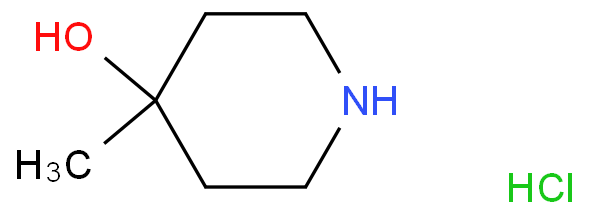
4-Piperidinol, 4-methyl-, hydrochloride (1:1) (CAS 586375-35-1) is the hydrochloride salt of 4-methyl-4-hydroxypiperidine, a saturated six-membered nitrogen heterocycle carrying a tertiary alcohol and a methyl group on the same ring carbon. The salt has the formula C6H14ClNO with a molecular weight of about 151.63 g/mol, against 115.17 g/mol for the free base. It is a building block, not a drug: the material traded under this CAS is supplied as a research or development intermediate for pharmaceutical and agrochemical synthesis, quoted as RUO grade for discovery work and as development or GMP-aligned grade for programmes advancing toward clinical supply. There is no approved therapeutic indication attached to the compound itself.
What looks like a simple small heterocycle is, in practice, a specification-sensitive purchase. The hydrochloride is hygroscopic, so water content and therefore assay drift with handling and storage. The chloride counter-ion must be confirmed as a true 1:1 stoichiometry rather than an assumed one. And because the ring nitrogen is a secondary amine, the substance is a potential nitrosamine precursor, which places it inside the nitrosamine risk-assessment obligations that regulators now apply across the supply chain. Buyers who specify only a purity percentage inherit all three problems at goods receipt.
The commercial picture is more stable than for many research intermediates. Piperidone and piperidinol building blocks have a broad, repeating demand base rather than single-project spikes, and capacity is widely distributed across Chinese and Indian multipurpose plants, with European and North American partners handling analytical qualification, repackaging and regulated documentation. Price competition is therefore real, but the durable differentiators are water and chloride control, nitrosamine documentation, elemental-impurity data and change control.
II. Product Deep Dive: Molecular Mechanisms and Production Evolution
2.1 Physicochemical Properties and Mechanisms
Two structural facts govern how this intermediate behaves in synthesis and in the warehouse. The C4 carbon is a tertiary carbinol that is stable to mild oxidants but labile under strong acid, and the ring nitrogen is an unhindered secondary amine. Together they explain the salt's hygroscopicity, its reactivity profile and its impurity story.
- Tertiary Carbinol on a Saturated Amine Scaffold: The quaternary ring carbon bears both hydroxyl and methyl, so the alcohol cannot be oxidised to a carbonyl under ordinary conditions; instead acid promotes dehydration to the corresponding tetrahydropyridine, which is the reason acid residues and acidic drying conditions are controlled. The motif is valued in medicinal chemistry because it fixes a polar, sp3-rich substituent vector while moderating basicity and lipophilicity relative to an unsubstituted piperidine.
- Salt Form, Hygroscopicity and Chloride Stoichiometry: Protonation of the secondary amine gives a water-soluble, crystalline hydrochloride with a theoretical chloride content near 23 percent. Hygroscopicity is the practical hazard: absorbed water depresses the calculated assay, promotes caking and can accelerate hydrolytic or dehydration pathways on standing. Specifications should therefore couple a Karl Fischer water limit with a chloride assay by argentometric titration or ion chromatography, and should state the basis on which the assay is calculated.
2.2 Synthesis and Manufacturing Technologies
Production falls into two route families, described here at the level of route class and control strategy rather than conditions or quantities, which belong inside a qualified facility under a campaign-specific risk assessment. What matters commercially is that each family leaves a different impurity signature, and the analytical method set has to be chosen accordingly before work starts.
- Organometallic Addition to a Protected Piperidone: The classical approach adds a methyl organometallic reagent, typically a Grignard or organolithium species, to an N-protected 4-piperidone, then removes the protecting group and forms the hydrochloride. Controls centre on competing reduction and enolisation side reactions, on unreacted ketone, on magnesium and lithium salts, on palladium or nickel residues where N-benzyl hydrogenolysis is used, and on ICH Q3C residual solvents such as tetrahydrofuran, methyl tert-butyl ether and toluene.
- Epoxide Aminolysis, Salt Formation and Isolation: Alternative constructions close the ring by amine opening of a suitable epoxide or by cyclisation of an amino-alcohol precursor. Whichever route is used, the final operations determine quality: controlled hydrochloride formation, crystallisation that rejects free base and inorganic chloride, washing, and vacuum drying to a water and residual-solvent end-point rather than to a fixed time. Solid-form work should cover crystal form, particle size and hygroscopicity before campaign scale-up.
2.3 Core Application Matrix
- Pharmaceutical Building Block: The 4-hydroxy-4-methylpiperidine motif appears in medicinal chemistry across kinase, central-nervous-system and anti-infective programmes, where the tertiary alcohol provides a hydrogen-bond donor and a defined exit vector. Material supplied for this work is RUO or development grade; the intermediate itself carries no approved therapeutic indication or dosing basis.
- Agrochemical and Specialty-Chemical Intermediates: Substituted piperidines are used in crop-protection and specialty-chemical synthesis, and the salt form simplifies handling and weighing relative to the free base. Buyers in this segment typically prioritise consistent physical form and reliable large-lot availability over the deepest analytical package.
- Reference Material and Custom Analogue Supply: The compound is also purchased as a characterised standard for impurity identification and method development, and as the anchor for analogue programmes covering alternative salts, isotopic labels and N-substituted derivatives, usually run under a single confidentiality agreement with one CDMO.
III. Global Market Supply-Demand Landscape and Export Trends
3.1 Demand Drivers and Market Shifts
Demand follows outsourcing of heterocyclic building-block synthesis rather than any single product cycle. Buyers increasingly consolidate heterocyclic purchases with fewer suppliers, then request deeper documentation from each, which has shifted competition from price toward qualification capability. The nitrosamine topic has amplified that shift: procurement teams now ask for a documented risk assessment before they ask for a quotation, and suppliers without one are screened out early.
3.2 Capacity Distribution and Export Flows
Capacity is broad and moderately competitive. Multikilogram and pilot-scale campaigns run in Chinese and Indian multipurpose plants with ready access to protected piperidones, organometallic reagents and hydrogenation equipment, while European and North American participants concentrate on analytical qualification, repackaging under controlled humidity, and regulated documentation. Export flows are correspondingly two-step, with bulk salt shipped from Asia and value-added distribution performed close to end markets.
3.3 Market Bifurcation and Pricing Dynamics
The market splits cleanly by documentation. RUO-grade material with an NMR identity, a titration or HPLC assay and a basic certificate moves at commodity-like per-gram pricing, and is adequate for exploratory chemistry. Development and GMP-aligned material, with validated assay and water methods, chloride stoichiometry confirmation, a nitrosamine risk assessment and LC-MS/MS testing, ICH Q3D elemental data, residual-solvent results and change control, is quoted as a campaign with qualification milestones. The differential reflects analytical and quality-system labour, and it widens whenever a buyer's own regulatory function reviews the file.
IV. In-depth Analysis of Global Compliance and Regulatory Barriers
As an intermediate, the compound is not itself subject to marketing authorisation. Its regulatory weight comes from chemical control law and from the impurity expectations that regulators apply to anything entering a drug substance supply chain.
4.1 European Market: REACH, CLP, and Sector-Specific Directives
- REACH Registration Status: Manufacture or import into the EU at or above one tonne per year requires a full registration dossier; beneath that threshold, a non-phase-in substance still requires enquiry and, where applicable, registration before placement on the market. Volumes for this building block can approach the threshold in consolidated programmes, so importers should establish the registration position and any only-representative arrangement in writing, and should record who holds the dossier.
- CLP Classification and Nitrosamine Expectations: Classification and labelling under CLP, with an SDS in the destination language, typically addresses skin and eye irritation and specific-target-organ toxicity, and drives packaging and workplace controls including HBEL-based OEB banding. In parallel, European medicines regulators expect marketing-authorisation holders and their suppliers to run nitrosamine risk assessments across the synthetic sequence, to test where a risk is identified, and to document nitrite control in raw materials, water and process streams.
4.2 North American Market: TSCA, EPA, and FDA Regulations
- TSCA Inventory and Import Basis: Commercial import into the United States requires the substance to be listed on the TSCA inventory or covered by an applicable exemption such as the research-and-development exemption, a low-volume exemption or a PMN route. The importer should state the basis on the entry and retain the supporting documentation, because the certification statement is the practical gate for research-quantity shipments.
- Non-API Position and Impurity Governance: The compound is not an FDA-approved active ingredient and holds no DMF of its own, although suppliers frequently support a customer's DMF or CEP with a technical package and, where needed, a Type II API DMF-style open part. Expectations follow ICH Q7 for GMP campaigns, ICH Q11 for development and lifecycle logic, ICH Q3C and Q3D for solvents and elements, and ICH M7 including its nitrosamine addendum for mutagenic-impurity assessment.
4.3 The Critical Hurdle: Quality Control and Safety Limits
Compliance Warning: The recurring failure with this intermediate is a specification that ignores the salt. A purity figure alone does not establish 1:1 chloride stoichiometry, does not bound water uptake in a hygroscopic hydrochloride, and does not address nitrosamine risk arising from the secondary amine. Require a Karl Fischer water limit, a chloride assay with an acceptance range, an LC-MS/MS test or a documented, science-based risk assessment for N-nitroso species with the nitrite-control rationale stated, ICH Q3D elemental results including any palladium or nickel from hydrogenolysis, and ICH Q3C residual-solvent data. Confirm the thermal behaviour of the lot by melting or decomposition screening before specifying drying or storage conditions.
V. Green Trade Barriers and ESG in Manufacturing
Heterocycle campaigns are solvent-heavy and metal-touching, and buyers now evaluate them on waste and metal recovery as much as on cost.
5.1 Carbon Footprint and Circular Economy
The dominant cradle-to-gate contributors are solvent production and incineration, the energy used in low-temperature organometallic addition, distillative solvent recovery and vacuum drying, and hydrogenolysis where a benzyl protecting group is used. Practical reductions include recovered solvent with a documented recycling rate, catalytic hydrogenolysis in place of stoichiometric reagents where the chemistry allows, precious-metal recovery from spent catalyst with assayed recovery yields, and right-sized packaging that cuts freight volume. Buyers increasingly request Scope 1 and 2 figures from the manufacturing site plus Scope 3 transport estimates, and ISO 14001 certification is a common questionnaire requirement.
5.2 Sustainable Sourcing and Traceability
Traceability should name the actual manufacturing site and route family, identify the origin of the protected piperidone and the organometallic reagent, and record the metal-recovery route. Because the compound feeds pharmaceutical supply chains, batch genealogy linking campaign, analytical batch record and shipped lot is essential for later investigations, and a reserved-sample policy is what makes a dispute resolvable. End-use declaration and Know-Your-Customer screening remain appropriate, and suppliers should be able to state SVHC relevance without qualification.
VI. Supply Chain Resilience and Export Logistics
Logistics failures with this salt are almost always moisture failures. A hydrochloride that has picked up water in transit is not dangerous; it is off-specification, and often unrecoverable without re-drying under controlled conditions.
6.1 Packaging Standards and Moisture/Contamination Control
- Hermetic, Desiccated Primary Packaging: Use high-barrier drums or bottles with heat-induction seals, double polyethylene liners, desiccant and, for development-grade lots, an inert headspace. Pack under controlled relative humidity, record the water content at release, and state a retest interval so the buyer knows when re-analysis is due.
- Humidity and Temperature in Transit: Ambient shipment is normally sufficient, provided the packaging barrier is intact and temperature excursions are limited; where a client specifies cold chain, use validated insulated packaging with data logging rather than informal cold packs. Avoid re-packing in uncontrolled environments, since a single humid repack can move water content outside specification.
6.2 Dangerous Goods Identification and Transit Protocols
Classification must be taken from the SDS and lot-specific data rather than assumed; amine hydrochlorides commonly attract irritant classifications that affect labelling, packing group and carrier documentation under ADR, IMDG and IATA DGR, while many lots travel as non-hazardous goods. Air freight suits gram-to-kilogram orders and sea freight suits consolidated campaigns, with customs documentation naming the CAS and the salt form to avoid classification queries. Buyers should also confirm that the supplier's change-control notification covers packaging and site changes, because a silent packaging change is a frequent root cause of water-content drift.
VII. Enterprise Global Expansion Strategy Guide
Three moves determine whether a supplier wins repeat heterocyclic programmes.
- Publish a Salt-Specific Specification: Offer water, chloride stoichiometry, free-base content, residual solvent and elemental data as standard, with the nitrosamine risk assessment attached. A specification that anticipates the buyer's regulatory reviewer shortens qualification by months.
- Operate a Dual-Grade Model: Keep an RUO grade for discovery and a development or GMP-aligned grade with ICH Q7 documentation, validated methods, change control and reserved samples. The second grade is what converts a catalogue sale into a programme relationship.
- Sell Qualification Support: Provide DMF-support packages, method-transfer protocols, impurity-information summaries and audit readiness, and treat confidentiality and tech-transfer discipline as deliverables rather than as administrative formalities.
VIII. Conclusion
4-Methyl-4-hydroxypiperidine hydrochloride is a workhorse heterocyclic intermediate with a broad, repeating demand base and no approved therapeutic indication of its own. Its commercial difficulty is not synthesis; it is the fact that the salt, the water and the secondary amine create specification obligations that a purity figure cannot satisfy. Suppliers who make those obligations their standard offering differentiate on something a competitor cannot copy quickly, because it depends on analytical practice and quality systems rather than on plant size.
For buyers, the recommendation is to qualify on the salt, not on the structure. Define water, chloride stoichiometry, free base, nitrosamine position, elemental impurities and residual solvents before placing the order, require change-control and reserved-sample commitments, and confirm packaging performance under the humidity conditions of the actual route. In heterocyclic intermediate sourcing, the cost of a rejected or drifting lot is far greater than the premium for a properly specified one.
IX. Industry Resource Connection and Supplier Ecosystem
Powered by Guidechem
This white paper is exclusively compiled by the Guidechem Intelligence Team based on global customs data, regulatory databases, and industry research. Guidechem is a leading global B2B chemical platform, dedicated to connecting global buyers with verified, high-quality manufacturers.
Relying on Guidechem's extensive global database, we have mapped the core participants in the current global 4-Piperidinol, 4-methyl-, hydrochloride (1:1) supply chain:
- China Heterocyclic Intermediate Ecosystem: Producers across Jiangsu, Shandong, Zhejiang and Hebei combine protected piperidone supply, organometallic capability and hydrogenation equipment with multipurpose kilo-lab to pilot capacity. Strengths are scale-up speed and competitive conversion cost; diligence should focus on water and chloride method validation, nitrosamine documentation and English-language regulatory files.
- India Custom-Synthesis Ecosystem: Hyderabad, Bengaluru, Ahmedabad and the Gujarat belt supply route scouting, method development and ICH-aligned documentation on FTE or milestone terms, with particularly strong experience of impurity justification and nitrosamine argumentation. Capacity is people-led, which suits problem-solving campaigns and analogue programmes better than commodity tonnage.
- EU and North American Qualified-Supply Ecosystem: European and North American partners provide GMP-aligned campaigns, DMF-support packages, controlled-humidity repackaging, reserved samples and audit-ready quality systems under ISO 9001, usually at higher unit cost. They are selected when the buyer's own regulatory function will review the file and when change control and traceability are decisive.
Disclaimer: The content of this white paper is compiled based on public market data and regulatory information available as of 2026. Global chemical regulations are subject to dynamic adjustments. In actual export operations, enterprises must consult professional regulatory advisors or relevant competent authorities to obtain the latest compliance guidance.



 EN
 Agricultural News
 Food News
 Industrial News
 Cosmetic News
 Pharmaceutical News
 Science News


 1YR

