-
We detected your language preference as English. Would you like to switch to the English version for a better experience?
Switch to English
Stay here


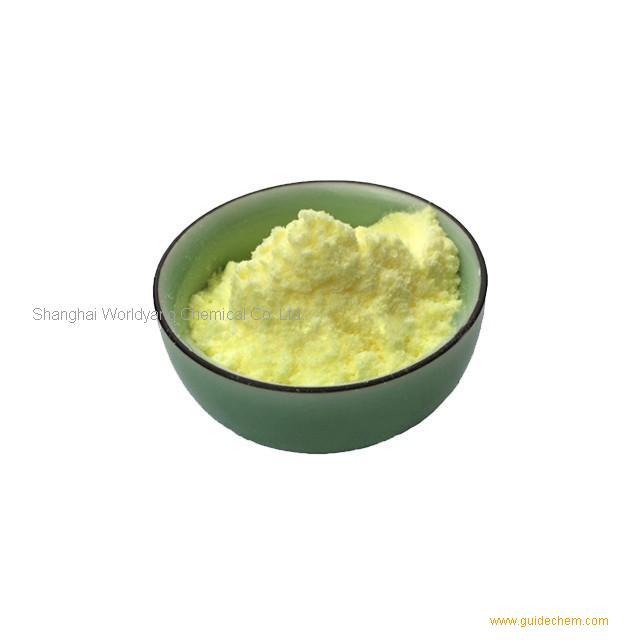
1,3,6,8-Pyrenetetrasulfonic acid tetrasodium salt, abbreviated PTSA and identified by CAS 59572-10-0, is a tetra-anionic pyrene fluorophore with an anhydrous molar mass of roughly 614 g/mol. Four sulfonate groups at the 1,3,6,8 positions convert a polycyclic aromatic hydrocarbon that is practically insoluble in water into a freely water-soluble salt needing no organic co-solvent, while the pyrene core retains the strong near-ultraviolet absorption, structured emission, long fluorescence lifetime, and excimer-forming behaviour that make pyrene derivatives the reference chromophore for microenvironment studies. It is supplied strictly as a research and reagent chemical, not as an active pharmaceutical ingredient or finished product.
Procurement quality for PTSA is defined on four axes rather than one. The degree of sulfonation must be genuinely tetra, because residual mono-, di-, and tri-sulfonated species have different spectral envelopes and partitioning behaviour; the substitution pattern must be the 1,3,6,8 isomer rather than a mixed isomer soup; water and inorganic salt carry-over, principally sodium sulfate from neutralisation, must be quantified; and fluorescence grade additionally requires a spectral purity and quantum yield certificate. A lot that assays 98% by HPLC area can still be unusable if it contains a fluorescent isomer impurity.
Commercially, the product sits at the intersection of two demanding regimes. As a sulfonated polycyclic aromatic it attracts questions about polycyclic aromatic hydrocarbon content, sulfonation waste streams, and wastewater loading; as a reagent entering life-science laboratories it must carry a clean Research Use Only position with no therapeutic or diagnostic claim. This paper addresses specification design, the fluorescence versus industrial grade split, REACH and TSCA verification, and the packaging and waste handling practices experienced buyers now insist upon before awarding supply.
The value of PTSA rests on pyrene photophysics. The rigid four-ring chromophore absorbs strongly in the near ultraviolet with a structured band system, shows a long singlet lifetime, and emits with resolved vibronic bands whose relative intensities report on local solvent polarity. Because sulfonation is performed on the ring rather than on a phenolic oxygen, the emission of PTSA is not pH-driven, which distinguishes it from the widely used pH probe pyranine, 8-hydroxypyrene-1,3,6-trisulfonic acid under CAS 6358-69-6, a distinction buyers must check when transferring literature methods between the two compounds.
Manufacturing is an electrophilic aromatic sulfonation problem rather than a multistep synthesis problem. Pyrene is sulfonated with oleum or fuming sulfuric acid, and the outcome is governed by acid strength, sulfur trioxide concentration, temperature ramp, and residence time; the 1,3,6,8 positions are the most activated and fill first, but driving to complete tetra-substitution without degradation or sulfone formation requires tight control and generous heat removal.
Demand is driven less by volume than by application breadth. Life-science reagent houses absorb a steady stream of small packs for assay development and methodological work; formulation scientists buy smaller quantities to probe surfactant systems; and materials groups purchase kilogram quantities as dispersants for carbon nanotube and graphene slurries used in battery electrodes and conductive coatings.
Feedstock geography drives capacity. Pyrene is recovered from coal tar and petroleum aromatic streams, so producers with access to those streams hold a structural cost advantage; China anchors this position and hosts the sulfonation capacity inherited from the dye intermediate industry. India supplies mid-tier material from its Gujarat and Maharashtra clusters, while Germany and Switzerland concentrate the chromatography and documentation needed for fluorescence grade. Export flows therefore run from Asian bulk producers to Western finishers, with the highest value added at the finishing end.
Price dispersion is extreme and often misunderstood. Industrial grade, sold on HPLC area percent and appearance alone, competes on neutralisation and drying cost. Fluorescence or spectroscopic grade carries an excitation and emission spectrum, an absorbance ratio check, a quantum yield figure, and a statement on fluorescent impurities, and can command an order of magnitude more per gram. Buyers who request the cheaper grade for a quantitative fluorescence assay routinely lose more in repeated experiments and failed method transfer than the grade premium would have cost.
The regulatory conversation has two halves that must not be confused. The first is chemical inventory compliance: the substance must be lawfully placed on the European market under REACH with a registration or an only-representative arrangement once tonnage thresholds are crossed, and it must carry an active TSCA Inventory designation for United States import. The second is end-use compliance: because PTSA is sold into research and diagnostic development environments, suppliers must hold a defensible Research Use Only position and must not support claims of therapeutic, diagnostic, or consumer benefit.
Sulfonation chemistry carries a recognisable environmental signature that buyers increasingly audit. The dominant burdens are spent sulfuric acid and oleum neutralisation, the inorganic salt load created when acid is neutralised to the sodium salt, and the chemical oxygen demand of aromatic residues in wastewater. Producers who recover or regenerate acid, who use membrane desalting instead of repeated recrystallisation to cut salt generation, and who treat aromatic-containing effluent before discharge consistently score better in customer audits than those relying on dilution.
Cradle-to-gate emissions are dominated by the aromatic feedstock and by the energy needed for concentration, drying, and membrane desalting rather than by the sulfonation step itself. Buyers measuring Scope 3 emissions should ask whether the pyrene came from coal tar or petroleum aromatic streams and whether the producer reports product carbon footprint data aligned with ISO 14067. Because downstream uses such as carbon nanotube dispersion serve battery and electronics chains, suppliers increasingly face cascaded carbon disclosure requests.
Traceability here means provenance of the polycyclic feedstock, control of process reagents, and documented absence of restricted aromatic impurities. Responsible suppliers declare feedstock origin, quantify residual polycyclic aromatic species, confirm the absence of intentionally added substances of very high concern, and operate ISO 9001 and ISO 14001 systems with retained samples. Retained samples matter operationally: a spectral discrepancy seen months later can be traced to a specific campaign rather than argued over without evidence.
PTSA is logistically forgiving compared with the sultones and trienes of this series, but it is not inert. It is a hygroscopic, light-sensitive, finely divided salt that cakes when it takes up moisture and that slowly photobleaches under strong illumination; both effects degrade quantitative fluorescence performance long before any chemical specification limit is breached.
Most notifications place this salt outside the dangerous-goods classes for transport, so it typically moves as non-regulated general cargo under IMDG, ADR, and IATA provided the supplier confirms that position in Section 14 of the safety data sheet for the specific packaging size; obtain that confirmation in writing rather than inferring it. Shipments should avoid prolonged high-temperature container dwell and be stored cool and dry on arrival. Waste handling is the counterpart obligation: sulfonated polycyclic aromatic residues should be collected as hazardous chemical waste and destroyed by high-temperature incineration, not discharged to sewer.
Growth in this market comes from grade discipline and documentation rather than from capacity. Suppliers that present PTSA as a single product lose to suppliers that present it as a two-tier portfolio with an explicit fluorescence specification. The following three moves are the ones that reliably shorten qualification cycles and protect margin.
1,3,6,8-Pyrenetetrasulfonic acid tetrasodium salt is a mature fluorophore whose commercial difficulty lies almost entirely in specification and positioning. The chemistry is well understood; what separates successful suppliers is control of sulfonation degree and isomer pattern, reduction of inorganic salt carry-over, and the willingness to certify optical performance rather than chromatographic area alone. Add a consistent Research Use Only stance, verified REACH and TSCA coverage, and packaging that genuinely excludes light and moisture, and the product becomes a dependable, high-margin reagent rather than a disputed powder.
Looking into 2026 and beyond, the growth vector is materials rather than assays. Demand for aqueous carbon nanotube and graphene dispersions in battery electrodes and conductive coatings is pulling kilogram volumes through channels designed for gram sales, favouring producers who can run membrane desalting at scale while still supporting a fluorescence-grade line. Those who invest in optical documentation, feedstock traceability, and sulfonation waste treatment will capture both ends of that market.
Powered by Guidechem
This white paper is exclusively compiled by the Guidechem Intelligence Team based on global customs data, regulatory databases, and industry research. Guidechem is a leading global B2B chemical platform, dedicated to connecting global buyers with verified, high-quality manufacturers.
Relying on Guidechem's extensive global database, we have mapped the core participants in the current global 1,3,6,8-Pyrenetetrasulfonic acid tetrasodium salt supply chain:
Disclaimer: The content of this white paper is compiled based on public market data and regulatory information available as of 2026. Global chemical regulations are subject to dynamic adjustments. In actual export operations, enterprises must consult professional regulatory advisors or relevant competent authorities to obtain the latest compliance guidance.
|
 |
 |
 |
 EN
 Agricultural News
 Food News
 Industrial News
 Cosmetic News
 Pharmaceutical News
 Science News


 5YRS

