-
We detected your language preference as English. Would you like to switch to the English version for a better experience?
Switch to English
Stay here


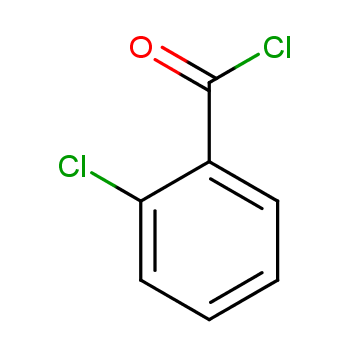
2-Chlorobenzoyl chloride (CAS 609-65-4, C7H4Cl2O, molecular weight 175.01) is the ortho-chlorinated aromatic acid chloride used as an acylating agent rather than as a structural ingredient. It is a colourless to pale yellow liquid boiling near 238 °C with density about 1.38 g/cm³ and a flash point above 100 °C. Its defining behaviour is hydrolytic: contact with water or moist air releases hydrogen chloride and converts the acid chloride to 2-chlorobenzoic acid, which is simultaneously the main quality failure mode and the main hazard.
Two route classes supply the market. One chlorinates the methyl group of 2-chlorotoluene through to the benzotrichloride stage and hydrolyses it back one step; the other treats 2-chlorobenzoic acid with thionyl chloride, phosgene-type reagents or phosphorus chlorides. The first is feedstock-efficient; the second is cleaner analytically but produces sulfur or phosphorus waste. Both converge on the same specification problem: free acid, hydrogen chloride and isomer carry-over.
Three issues dominate 2026 sourcing. Compliance sensitivity comes first, because the ortho-chlorobenzoyl motif appears in several controlled or internationally monitored substances, so reputable suppliers trade only against a signed end-use declaration with know-your-customer screening. Second, hazard: the substance is corrosive and water-reactive, moving under a Class 8 entry in anhydrous, lined, nitrogen-padded packaging. Third, quality: assay, free acid, isomer content and colour must be specified together, because free acid silently consumes base in the customer's acylation.
The molecule combines an acid chloride with an ortho-chlorinated ring, and both features matter. The acid chloride is the most electrophilic of the common carboxylic acid derivatives, so amines, alcohols and arenes acylate rapidly and irreversibly, usually with an amine or pyridine base to trap the hydrogen chloride formed. The ring chlorine withdraws electron density and adds bulk next to the reactive centre, and makes the resulting ortho-chloro aromatic carbonyl a stable element in the target.
Two route classes dominate, and the choice between them determines the impurity spectrum, the waste stream and indirectly the compliance posture of the plant. Both require anhydrous finishing and vacuum distillation.
Demand is tied to a small number of commercial molecules rather than to general industrial activity, so volumes are steady but lumpy and highly customer-specific. Off-patent competition in pharmaceuticals and agrochemicals, capacity additions in China and India, and European pressure on chlorinated aromatics all shape the picture. Through 2026, buyers are consolidating supply toward vendors with complete REACH and TSCA files, and compliance screening has lengthened the onboarding of new accounts.
Capacity sits mainly in China, especially in Shandong, Jiangsu and Zhejiang, where integrated chlorine, toluene and benzoic acid assets support both routes at scale. Indian producers in Gujarat and Maharashtra supply domestic agrochemical and pharmaceutical customers and export to regulated markets with stronger documentation. European production is smaller and focused on high-purity campaigns and repacking, with Rotterdam and Antwerp used for regional stocking. Flows run from Asia to Europe and North America.
Price tracks chlorine and toluene or benzoic acid cost, distillation energy and, decisively, specification and compliance overhead. Technical grade at 98 to 99% with uncontrolled isomer content is contestable; material at 99.5% or better with free acid capped, isomer limits, colour specification and a full documentation pack carries a meaningful premium. Freight and compliance cost per kilogram is materially above that of a neutral liquid, and buyers comparing only unit prices misread landed cost.
Beyond the routine inventory and classification obligations, this product carries a specific commercial sensitivity. The ortho-chlorobenzoyl motif occurs in substances that are controlled or under international surveillance, and while the acid chloride itself is a legitimate industrial reagent, reputable trade requires end-use declarations, know-your-customer screening and, where applicable, national precursor registrations and permits. Buyers should expect to document legitimate use.
Chlorine chemistry is energy-intensive and its waste streams are tightly regulated, so environmental performance is a real differentiator rather than a brochure item. Buyers increasingly ask for evidence on three fronts: hydrogen chloride recovery rather than neutralisation, treatment of chlorinated volatile organic compounds in off-gas, and control of adsorbable organic halogen in effluent. Certification to ISO 14001, EcoVadis or Together for Sustainability assessment and a product carbon footprint aligned to ISO 14067 now feature in most European enquiries.
Emissions concentrate in chlorine and hydrogen chloride handling, in the vacuum distillation that delivers specification, and in the scrubbing and wastewater treatment that follow. Credible reduction levers are recovering hydrogen chloride as saleable acid or recycling it to chlorination, thermal oxidation with acid-gas scrubbing for chlorinated volatile organic compounds, and heat integration on the distillation train. Customers increasingly want cradle-to-gate figures per lot rather than corporate averages.
Traceability expectations combine the usual REACH and TSCA documentation with end-use traceability. Suppliers should retain the end-use declaration, know-your-customer screening result and shipping records for every lot, and be able to demonstrate that the customer is a legitimate industrial user. Where a customer's own product is regulated, the supplier is normally asked to support audits. Chain-of-custody documentation through any repacking or bulk transfer completes the picture.
Everything in the logistics chain follows from the reaction with water. Packaging, segregation, venting policy, protective equipment and emergency response all assume that any leak will generate hydrogen chloride gas and acidic chlorinated liquid, and that the product will degrade if the headspace is not dry.
Shipments typically move as UN 3265, corrosive liquid acidic organic not otherwise specified, Class 8, with the packing group set by the notified classification; the shipper must confirm the entry and any air-freight passenger or cargo restriction per lot from the current safety data sheet. Sea freight follows the IMDG Code with corrosive labelling and segregation from alkalis and foodstuffs, while road and rail follow ADR and RID. ISO tank containers are preferred for bulk because they avoid repeated transfers, and emergency response guidance must name hydrogen chloride evolution as the primary release scenario.
Three moves determine success for suppliers: make compliance screening a capability, sell anhydrous integrity, and treat hydrogen chloride as an asset rather than a waste. None requires additional reactor capacity.
2-Chlorobenzoyl chloride is a well-established acylating agent shaped commercially by its hazard and compliance sensitivity. It delivers an ortho-chlorobenzoyl group efficiently and irreversibly, releasing one mole of hydrogen chloride per mole of product, and that single fact drives packaging, transport, plant design and waste treatment. Keeping the chain anhydrous is most of the operational task.
The 2026 outlook rewards disciplined suppliers. Demand is stable, Chinese and Indian capacity keeps pressure on commodity grades, and buyers continue to raise documentation and screening expectations. Vendors combining end-use compliance, verified REACH and TSCA status, anhydrous packaging integrity and hydrogen chloride recovery will hold their margins; those treating the product as an ordinary drum chemical will meet regulatory and quality problems long before they meet a price ceiling.
Powered by Guidechem
This white paper is exclusively compiled by the Guidechem Intelligence Team based on global customs data, regulatory databases, and industry research. Guidechem is a leading global B2B chemical platform, dedicated to connecting global buyers with verified, high-quality manufacturers.
Relying on Guidechem's extensive global database, we have mapped the core participants in the current global 2-Chlorobenzoyl Chloride supply chain:
Disclaimer: The content of this white paper is compiled based on public market data and regulatory information available as of 2026. Global chemical regulations are subject to dynamic adjustments. In actual export operations, enterprises must consult professional regulatory advisors or relevant competent authorities to obtain the latest compliance guidance.
|
 |
|
|
 EN
 Agricultural News
 Food News
 Industrial News
 Cosmetic News
 Pharmaceutical News
 Science News


 1YR

