
I. Executive Summary
PEG-2 cocomonium chloride (CAS 61791-10-4) belongs to the family of ethoxylated quaternary ammonium compounds derived from coconut-range fatty alkyl chains. Structurally it is a permanently charged cationic surfactant in which a quaternised nitrogen carries a coco alkyl group, a methyl group and hydroxyethyl-derived polyoxyethylene chains, with chloride as the counter-ion. Because both the alkyl chain distribution and the ethylene oxide chain distribution are statistical rather than discrete, the commercial substance is registered and described as an unknown or variable composition substance, and that fact shapes every regulatory and analytical conversation around it.
Commercially the molecule serves two different value pools that ask for very different things. In the higher-value pool, personal care and specialty conditioning applications require low colour, low odour, tightly documented residuals and manufacturing under recognised cosmetic good manufacturing practice. In the larger industrial pool, the same chemistry serves fabric care, textile auxiliaries, cationic bitumen emulsions and antistatic treatment, where robustness and price dominate. Between the two sit formulation-level obligations that belong to the downstream manufacturer, not to the supplier.
This white paper addresses industrial buyers, registrants, contract manufacturers and compliance officers. It examines how PEG-2 cocomonium chloride is made at the route-class level, which residuals actually determine acceptance, how European and North American instruments treat cationic surfactants and their impurities, and how oleochemical traceability requirements are reshaping sourcing. It deliberately provides no consumer-facing guidance and no formulation or use-level advice; nitrosamine control in finished products is the validated responsibility of the downstream manufacturer.
II. Product Deep Dive: Molecular Mechanisms and Production Evolution
2.1 Physicochemical Properties and Mechanisms
Function follows the charge. The quaternary nitrogen is permanently cationic across the whole pH range in which these systems are used, so adsorption onto negatively charged surfaces is electrostatic and effectively instantaneous. The hydroxyethyl-derived ethoxylate chains tune the balance between substantivity and water dispersibility; increasing the ethylene oxide content increases tolerance to electrolytes and hardness and improves cold-water behaviour, while excessive ethoxylation dilutes surface activity and reduces deposition.
- Substantivity and surface modification: Adsorption onto keratin, cellulose and many mineral surfaces produces a durable lubricating monolayer that delivers combability, softness and antistatic behaviour even after rinsing. Performance tracks the coco alkyl distribution, because lauric-range chains dominate the balance between water solubility and deposition, and batches with a shifted chain distribution behave measurably differently in the customer's own validated test methods.
- Charge-driven incompatibility: The same permanent charge that delivers substantivity causes charge neutralisation and precipitation when these actives meet anionic surfactants or anionic polymers. Compatibility management, preservative interaction and electrolyte effects are therefore formulation-level matters handled by the downstream manufacturer, and ingredient suppliers support that work with charge density, active assay and composition data rather than with recommendations.
2.2 Synthesis and Manufacturing Technologies
Two route classes account for essentially all commercial material, differing mainly in the order in which ethoxylation and quaternisation are performed. Choice between them is driven by target colour, target residual profile and available assets. What actually differentiates suppliers is finishing: how completely residual ethylene oxide, 1,4-dioxane, unquaternised amine and residual quaternising agent are removed, and how consistently the ethylene oxide number distribution is held from lot to lot.
- Ethoxylation and oligomer distribution control: Controlled addition of ethylene oxide to the hydroxyethyl-substituted tertiary amine under alkaline catalysis produces a statistical oligomer distribution. Reaction control targets the nominal average adduct number while limiting by-products, and residual ethylene oxide plus 1,4-dioxane are reduced by vacuum and steam stripping with subsequent verification. The resulting chain-length distribution must be recorded because it is part of the substance identity, not merely a quality attribute.
- Quaternisation, counter-ion and impurity purge: Quaternisation is performed with methylating agents, and where the target is the chloride salt the counter-ion is obtained either directly or through metathesis from the corresponding methyl sulfate salt, which is why residual control programmes cover both methylating-agent residues and ionic balance. Finished lots are released against free amine and amine salt, chloride content, pH, active assay, Hazen colour and odour, plus gas chromatographic confirmation that residual alkylating agent is below the agreed acceptance criterion.
2.3 Core Application Matrix
- Rinse-off conditioning systems: The principal high-value outlet is use as a conditioning and antistatic ingredient in rinse-off hair care formulations, where substantivity to damaged keratin is the functional objective. Manufacturers supply ingredient data; use conditions, restrictions and safety substantiation belong to the cosmetic Responsible Person.
- Fabric care and textile auxiliaries: In household and industrial softening, the cationic headgroup deposits onto cotton and synthetic fibres to deliver softness and static control, and the ethoxylate content supports cold-water dispersibility in concentrated systems relative to older-generation quat chemistries.
- Cationic bitumen emulsions and industrial auxiliaries: The product functions as an emulsifier and adhesion promoter for cationic bitumen emulsions and as an antistatic and anti-caking agent in mineral processing and pigment handling, markets which value consistent active content and reliable viscosity more than sensory attributes.
III. Global Market Supply-Demand Landscape and Export Trends
3.1 Demand Drivers and Market Shifts
Volume growth is concentrated in Asia-Pacific personal care markets, where rising consumption of rinse-off conditioning products sustains cationic surfactant demand, and in fabric care formats that are moving toward compacted and cold-water products. Against this, the mature European and North American markets exert downward pressure on persistent cationic structures through brand-formulator sustainability commitments, which is why ester-containing quaternaries and other readily biodegradable structures continue to take share in fabric softening applications.
3.2 Capacity Distribution and Export Flows
The value chain is layered. Coconut-range oils and their methyl esters are converted to fatty alcohols and fatty amines predominantly in Southeast Asian oleochemical complexes, and those intermediates are then quaternised either in the same complexes, in Chinese and Indian surfactant plants, or in Western facilities serving high-specification cosmetic customers. Export flows therefore run from feedstock-producing Southeast Asia into quaternisation hubs, followed by second-tier flows of finished grades into European, North American and domestic Asian formulation markets.
3.3 Market Bifurcation and Pricing Dynamics
Price bifurcates between industrial material sold on active content alone and personal care material sold against an extended panel covering colour, odour, residual ethylene oxide, 1,4-dioxane and alkylating-agent content, supported by audits. That second tier commands a durable premium, and the premium is rising rather than falling as procurement teams internalise the cost of their own finished-product testing. Feedstock exposure is dominated by lauric oil pricing, so coconut and palm kernel oil markets, alongside refinery energy costs, transmit into offers faster than plant-level conversion economics.
IV. In-depth Analysis of Global Compliance and Regulatory Barriers
For this ingredient, compliance is a shared object. The supplier owns registration, classification and residual control; the downstream manufacturer owns use conditions, safety substantiation, finished-product restrictions and any finished-product specific testing. Deals fail when one party assumes the other has covered a gap, and the two most common gaps are residual impurities from manufacture and restrictions that attach to use rather than to the substance.
4.1 European Market: REACH, CLP, and Sector-Specific Directives
- REACH registration and CLP classification: Registration must describe the variable composition through an analytical fingerprint covering both alkyl and ethylene oxide distributions, supported by exposure scenarios for formulation and industrial uses. Classification is the commercially decisive part: cationic surfactants frequently assign as acute hazardous to the aquatic environment with a multiplying factor and as irritant, which cascades into mixture classification for the customer's products, drives environmental labelling claims and attracts scrutiny during any restriction review of cationic surfactant groups under current chemicals policy.
- Cosmetic and detergent frameworks: In cosmetic applications the ingredient is used under the responsibility of the Responsible Person established by the Cosmetics Regulation, with any conditions attached through the restriction entries checked against the finished product's rinse-off or leave-on classification and label. In detergent applications the surfactant must satisfy the biodegradability requirements set for surfactants in detergents, meaning documented ready biodegradability testing and recognition that derogations may be required for this surfactant group.
4.2 North American Market: TSCA, EPA, and FDA Regulations
- TSCA obligations and residual listings: Commercial grades are covered by inventory listings appropriate to variable-composition substances, and importers must confirm the correct listing and active designation before entry, while periodic chemical data reporting obligations apply above the applicable tonnage threshold. Independently, trace ethylene oxide and 1,4-dioxane are addressed by listing regimes and state chemical policy rather than by TSCA itself, so specification limits for these two impurities are set by downstream market access, not by federal inventory law.
- US cosmetics facility and listing duties: The Modernization of Cosmetics Regulation Act introduced mandatory facility registration and product listing, responsible-person accountability, records that must be available to the authority on request, and the framework for future good manufacturing practice rulemaking. Combined with state-level restrictions on 1,4-dioxane in personal care and cleaning products, this places the burden for finished-product compliance on the brand or contract manufacturer while pushing ingredient suppliers to supply auditable residual data.
4.3 The Critical Hurdle: Quality Control and Safety Limits
Compliance Warning: The decisive barrier for this ingredient is the residual panel, and specifically the combination of residual ethylene oxide, residual 1,4-dioxane and residual alkylating agent. Ethylene oxide and 1,4-dioxane are subject to restriction entries in the EU REACH restricted substances list and to listing-driven and state-level limits in the United States, so a lot that is nominal-compliant on active content can still be unsellable in those markets. Buyers should therefore specify numeric acceptance criteria with named analytical methods for all three residuals, plus limits for free amine and amine salt, pH, chloride content, colour and odour, and require per-lot certification rather than a typical data sheet. Where quaternisation involves alkylating agents of genotoxic concern, the supplier must demonstrate purge to an agreed limit using a validated method and must not rely on process assumptions. Finally, nitrosamine assessment cannot be delegated upstream: finished-product nitrosamine control, including the assessment of any precursor amine inventory and of the finished matrix, is the validated responsibility of the downstream manufacturer, and this white paper deliberately provides no nitrosating conditions or formulation instructions of any kind.
V. Green Trade Barriers and ESG in Manufacturing
Few intermediates carry a sustainability narrative as contested as this one. It is derived from tropical plantation oils on the one hand, and it is a persistent cationic surfactant on the other, so customers simultaneously ask for deforestation-free evidence and for reassurance about aquatic fate.
5.1 Carbon Footprint and Circular Economy
Cradle-to-gate emissions are dominated upstream by plantation-to-refinery operations and downstream by hydrogenation and residual stripping energy, so supplier programmes prioritise renewable electricity, heat recovery around strippers and reduced stripping cycles enabled by better reaction control. Because quaternary ammonium structures are designed to persist long enough to deliver substantivity, end-of-life fate is the honest limitation of this chemistry: producers seeking to defend wastewater-derived risk narratives should support customers with verified biodegradation screening data and, where suitable, offer ester-containing alternatives with improved ultimate biodegradability profiles.
5.2 Sustainable Sourcing and Traceability
Coconut-derived lauric streams sit close to palm-derived ones in integrated refineries, so even where coconut itself is not listed among the regulated commodities under the European Union Regulation on deforestation-free products, buyers should expect full geolocation, legality and risk-mitigation evidence equivalent to that required for listed commodities, particularly where refineries co-process listed materials. Most large producers market these oleochemicals through mass-balance book-and-claim systems, and ISO 16128 natural-origin calculations are used for labelling. That said, quaternary ammonium surfactants generally fall outside accepted natural and organic cosmetics certification schemes, so using RSPO-style or book-and-claim credentials as evidence of certification under those schemes would be misleading and should be avoided.
VI. Supply Chain Resilience and Export Logistics
Logistics failures here are rarely about chemistry. They are about temperature history, microbial stability of aqueous grades, and contamination from equipment carrying anionic residues into a cationic product, producing haze that appears during incoming inspection.
6.1 Packaging Standards and Moisture/Contamination Control
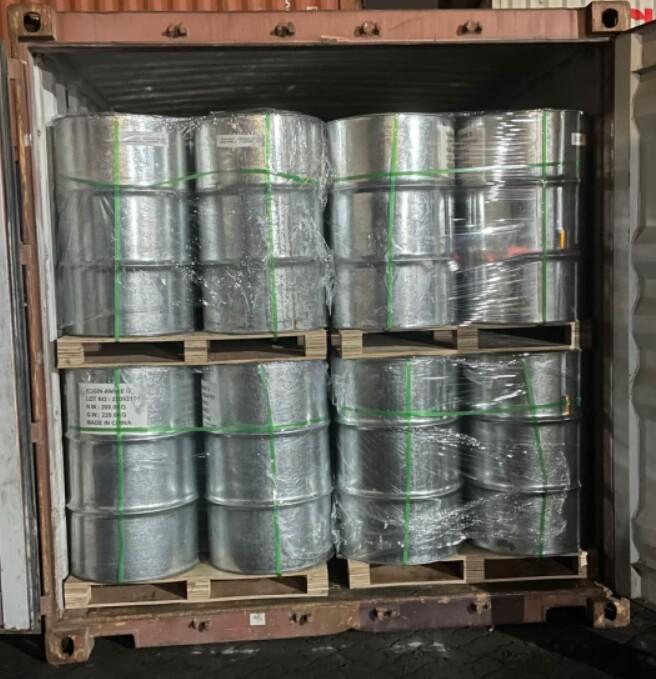
- Dedicated cationic-compatible containment: Bulk consignments move in stainless steel isotanks or lined drums reserved for cationic material, because even small anionic carryover from a previous cargo causes visible precipitation. Where grades are supplied as aqueous solutions, the primary packaging must be closed under hygienic conditions, and protection against contamination depends on the manufacturer's validated in-can preservation system and its own hygiene controls, which is why customers should confirm that an aqueous grade carries a documented preservation and hygiene programme.
- Temperature, colour and odour control: Storage and transit temperature must stay within the supplier's stated band, warm enough to keep viscous grades pumpable but not hot enough to accelerate oxidation. Elevated temperature during a long tropical dwell drives visible colour growth and aldehyde-type odour notes, both of which are cosmetic-grade reject criteria even when all chemical limits remain in specification.
6.2 Dangerous Goods Identification and Transit Protocols
Transport assignment follows the verified classification of the specific aqueous or concentrated grade. Many personal care grades are consigned without a dangerous-goods entry, but where a grade assigns as environmentally hazardous because of aquatic classification it is shipped under the environment, liquid, not otherwise specified entry of hazard class 9, packing group III, with marine pollutant marking under the International Maritime Dangerous Goods Code and with correspondingly restricted acceptance for air freight. Aqueous grades must never be allowed to freeze, because phase separation on thawing permanently damages homogeneity, and ISO tank movements typically use temperature-controlled or temperature-monitored equipment with records retained to support any subsequent quality investigation.
VII. Enterprise Global Expansion Strategy Guide
Suppliers aiming to move up the value chain should treat documentation and application support as the product, since the chemistry itself is mature.
- Make the low-residual panel standard: Rather than charging for it, build ethylene oxide, 1,4-dioxane and alkylating-agent control into the base specification with named validated methods and per-lot certification. Customers increasingly treat missing residual data as a disqualification rather than as a negotiable cost item.
- Segment dossiers by end market: Maintain separate documentation sets for cosmetic, detergent and industrial customers, supported by ISO 22716 aligned manufacturing for the cosmetic tier, plus Chinese import requirements covering filing against the existing cosmetic ingredient inventory and the separate new-ingredient registration pathway where applicable.
- Dual-plant and dual-platform positioning: Combine feedstock-adjacent capacity in Southeast Asia with high-spec finishing in Europe or North America, and pair this legacy quat with an ester-containing platform so that customers reformulating toward improved biodegradability remain customers.
VIII. Conclusion
PEG-2 cocomonium chloride remains a workhorse cationic surfactant whose economics are dictated less by its performance than by its paperwork. Its performance in conditioning, softening and cationic emulsification is well understood and reproducible; its market access is determined by residual control, defensible classification, audited manufacturing and credible oleochemical traceability.
Through 2026 and beyond, volume growth will continue to come from Asian personal care and concentrated fabric care, while mature markets mature through sustainability-driven substitution toward more biodegradable structures. Suppliers who invest in residual analytics, honest sourcing documentation for lauric feedstocks and a parallel improved-biodegradability platform will retain customer relationships even as specific grades decline, and will avoid the reputational risk of overselling certification credentials this chemistry cannot support.
IX. Industry Resource Connection and Supplier Ecosystem
Powered by Guidechem
This white paper is exclusively compiled by the Guidechem Intelligence Team based on global customs data, regulatory databases, and industry research. Guidechem is a leading global B2B chemical platform, dedicated to connecting global buyers with verified, high-quality manufacturers.
Relying on Guidechem's extensive global database, we have mapped the core participants in the current global PEG-2 cocomonium chloride supply chain:
- Southeast Asian oleochemical complexes: Indonesian, Malaysian and Philippine producers convert coconut and palm kernel streams into fatty alcohols and fatty amines, offering the shortest route from plantation to quaternisation and setting the cost floor for coco-derived cationic surfactant through mass-balance and book-and-claim sustainability mechanisms.
- Chinese and Indian quaternisation capacity: Large multipurpose surfactant plants operate both ethoxylation and quaternisation assets, serving domestic formulation growth and exporting industrial and emerging cosmetic grades, increasingly competing on residual analytics and consistent extension across distribution rather than on price alone.
- Western European and North American specialists: Higher-specification producers hold REACH registrations, ISO 22716 aligned manufacturing and deep regulatory dossiers, supplying customers whose brands require auditable residuals documentation and defensible mixture classification support.
Disclaimer: The content of this white paper is compiled based on public market data and regulatory information available as of 2026. Global chemical regulations are subject to dynamic adjustments. In actual export operations, enterprises must consult professional regulatory advisors or relevant competent authorities to obtain the latest compliance guidance.


 EN
 Agricultural News
 Food News
 Industrial News
 Cosmetic News
 Pharmaceutical News
 Science News


 4YRS


