
I. Executive Summary
Calcifediol monohydrate (CAS 63283-36-3), the crystalline monohydrate of 25-hydroxyvitamin D3, is unusual in the fine-chemical trade: it is both a regulated active pharmaceutical ingredient with approved medicinal presentations in major markets and a high-value food and feed ingredient. A GMP-bound lot must carry a DMF, ASMF or CEP reference and an ICH Q7 manufacturing statement; a food or feed lot must instead meet supplement or feed-additive authorisations. Buyers who conflate the two find that their paperwork does not match their declared end use.
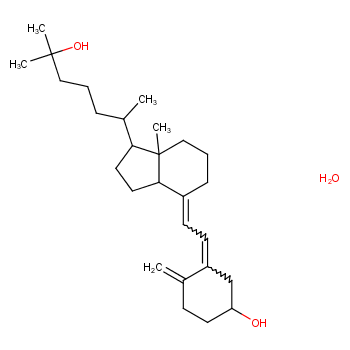
Chemically, calcifediol is the C-25-hydroxylated secosteroid derived from cholecalciferol, and the monohydrate carries one water of crystallisation, a little over four percent by weight. Because potency may be expressed on the as-is or the dried basis, a two percent disagreement in water content becomes the same disagreement in apparent assay. Industrial routes start from cholesterol or 7-dehydrocholesterol and install the 25-hydroxyl group by photochemical secosteroid chemistry or by direct chemical or enzymatic C-25 hydroxylation of a pre-formed skeleton.
This paper treats the molecule from a procurement standpoint: the pharmacopoeial and ICH framework for the pharmaceutical grade; the EU written-confirmation regime for imported active substances under Directive 2001/83/EC as amended by the Falsified Medicines Directive; the US DMF and establishment-registration pathway; NMPA active-substance registration in China; and the food and feed perimeter. Medicinal status is noted only as a registration fact. No health, efficacy or dosing claim is made or implied.
II. Product Deep Dive: Molecular Mechanisms and Production Evolution
2.1 Physicochemical Properties and Mechanisms
Calcifediol is the circulating 25-hydroxylated metabolite of cholecalciferol, formed by hepatic hydroxylation and further converted to the 1α,25-dihydroxy species by renal CYP27B1. For a manufacturer the relevance of that pathway is analytical rather than therapeutic: it fixes the structure the specification must prove and the related substances a credible impurity profile must resolve. The molecule is lipophilic, poorly soluble in water, and degrades under light, oxygen and heat.
- Secosteroid architecture and isomeric liability: The triene is photochemically and thermally labile; the B-ring can reopen to previtamin forms and the 5,6-double bond can isomerise to trans geometry. Specifications must resolve 25-OH-D3 from 1α-OH-D3, 5,6-trans-25-OH-D3 and previtamin D3, typically by reversed-phase HPLC near 265 nm with LC-MS/MS confirmation. Since the 1α-hydroxylated analogue is far more potent per unit mass, cross-contamination in a multi-product plant is a safety issue as much as a specification issue.
- Monohydrate stoichiometry and hydrate stability: Water content is controlled by Karl Fischer titration within a narrow band, and the hydrate must survive drying, milling and packaging without converting to a lower hydrate or an amorphous form; DSC, TGA and XRPD confirm the solid form. Assay is reported both as-is and on the dried basis, so the contract should state which basis governs release and payment.
2.2 Synthesis and Manufacturing Technologies
Commercial manufacture is a two-part problem: build the secosteroid triene with the correct C-25-functionalised side chain, then install the 25-hydroxyl group regioselectively without damaging the triene. Plants that also make cholecalciferol, alfacalcidol or calcitriol share the same photochemical front end, so campaign planning and equipment segregation sit at the centre of quality assurance.
- Photochemical secosteroid route class: Filtered UV irradiation of 7-dehydrocholesterol, or of elaborated cholesterol, opens the B-ring to a previtamin intermediate that is thermally equilibrated to the vitamin triene; the side chain must already carry the C-25 function. Critical control points are irradiation dose and wavelength distribution, which fix the previtamin and trans-isomer ratio, and the thermal isomerisation step, run under oxygen exclusion. Exact photolysis conditions are plant intellectual property.
- Direct C-25 hydroxylation, chemical and biocatalytic: Chemical variants use allylic or tertiary C–H functionalisation with strong oxidants and need protecting groups and chromatography. Biocatalytic variants exploit cytochrome P450 monooxygenases or engineered microbial hydroxylases with cofactor regeneration, offering regioselectivity chemical oxidation struggles to match and avoiding metal residues, at the cost of lower productivity and a downstream that must clear protein, host-cell DNA and endotoxin.
2.3 Core Application Matrix
- Pharmaceutical active substance: Calcifediol is an established active substance with approved medicinal presentations in major markets, including extended-release oral products authorised in the United States and calcifediol-containing medicinal products authorised in European member states; that status is stated strictly as a registration fact. Material for this channel must be made under ICH Q7 GMP and supported by an open or closed DMF, ASMF or CEP.
- Authorised feed additive for poultry: 25-hydroxycholecalciferol is an authorised nutritional feed additive in the European Union under Regulation (EC) No 1831/2003 for specified poultry categories, with an authorising measure fixing identification, purity criteria and conditions of use. This is a feed supply, not an API supply: limits come from the authorising regulation and feed-hygiene law.
- Food supplements and analytical standards: As a supplement ingredient the substance falls under Directive 2002/46/EC, but since it is not among the vitamin forms in Regulation (EC) No 1170/2009, a novel-food assessment under Regulation (EU) 2015/2283 is normally required first. In the United States the DSHEA framework with 21 CFR Part 111 cGMP applies.
III. Global Market Supply-Demand Landscape and Export Trends
3.1 Demand Drivers and Market Shifts
Pharmaceutical demand is anchored by established medicinal presentations and by generic and reformulation activity; feed demand tracks poultry economics and the comparative cost of the additive against conventional cholecalciferol. The direction of travel in 2026 is the same across both: buyers are consolidating onto fewer, better-documented suppliers and specifying assay basis, isomer limits and solid form in the contract rather than leaving them to the certificate of analysis.
3.2 Capacity Distribution and Export Flows
Photochemical capacity is capital-intensive and concentrated, and few plants run the irradiation step under GMP. Intermediates and crude secosteroid are widely traded from China and India, while final purification, hydrate control, micronisation and release testing happen at integrated sites or at European finishing facilities. Flows run in two tiers: intermediates by sea under controlled temperature, finished API by air under qualified cold chain.
3.3 Market Bifurcation and Pricing Dynamics
The market is sharply bifurcated. GMP material with dossier support commands a multiple of the price of undifferentiated material, and the premium reflects documentation, audit readiness and dedicated-campaign costs rather than scarcity. Feed and food grades price much closer to sterol feedstock, purification yield and solvent recovery. Because assay-basis disputes can move the effective price by several percent, contracts should fix a basis and name a referee method.
IV. In-depth Analysis of Global Compliance and Regulatory Barriers
Compliance is best understood as three parallel regimes governing one molecule: the pharmaceutical regime in the European Union and United States plus the NMPA regime in China, the food-supplement regime, and the feed-additive regime. The most frequent failure is not chemical but one of alignment — a lot documented for one perimeter being offered into another. Procurement teams should fix the declared end use before issuing the order.
4.1 European Market: REACH, CLP, and Sector-Specific Directives
- Active-substance import under Directive 2001/83/EC Articles 46b and 46f: Active substances imported into the European Union must be made to GMP at least equivalent to EU standards and accompanied by a written confirmation from the competent authority of the exporting country, a regime introduced by Directive 2011/62/EU on falsified medicines. The confirmation must cover the specific site and be held by the importer before release. GMP Part II and Annex 16 expectations apply to the importer's own system.
- Food and feed perimeter — 2002/46/EC, 1170/2009, 2015/2283 and 1831/2003: As a supplement ingredient the substance falls under Directive 2002/46/EC, but since it is not among the vitamin forms listed in Regulation (EC) No 1170/2009, a novel-food assessment under Regulation (EU) 2015/2283 is normally required, turning on evidence of significant consumption in the Union before 15 May 1997. As a feed additive it is governed by its authorisation under Regulation (EC) No 1831/2003.
4.2 North American Market: TSCA, EPA, and FDA Regulations
- FDA Drug Master File and establishment registration: For pharmaceutical use the site is referenced through a Type II DMF incorporated by the applicant, and the facility must be registered and listed under 21 CFR Part 207. The site is subject to FDA inspection, and the file must stay current with the route, impurity profile, solid form and packaging actually supplied; a DMF describing the anhydrous form cannot silently support a monohydrate supply.
- Dietary-ingredient framework — DSHEA and 21 CFR Part 111: Material for dietary supplements is governed by DSHEA and by Part 111 cGMP, including identity testing on receipt and component specifications. Where the ingredient lacks a documented history, new-dietary-ingredient notification considerations arise. Elemental-impurity and microbiological criteria in the food channel come from food-grade specifications rather than ICH Q3D.
4.3 The Critical Hurdle: Quality Control and Safety Limits
Compliance Warning: The decisive hurdle is the combination of isomer resolution, hydrate water content and elemental impurities. A supplier reporting a single "assay by HPLC" figure without resolving 25-OH-D3 from 1α-OH-D3, the 5,6-trans isomer and previtamin D3 has not established identity in any meaningful sense, and a certificate showing assay on an undeclared basis, or water content determined weeks before shipment, is inadequate. Buyers should require ICH Q1A stability data on the packaged configuration shipped, an ICH Q3D elemental-impurity assessment, ICH Q3C solvent statements and documented TSE/BSE status where the sterol is animal-derived.
V. Green Trade Barriers and ESG in Manufacturing
ESG scrutiny centres on three genuinely material issues: the animal origin of the sterol feedstock, the energy and solvent intensity of irradiation and purification, and traceability back to the cholesterol source. European customers increasingly demand written answers during qualification, and those answers must survive audit.
5.1 Carbon Footprint and Circular Economy
The photochemical step and the chromatography that follows dominate the energy and solvent footprint, so process mass intensity and E-factor are high by pharmaceutical standards. Sites certified to ISO 14001 normally report solvent recovery, energy per kilogram released and the fate of spent solvent, and buyers assessing Scope 3 emissions increasingly ask for those figures rather than a generic sustainability statement. Biocatalytic hydroxylation cuts solvent load and oxidant waste where productivity allows.
5.2 Sustainable Sourcing and Traceability
Cholesterol is commonly derived from lanolin in sheep's wool grease, alternatively from fish oils or phytosterol fermentation, and each origin carries a different documentation burden. Animal-origin material requires traceability to source and a TSE/BSE risk assessment, and the pharmaceutical dossier must address the relevant transmissible spongiform encephalopathy guidance. Food and feed customers additionally ask for halal and kosher certification, non-GMO statements, allergen declarations and segregation evidence.
VI. Supply Chain Resilience and Export Logistics
Calcifediol monohydrate is a light-, oxygen- and heat-sensitive solid shipped in small, high-unit-value lots. Protection from photo-degradation and oxidation, rather than any bulk-hazard consideration, drives packaging and mode selection, and it makes a temperature excursion a quality event rather than a service complaint.
6.1 Packaging Standards and Moisture/Contamination Control
- Amber, inert and oxygen-excluded primary packaging: API lots are packed in amber glass or amber high-barrier containers under nitrogen or argon headspace with an oxygen scavenger and an induction-sealed closure. Because the solid must retain its monohydrate stoichiometry, the desiccant strategy has to be designed rather than assumed: an aggressive desiccant can strip water of crystallisation and push the material out of specification.
- Cold chain, monitoring and hydrate-safe handling: Shipments travel at controlled refrigerated temperature with continuous logging and, for high-value lots, GPS and light-exposure indication. Container qualification should demonstrate maintenance of the range under realistic lane profiles, and the receiving procedure should define the response to an excursion — normally quarantine and assessment against the stability dataset.
6.2 Dangerous Goods Identification and Transit Protocols
Transport classification must come from the current safety data sheet and the current adaptation to technical progress of the CLP Regulation, not be assumed from the fact that this is a vitamin derivative. Vitamin D analogues carry acute-toxicity and specific-target-organ classifications that, where they apply to a consignment, drive a Class 6.1 toxic-solid assignment under UN 2811 with the corresponding ADR, IMDG and IATA packing instructions. Where they do not apply, the material travels as a temperature-controlled pharmaceutical consignment, but the SDS, labelling and carrier declaration must still be consistent.
VII. Enterprise Global Expansion Strategy Guide
Suppliers win here on documentation discipline rather than price. The buyers are pharmaceutical companies, feed formulators and reference-standard houses; their qualification cycles are long, their audits substantive and their tolerance for unaligned paperwork close to zero.
- Fix grade, form and assay basis at contract stage: State whether the material is pharmaceutical, food or feed grade, that the solid form is the monohydrate, and which basis governs reported and paid assay. Define referee methods for water, assay and isomer content and require the certificate of analysis to show all of them together.
- Build the dossier, not just the drum: Maintain a Type II DMF or an ASMF or CEP matching the commercial process and solid form, obtain and hold the EU written confirmation for the site, complete NMPA active-substance registration and be ready for the associated inspection, and hold ISO 9001 and ISO 14001 alongside GMP.
- Dual-source across regions and audit separately: Qualify at least one Asian and one European or North American source and audit both against one protocol, since failure modes differ: feedstock traceability and campaign segregation at integrated Asian sites, capacity and cost at Western sites. Re-verify isomer and elemental-impurity profiles on every lot.
VIII. Conclusion
Calcifediol monohydrate concentrates its commercial risk in specification and documentation rather than in availability. The chemistry is well understood, the route classes are established and capacity exists. What separates a supplier who clears qualification from one who does not is the ability to resolve the isomer profile, to define and hold the monohydrate stoichiometry, to state the assay basis unambiguously and to produce the regulatory artefact appropriate to the declared end use.
Looking into 2026 and beyond, the structural trends are continued movement toward biocatalytic hydroxylation where productivity allows, tightening expectations around animal-origin traceability and TSE status, and a widening gap between dossier-backed GMP material and undifferentiated material sold into food, feed and research channels. Organisations investing in the dossier and in dual-regional sourcing will supply all three perimeters; those competing only on unit price will not.
IX. Industry Resource Connection and Supplier Ecosystem
Powered by Guidechem
This white paper is exclusively compiled by the Guidechem Intelligence Team based on global customs data, regulatory databases, and industry research. Guidechem is a leading global B2B chemical platform, dedicated to connecting global buyers with verified, high-quality manufacturers.
Relying on Guidechem's extensive global database, we have mapped the core participants in the current global Calcifediol monohydrate supply chain:
- China — integrated sterol-to-secosteroid base: Chinese producers hold the deepest upstream position, from lanolin-derived or fermented cholesterol through 7-dehydrocholesterol to crude and purified calcifediol, backed by large photochemical and chromatographic capacity and NMPA active-substance registration with its inspection regime. The cluster leads on cost and scale for intermediates and feed grade.
- India — dossier-oriented API manufacturing: Indian suppliers are strongest where the requirement is a documented pharmaceutical file: US Type II DMFs, facility registration and listing, FDA and EU inspection history, and experienced handling of potency and isomer specifications in vitamin D suites run as campaigns to control cross-contamination. Indian material is a primary source for US and EU generic applicants.
- European Union and United States — finishing, release and feed formulation: Western participants concentrate on the high-value end: final purification, solid-form control, micronisation, GMP release testing, ASMF and CEP maintenance, and formulation of the authorised additive into premixtures under Regulation (EC) No 1831/2003. The region also hosts the reference-standard houses supplying ISO 17034 standards and ISO/IEC 17025 testing.
Disclaimer: The content of this white paper is compiled based on public market data and regulatory information available as of 2026. Global chemical regulations are subject to dynamic adjustments. In actual export operations, enterprises must consult professional regulatory advisors or relevant competent authorities to obtain the latest compliance guidance.


 EN
 Agricultural News
 Food News
 Industrial News
 Cosmetic News
 Pharmaceutical News
 Science News


 3YRS

