
I. Executive Summary
Calcium 2-oxoglutarate (Ca-AKG, CAS 71686-01-6) is the calcium salt of alpha-ketoglutaric acid, and it trades in two quite different channels: as a mineral-salt ingredient for dietary supplements and sports nutrition, and as a cell-culture and bioprocess material. Those channels want the same molecule but not the same specification. A food-grade buyer needs heavy metals, microbiological criteria, residual solvent and moisture controlled to food expectations from a certified supplier; a bioprocess buyer additionally cares about trace metals, endotoxin and fermentation consistency. Suppliers offering one generic grade to both lose both.
The technical substance of the trade is stoichiometry and stability. Calcium content, AKG content by HPLC or enzymatic assay, water, lead, cadmium, mercury and arsenic, microbiological limits and residual solvent must be reported together, because the alpha-keto acid function is intrinsically reactive and the salt is hygroscopic. Degradation shows up as assay drift and caking rather than as a dramatic failure. No health, longevity, anti-aging or disease claim is made or implied in this document; claims compliance for any finished product is the responsibility of the finished brand.
This paper sets out the food-grade regimes that govern the ingredient — EU food-supplement Directive 2002/46/EC, Regulation (EC) No 1170/2009 on permitted mineral forms and the novel-food assessment under Regulation (EU) 2015/2283; the US dietary-ingredient framework of DSHEA with 21 CFR Part 111 and new-dietary-ingredient considerations; USP and FCC grade options; ISO 22000 and FSSC 22000; halal, kosher, vegan, allergen and GMO statements; REACH, CLP and TSCA — and the China, India and Western supply ecosystem. Anti-doping screening is addressed purely as a supply-chain compliance topic.
II. Product Deep Dive: Molecular Mechanisms and Production Evolution
2.1 Physicochemical Properties and Mechanisms
2-Oxoglutarate is a tricarboxylic-acid-cycle intermediate and a central node of carbon and nitrogen metabolism, sitting at the transamination step between glutamate and the cycle. For an ingredient manufacturer that role matters practically: it fixes the related organic acids a specification must separate, and it explains why commerce uses the calcium salt rather than the free acid, which is strongly acidic and hygroscopic.
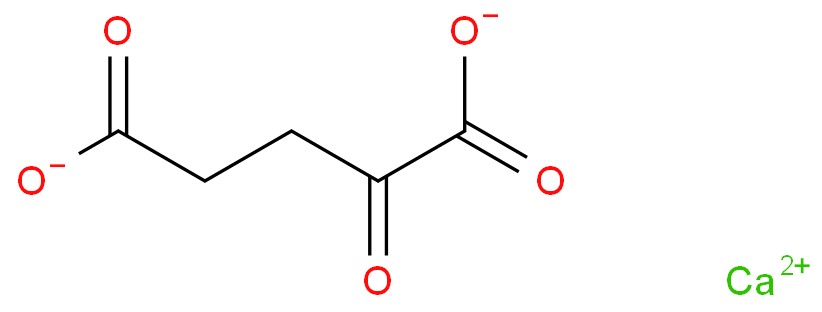
- Alpha-keto acid reactivity and the salt-form rationale: The ketone adjacent to a carboxylate makes the molecule prone to decarboxylation and condensation under heat, low pH and high moisture, particularly during spray drying or warm storage. Conversion to the calcium salt raises the decomposition threshold and gives a free-flowing powder, but 2-oxoglutarate is dicarboxylic, so mono- and di-calcium forms and variable hydration states are possible. Calcium content, AKG content and water must therefore be declared together, with XRPD confirming a consistent solid form between lots.
- Assay strategy and degradation markers: AKG content is normally determined by HPLC with UV or refractive-index detection, or by an enzymatic assay using glutamate dehydrogenase with ammonium, validated against the salt form supplied. The informative specification also quantifies succinate, pyruvate and acetate as degradation markers, plus water by Karl Fischer, residual solvent, heavy metals and standard microbiological criteria. A certificate reporting only a titration figure will not detect a lot that has degraded in transit.
2.2 Synthesis and Manufacturing Technologies
Production is always two-stage: generate 2-oxoglutaric acid, then convert it to the calcium salt and isolate it. Two route classes are in commercial use for the acid, described here at class level only.
- Fermentative production route class: Sugar-based fermentation using bacterial or yeast producers, or biotransformation of L-glutamate with glutamate oxidase or dehydrogenase systems, gives the acid from renewable carbon. Downstream is the difficult part: biomass separation, acidification, ion exchange or electrodialysis, decolourisation, concentration, then neutralisation with calcium hydroxide or carbonate and isolation. The characteristic impurity set is co-produced organic acids, colour bodies, residual sugars and inorganic salts; bioprocess-grade material additionally needs endotoxin and trace-metal control.
- Chemical synthesis route class: Classical routes build the keto-diacid skeleton from succinate or glutarate derivatives by nitrile hydrolysis or oxidative transformations, giving an impurity profile dominated by chloride, unreacted diacid and process solvents rather than fermentation by-products. This route class scores well on inorganic purity and poorly on carbon intensity and solvent load, and the absence of biological residues is an advantage for cell-culture material. Most food-use supply is fermentative, with chemical-route material occupying niche high-purity positions.
2.3 Core Application Matrix
- Dietary supplement and sports-nutrition ingredient: The dominant channel supplies food-grade Ca-AKG to contract manufacturers and brands formulating capsules, tablets and powders. The supplier's obligation is an ingredient meeting food-grade contaminant, microbiological and labelling requirements with full traceability; the supplier does not make and must not support any health or performance claim.
- Cell-culture and bioprocess medium component: Bioprocess users buy Ca-AKG as a defined medium component where consistency matters more than price: tight AKG assay, low and declared trace metals, low endotoxin, controlled bioburden and a documented fermentation-derived impurity profile. Lots are qualified against the customer's own process performance, which makes change control and advance notification a contractual requirement.
- Contract manufacturing and custom grade development: A growing share of business is programme work: salt-form and stoichiometry variants, granulated or milled particle-size grades for tableting, blends with other mineral salts and private-label packing. These programmes require validated methods, stability data and documented change control under a quality agreement.
III. Global Market Supply-Demand Landscape and Export Trends
3.1 Demand Drivers and Market Shifts
Ingredient demand follows the expansion of sports-nutrition and lifestyle supplement categories and the outsourcing of formulation to contract manufacturers; bioprocess demand follows investment in cell-culture and fermentation capacity. The commercial direction in 2026 is that brands are pushing documentation upstream: they ask for contaminant data at food-supplement limits, allergen, GMO and vegan statements, halal and kosher certification, and increasingly ISO/IEC 17025 third-party testing rather than in-house certificates alone.
3.2 Capacity Distribution and Export Flows
Acid production is concentrated where large-scale organic-acid fermentation exists, above all in China, with India building capacity and Western sites focused on high-purity, bioprocess and certified food-grade material. Flows are bulk rather than parcel: drums, big bags and palletised cartons by sea, with air freight reserved for qualification samples and high-value bioprocess lots. Finishing, blending and encapsulation happen close to the brand, mostly in the European Union and the United States.
3.3 Market Bifurcation and Pricing Dynamics
The market splits into food-grade bulk and bioprocess-grade speciality. Food-grade pricing is competitive and tracks glucose feedstock cost, fermentation yield, downstream recovery and energy for concentration and drying, with periods of overcapacity compressing margins sharply. Bioprocess-grade material carries a substantial premium justified by endotoxin control, trace-metal specification, documentation and change control. Because the product is hygroscopic and heat-sensitive, price also reflects packaging quality and validated shelf life.
IV. In-depth Analysis of Global Compliance and Regulatory Barriers
Ca-AKG is a food and bioprocess ingredient, not a medicine, so the governing regimes are food law, dietary-supplement law and general chemical control. Supplier exposure concentrates in two places: whether the ingredient may lawfully be used in the target supplement framework at all, and whether contaminant and microbiological limits meet food expectations rather than industrial ones.
4.1 European Market: REACH, CLP, and Sector-Specific Directives
- Food-supplement framework — 2002/46/EC, 1170/2009, 2015/2283 and 1924/2006: Where calcium is the declared nutrient, the mineral form must be among those permitted under Regulation (EC) No 1170/2009, and the product must comply with Directive 2002/46/EC, contaminant limits in Regulation (EU) 2023/915 and labelling under Regulation (EU) No 1169/2011. The 2-oxoglutarate moiety requires a novel-food assessment under Regulation (EU) 2015/2283 unless significant consumption in the Union before 15 May 1997 can be documented. Health claims are governed by Regulation (EC) No 1924/2006, and this paper makes none.
- REACH, CLP, food-contact materials and food-safety management: Placed on the EU market in its own right, Ca-AKG remains within REACH registration and CLP classification and labelling obligations, and a compliant safety data sheet is expected for industrial handling even where the material is food grade. Packaging must satisfy Regulation (EC) No 1935/2004 and the good manufacturing practice requirements of Regulation (EC) No 2023/2006 with a written declaration. Manufacturers are normally certified to ISO 22000 or FSSC 22000, and microbiological criteria follow Regulation (EC) No 2073/2005 practice.
4.2 North American Market: TSCA, EPA, and FDA Regulations
- FDA dietary-ingredient framework — DSHEA and 21 CFR Part 111: As a dietary ingredient the material falls under DSHEA: the marketer bears responsibility for safety and, where the ingredient is not grandfathered, for a new dietary ingredient notification, while the finished-supplement manufacturer must meet Part 111 current good manufacturing practice, including identity testing on receipt and component specifications. Food facility registration and FSMA preventive-controls expectations apply alongside, and no disease claim may be made.
- Grade standards, TSCA and state-level contaminant rules: Buyers commonly specify Food Chemicals Codex or USP grade where a monograph or specification exists, and those drive heavy-metal and assay limits in the purchase contract. Import as a chemical substance requires the material to be listed as active on the TSCA inventory or covered by an applicable exemption. California Proposition 65 exposure to lead and cadmium is a practical driver of specification even where federal limits are looser, which is why suppliers are asked for full elemental data.
4.3 The Critical Hurdle: Quality Control and Safety Limits
Compliance Warning: The decisive controls are heavy metals, microbiological limits and degradation. A certificate reporting only assay and loss on drying, without lead, cadmium, mercury and arsenic at food-supplement limits, without total viable count, yeast and mould, Escherichia coli and Salmonella, and without water and residual solvent, will not pass a serious brand's qualification. Buyers should also require validated shelf-life data on the actual packaging, ISO/IEC 17025 third-party verification, and for sports-nutrition chains documented anti-doping screening, treated strictly as contamination control. No health, longevity or performance claim is made.
V. Green Trade Barriers and ESG in Manufacturing
The ESG profile is that of a fermentation product: renewable carbon in, but significant energy for aeration, sterilisation and downstream concentration, and a high organic-load effluent stream. Customers evaluate suppliers on fermentation efficiency and effluent treatment rather than on generic sustainability statements, and on the declared status of the production organism.
5.1 Carbon Footprint and Circular Economy
Energy concentrates in fermentation aeration and sterilisation, in the recovery train and in drying, so the footprint is dominated by steam and electricity rather than feedstock. Sites certified to ISO 14001 normally disclose energy per kilogram, water consumption, effluent chemical oxygen demand and the fate of spent biomass — the figures a Scope 3 assessment needs. Yield improvement and heat integration in the recovery train are the highest-value levers.
5.2 Sustainable Sourcing and Traceability
Traceability questions centre on the production organism and the carbon source. Whether the fermentation strain is genetically modified must be declared, because many brands require non-GMO positioning; the sugar source is typically corn or cassava-derived glucose, which drives allergen and country-of-origin declarations. Vegan and vegetarian status follows from the absence of animal-derived processing aids, halal and kosher certification is frequently required, and FSSC 22000 or ISO 22000 provides the audited framework behind those statements.
VI. Supply Chain Resilience and Export Logistics
Ca-AKG moves as a hygroscopic, food-grade powder in bulk packaging, and the logistics risk is moisture and heat rather than regulatory hazard. Caking, colour development and assay drift are the visible symptoms, and they usually result from warm storage or a liner not matched to transit duration.
6.1 Packaging Standards and Moisture/Contamination Control
- Food-grade primary packaging and compliance declarations: Standard supply is a food-grade polyethylene liner inside a fibre drum or multiwall kraft bag, tamper-evident and lot-coded for traceability. Liners and pallet-wrap need a food-contact compliance declaration under Regulation (EC) No 1935/2004 or the applicable FDA provision, and packing should run under a certified food-safety management system. Bulk bags require moisture-barrier liners and controlled discharge.
- Moisture control, water activity and shelf-life validation: Because the salt is hygroscopic, filling should occur under controlled relative humidity and liners should be heat-sealed rather than tied, with water activity reported on release. Shelf life must be supported by real-time and accelerated stability data generated on the commercial packaging, with the labelled storage condition — typically cool and dry — matched to what the data supports rather than to convenience.
6.2 Dangerous Goods Identification and Transit Protocols
Food-grade Ca-AKG is not classified as a dangerous good for transport under ADR, IMDG or IATA, so ambient sea and road movement is appropriate. The powder is combustible as a dust, however, so filling, conveying and discharge equipment should be assessed for dust-explosion risk under ATEX or equivalent national requirements. Container shipments should specify desiccant quantity, avoid stowage adjacent to heat sources on long warm-lane voyages, and use temperature and humidity logging.
VII. Enterprise Global Expansion Strategy Guide
Suppliers win this business by matching grade to channel and by carrying the documentation burden for the brand. Buyers are contract manufacturers, supplement brands and bioprocess groups; they qualify slowly but buy repeatedly once a source is approved.
- Define and hold two grades: Run food-grade and bioprocess-grade specifications as separate products with separate change control: food grade built on heavy metals, microbiological criteria, residual solvent and moisture; bioprocess grade adding endotoxin, trace metals and fermentation-consistency commitments. Publish calcium content, AKG assay and degradation-marker limits, and never substitute one grade for the other.
- Certify the system and verify externally: Hold ISO 22000 or FSSC 22000, add ISO 14001 and ISO 9001, and maintain halal, kosher, vegan, allergen, GMO and country-of-origin statements with evidence behind each. Support in-house certificates with periodic ISO/IEC 17025 third-party testing on heavy metals and assay, since brands increasingly require it as a condition of approval.
- Own the claims boundary: Supply the ingredient with a clear statement that no health, longevity, anti-aging or disease claim is made and that claims compliance for the finished product rests with the brand. Provide the contaminant, stability and traceability data pack the brand needs for its own regulatory position, and decline requests to supply claims language.
VIII. Conclusion
Calcium 2-oxoglutarate is a bulk fermentation ingredient whose commercial success depends on grade discipline and documentation rather than novelty. The molecule is well understood and capacity exists; what differentiates a supplier is a food-grade specification that actually meets supplement contaminant limits, honest stoichiometry and stability data, a certified food-safety management system, and the discipline to keep health, longevity and performance claims outside the transaction.
Into 2026 the trends are consolidation of food-grade capacity among fewer, better-certified producers, widening demand for ISO/IEC 17025 verification, and growing attention to anti-doping screening in sports-nutrition supply chains. Organisations investing in validated stability data, separate bioprocess-grade capability and complete traceability files will hold branded business; those selling an undifferentiated powder on assay alone will be pushed downmarket.
IX. Industry Resource Connection and Supplier Ecosystem
Powered by Guidechem
This white paper is exclusively compiled by the Guidechem Intelligence Team based on global customs data, regulatory databases, and industry research. Guidechem is a leading global B2B chemical platform, dedicated to connecting global buyers with verified, high-quality manufacturers.
Relying on Guidechem's extensive global database, we have mapped the core participants in the current global Calcium 2-oxoglutarate supply chain:
- China — organic-acid fermentation base: Chinese producers dominate the acid and its calcium salt, built on large sugar-based fermentation capacity, integrated recovery trains and spray drying, and they set the global price floor for food-grade material. Leading sites carry FSSC 22000 or ISO 22000 with halal and kosher certification and export documentation, though buyers still verify GMO strain declarations and contaminant data lot by lot.
- India — fermentation scale-up and export documentation: Indian manufacturers are expanding organic-acid and salt capacity and are strongest where a buyer needs process development, salt-form variants and English-language regulatory dossiers for EU and US customers. Their position is mid-cost with strong chemistry and documentation capability, supplying ingredient distributors and contract manufacturers rather than retail brands directly.
- European Union and United States — finishing, certification and brands: Western participants concentrate on high-purity and bioprocess-grade material, blending, granulation, encapsulation and private-label packing, plus the ISO/IEC 17025 laboratories and certification bodies that verify contaminant and assay claims. This region holds the brands and the claims-compliance expertise, and it defines the specification template Asian producers must meet.
Disclaimer: The content of this white paper is compiled based on public market data and regulatory information available as of 2026. Global chemical regulations are subject to dynamic adjustments. In actual export operations, enterprises must consult professional regulatory advisors or relevant competent authorities to obtain the latest compliance guidance.


 EN
 Agricultural News
 Food News
 Industrial News
 Cosmetic News
 Pharmaceutical News
 Science News


 11YRS

