
I. Executive Summary
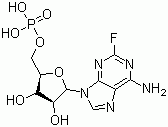
Fludarabine phosphate (CAS 75607-67-9), the 5'-monophosphate ester of 9-β-D-arabinofuranosyl-2-fluoroadenine (F-ara-A), is a licensed parenteral antineoplastic active substance, not a research-grade material. Everything about its export trade follows from that status: customers are licensed manufacturers and marketing-authorisation holders, and commercial value is carried by the dossier — an open US DMF, an EU ASMF or a CEP — rather than by a spot price per kilogram. Typical specifications centre on assay, related substances, residual solvents, water content and endotoxin limits, and buyers qualify the supplier's containment and cleaning programme alongside the certificate of analysis.
The molecule is a deliberate double modification of adenosine: a fluorine at C2 of the adenine ring suppresses deamination by adenosine deaminase, while the arabinose configuration places the 2'-hydroxyl in the "up" position. The phosphate ester is a solubilising prodrug group, cleaved in vivo to the nucleoside, which is why the free nucleoside is simultaneously a specified impurity, a stability marker and a release-critical assay parameter.
For CDMO and API exporters, 2026 competitiveness is decided in four places: β-selective glycosylation and 5'-selective phosphorylation with tight anomer and positional-isomer control; cytotoxic containment built on a documented HBEL/PDE and validated cleaning; an ICH M7 assessment covering the phosphorylation reagents; and import-side instruments such as the EU written confirmation. This document addresses B2B quality, regulatory and supply-chain questions only; it contains no clinical, prescribing or dosing guidance.
II. Product Deep Dive: Molecular Mechanisms and Production Evolution
2.1 Physicochemical Properties and Mechanisms
Fludarabine phosphate is a white to off-white crystalline solid of molar mass 365.21 g/mol, supplied as the free phosphate acid or a defined salt. The ester converts a poorly water-soluble nucleoside into a freely water-soluble parenteral-grade substance, and that single design decision shapes the entire specification: water content, pH of solution, free nucleoside level and endotoxin burden are the four parameters that most often decide whether a lot is releasable. The ionisable phosphate also means pH, counter-ion and moisture interact: a lot that assays correctly can still fail on clarity or pH of solution, which is why those are release tests rather than informational data.
- Prodrug logic and activation path: The 5'-phosphate delivers aqueous solubility for intravenous presentation; phosphatases cleave it to F-ara-A, which enters cells and is converted to the active triphosphate nucleotide that interferes with DNA synthesis. Because the nucleotide is generated inside the cell, the API specification must control the nucleoside both as a process impurity and as a degradant — a dual role that makes the limit unusually demanding, since it must assure stability performance while remaining achievable after chromatographic purification.
- Degradation liabilities and handling consequences: The molecule is exposed to hydrolytic dephosphorylation under heat and moisture, to pH-driven instability in solution, and to oxidative and photolytic stress. Practically, this forces low water activity in the solid, conservative thermal budgets during drying and milling, amber primary packaging, and a qualified cold chain rather than ambient freight. Solid-state form matters for the same reason: the specified polymorph and a tightly bounded water content are what keep dephosphorylation inside the retest window.
2.2 Synthesis and Manufacturing Technologies
Manufacturing converges on two difficult steps: constructing the β-D-arabinofuranosyl nucleoside with the correct anomer and N9 regioisomer, then phosphorylating the 5'-hydroxyl selectively without touching the 2'- and 3'-positions. Both steps are classical in nucleoside chemistry and both are unforgiving at commercial scale, which is why relatively few plants hold validated, auditable campaigns for this substance. Starting-material quality also propagates directly into the impurity profile, so qualification of the protected arabinose donor and 2-fluoroadenine suppliers is a regulatory expectation rather than a purchasing preference.
- Glycosylation and anomer/regioisomer control: A silyl-Hilbert-Johnson / Vorbrüggen-type coupling joins silylated 2-fluoroadenine (or a 2,6-diaminopurine precursor later converted by diazotative fluorination) with a protected arabinofuranosyl donor under Lewis-acid promotion. Because arabinose donors lack C2 acyl neighbouring-group participation, β-selectivity must be engineered through solvent, temperature and promoter choice, with crystallisation or chromatography as the fallback for rejecting the α-anomer and N7-isomer. Because rejection downstream is expensive, development effort concentrates on raising the β:α ratio at the coupling stage itself.
- 5'-Selective phosphorylation and finishing: The Yoshikawa/Sowa-Thomas protocol — phosphorus oxychloride in a trialkyl phosphate solvent at low temperature, followed by controlled quench and hydrolysis — remains the industrial workhorse, with phosphoramidite oxidation and enzymatic phosphotransferase routes as alternatives. Downstream, ion-exchange or preparative chromatography removes 2'/3'-phosphate isomers and bis-phosphorylated species before crystallisation, salt formation and polymorph control. Residual reagent control is the hidden cost of this step: inorganic phosphate, chloride and alkyl phosphate esters must be driven below validated limits, making the quench both safety-critical and quality-critical.
2.3 Core Application Matrix
- Licensed parenteral finished-dose manufacturing: The dominant outlet. Sterile-grade API is released to licensed manufacturers for injectable presentations, which raises the bar on bacterial endotoxins, bioburden, microbial limits, particulate control and, where applicable, sterile crystallisation and aseptic handling of the API. Suppliers serving this segment hold sterile-grade capability or a qualified aseptic partner, and must demonstrate endotoxin control through validated methodology and qualified water systems.
- Generic supply chains and tender markets: Following originator exclusivity, the API is purchased for generic filings and hospital tenders. Buying decisions turn on dossier readiness — an open DMF with letter of access, an ASMF or a CEP — on change-control transparency, and on the supplier's ability to survive a customer audit.
- Investigational and analytical-support supply: GMP batches for investigational medicinal products under EU Clinical Trials Regulation 536/2014 and Annex 13, plus pharmacopoeial and in-house reference standards, impurity markers and formulation-development support for licensed partners. All such supply is made to licence holders under documented end-use declarations.
III. Global Market Supply-Demand Landscape and Export Trends
3.1 Demand Drivers and Market Shifts
Demand is structurally stable and procurement-driven rather than promotional: hospital oncology injectables are bought through tender systems, and volume follows reimbursement listings and generic substitution rules. The commercial volatility sits on the supply side — periodic withdrawal of finished-dose presentations, consolidated nucleoside capacity and the retirement of older multipurpose cytotoxic plants have repeatedly tightened the qualified-supplier list. A slower driver pushes the same way: health systems increasingly contract with fewer, better-audited suppliers as shortage-prevention and quality-defect reporting obligations expand.
3.2 Capacity Distribution and Export Flows
Effective capacity is constrained by containment, not reactor volume. A site must be able to run phosphorus oxychloride phosphorylation and chromatographic purification inside an OEB 4–5 envelope with validated cleaning, and that combination limits the field to a modest number of dedicated oncology facilities. Flows run from API producers in Asia to finished-dose sites in the EU, North America and Latin America, with QA release and dossier ownership concentrated at the importing end. Lead times are therefore dominated by campaign scheduling and cleaning-verification release rather than synthesis time, and any capacity expansion is realistically measured in qualified isolator-hours.
3.3 Market Bifurcation and Pricing Dynamics
The market is bifurcated by compliance depth. Dossier-holding suppliers selling into regulated markets price in the cost of containment campaigns, cleaning validation, preparative chromatography solvents and stability programmes, and they hold price because switching costs are high. Below that tier, material produced without a defensible HBEL and M7 position competes only on price and is progressively excluded from regulated tenders, since customers discount apparent savings that a failed inspection would erase.
IV. In-depth Analysis of Global Compliance and Regulatory Barriers
Two regulatory systems operate in parallel over this substance. The first is quality: ICH Q7 and EU GMP Part II, plus the finished-dose expectations of the customer's marketing authorisation. The second is occupational and environmental control of a cytotoxic compound. A supplier that satisfies only the first will fail the audit, and a supplier that satisfies only the second cannot ship.
4.1 European Market: REACH, CLP, and Sector-Specific Directives
- EU GMP Part II, ASMF/CEP and import controls: API imported into the EU must be manufactured to EU GMP Part II (ICH Q7) standards and, unless the exporting country is on the recognised list, must be accompanied by a written confirmation of compliance issued by the exporting competent authority under Article 46b(2)(b) of Directive 2001/83/EC, supported by the importer's manufacturing/import authorisation and qualified-person oversight.
- Contained manufacture and cross-contamination prevention: Cytotoxic APIs must be supported by a health-based exposure limit derived from a PDE, translated into occupational exposure banding (typically OEB 4–5 for this class), and enforced through dedicated or rigorously campaigned facilities with validated cleaning against MACO-derived swab and rinse limits. Sterile finishing is additionally governed by EU GMP Annex 1, and worker protection by the Carcinogens and Mutagens Directive 2004/37/EC and national CMR provisions.
4.2 North American Market: TSCA, EPA, and FDA Regulations
- FDA Type II DMF, GDUFA and cGMP: US supply runs through a Type II DMF referenced by the customer's application, with facility establishment registration, listing, GDUFA-linked assessment and pre-approval inspection exposure. The API operation must meet 21 CFR 210/211 cGMP expectations, and the DMF holder must maintain change-control notification and annual reporting discipline.
- ICH M7, Q3C and Q3D control of the reagent legacy: Phosphorus oxychloride and alkylating intermediates used in phosphorylation and glycosylation chemistry require a documented mutagenic-impurity risk assessment with purge-factor justification or test-based control to threshold-of-toxicological-concern limits, alongside Q3C residual solvent control, Q3D elemental impurity assessment for metal catalysts and Q1A stability evidence.
4.3 The Critical Hurdle: Quality Control and Safety Limits
Compliance Warning: Four failures account for most lost business. First, no documented HBEL/PDE: without it, a customer cannot accept the material into a shared facility, regardless of certificate-of-analysis results. Second, cleaning-validation gaps: swab and rinse limits that are not derived from the PDE, or recovery studies that do not cover cytotoxic residues, will be rejected on inspection. Third, an incomplete ICH M7 assessment that ignores phosphorylation reagents and their degradation products. Fourth, uncontrolled α-anomer, N7-regioisomer and 2'/3'-phosphate species, which manifest as out-of-trend related-substance results rather than as obvious failures. A fifth, softer failure mode is documentation latency: change-control notifications, transferred impurity methods and stability commitments that arrive after the first commercial shipment routinely stall qualification for months. This substance is supplied only to licensed pharmaceutical manufacturers under documented end-use declarations; no dosing, administration or clinical guidance is provided or implied.
V. Green Trade Barriers and ESG in Manufacturing
Oncology API manufacturing carries a distinctive ESG profile: heavy solvent use, phosphorus-containing effluent, cytotoxic waste streams requiring incineration, and cold-chain distribution. Pharma customers audit all four, increasingly through shared platforms rather than site visits.
5.1 Carbon Footprint and Circular Economy
Preparative chromatography is the carbon hotspot of this process class, because the mobile phase dominates both energy and solvent footprints. Credible decarbonisation therefore starts with solvent recovery by distillation, solvent selection guided by ICH Q3C class preferences, and process intensification that raises column loading and reduces batch count. Scope 1 and 2 reporting is now routine in customer questionnaires; Scope 3 transparency across starting-material and cold-chain partners is the next frontier.
5.2 Sustainable Sourcing and Traceability
Traceability requirements extend upstream to the 2-fluoroadenine and protected arabinose starting materials: genealogy, change control, sub-supplier qualification and, increasingly, Pharmaceutical Supply Chain Initiative-aligned audits. Effluent management is equally visible — phosphate loads and solvent residues must be treated and monitored, and cytotoxic waste must be segregated and destroyed by licensed incineration with documented destruction certificates.
VI. Supply Chain Resilience and Export Logistics
A cytotoxic, moisture-sensitive, cold-chain injectable-grade solid is a demanding logistics object. The API itself is generally not classified as a dangerous good for transport, but the campaign reagents are, and the finished API requires GDP-grade temperature control, containment labelling and complete batch genealogy from the moment it leaves the isolator.
6.1 Packaging Standards and Moisture/Contamination Control
- Primary containment and cytotoxic labelling: Double-bagged inner packaging inside amber glass or HDPE bottles with desiccant and tamper-evident closure, sealed and externally decontaminated before removal from the containment suite. Each unit carries cytotoxic handling marking, batch and retest data, and a certificate of analysis traceable to the validated analytical methods.
- Cold-chain and moisture control: Most specifications call for refrigerated storage with moisture protection and avoidance of freeze-thaw cycling. Qualified insulated shippers with phase-change materials, calibrated data loggers and documented lane qualification under GDP are standard, and excursions must trigger a documented quality disposition rather than an automatic release.
6.2 Dangerous Goods Identification and Transit Protocols
Finished API shipments travel as non-dangerous pharmaceutical solids under IATA, ADR and IMDG rules, provided the substance is not assigned a UN number under its hazard profile; the bulk dangerous-goods burden sits upstream with phosphorus oxychloride, solvents and Lewis-acid promoters. Air freight is preferred for time and temperature assurance, with validated 2–8 °C lanes, pre-cooled packaging, customs-ready dossier copies and, for EU import, coordination of the written confirmation and importer authorisation before dispatch. Because the material is cytotoxic, spill response, return handling and disposal responsibilities must be allocated contractually in advance, and carriers must accept cytotoxic consignments in writing.
VII. Enterprise Global Expansion Strategy Guide
Growth in this substance is won through qualification, not through capacity announcements. The sequence below reflects how regulated buyers actually make decisions.
- Make containment a documented product: Derive and publish the HBEL/PDE, band the compound, install isolator or single-use closed handling, and build a cleaning-validation package with PDE-derived limits and recovery studies. Buyers qualify the containment narrative before they qualify the molecule.
- Lead with the dossier: Maintain a Type II DMF with a responsive letter-of-access process, pursue ASMF and, where a monograph route applies, CEP coverage, and prepare the EU written-confirmation pathway in advance. Dossier maturity converts a price enquiry into a framework agreement.
- Engineer the two hard steps: Invest in real-time anomer and regioisomer monitoring during glycosylation and in quench-controlled phosphorylation with in-process HPLC, then reduce chromatographic solvent load through higher loading and continuous options. Yield and solvent intensity are the two levers that survive generic price pressure.
VIII. Conclusion
Fludarabine phosphate is a mature, licensed oncology API traded in a low-growth, high-barrier market. Its economics are set less by demand than by the cost of doing it correctly: contained campaigns, chromatographic purification, cold-chain distribution and a dossier that survives inspection.
Suppliers that combine a defensible HBEL and cleaning package, complete ICH M7 and Q3D positions, and DMF/ASMF-CEP readiness will continue to capture regulated volume at defensible margins. Material is supplied exclusively to licensed pharmaceutical manufacturers; nothing in this paper constitutes clinical, prescribing or dosing guidance.
IX. Industry Resource Connection and Supplier Ecosystem
Powered by Guidechem
This white paper is exclusively compiled by the Guidechem Intelligence Team based on global customs data, regulatory databases, and industry research. Guidechem is a leading global B2B chemical platform, dedicated to connecting global buyers with verified, high-quality manufacturers.
Relying on Guidechem's extensive global database, we have mapped the core participants in the current global Fludarabine phosphate supply chain:
- China: nucleoside API and CDMO base: Coastal oncology API parks combine nucleoside coupling, phosphorylation and preparative chromatography, with growing numbers of OEB 4–5 suites and DMF filings aimed at regulated export.
- India: dossier-driven oncology API cluster: Hyderabad and Bengaluru-area sites pair contained synthesis with mature DMF and CEP portfolios, supplying generic finished-dose manufacturers in regulated and semi-regulated markets.
- EU: finishing, QA and import gateway: Italian, German and Spanish sites hold manufacturing and import authorisations, qualified-person release and ASMF ownership — the compliance layer that governs market access.
Disclaimer: The content of this white paper is compiled based on public market data and regulatory information available as of 2026. Global chemical regulations are subject to dynamic adjustments. In actual export operations, enterprises must consult professional regulatory advisors or relevant competent authorities to obtain the latest compliance guidance.




 EN
 Agricultural News
 Food News
 Industrial News
 Cosmetic News
 Pharmaceutical News
 Science News


 14YRS

