
I. Executive Summary
N-Desmethyl iomeprol (CAS 77868-40-7) is the N-demethylated derivative of iomeprol, a non-ionic tri-iodinated X-ray contrast medium of the isophthalamide class. It is traded not as a drug substance but in two closely related professional roles: as a specified related substance that the iomeprol specification must identify, quantify and control, and as an analytical reference standard against which that control is exercised. Both roles sit inside the quality system of a contrast-media manufacturer or a generic developer, which means the buying decision is made by analytical and regulatory specialists rather than by production planners, and the criteria are documentation, purity assignment and traceability rather than price per gram.
The specification for any iodinated contrast medium is dominated by iodine. Assay is effectively an iodine-content specification, and the impurity profile is built around iodine speciation, with free iodide, ionic iodinated compounds and partially deiodinated species controlled alongside structural relatives such as the N-desmethyl compound. Analytical methods therefore combine reversed-phase HPLC for organic related substances with ion chromatography for iodide and inductively coupled plasma techniques for total iodine, and the reference standard must be fit for all of them. A supplier offering only an HPLC purity figure is not offering a usable standard.
Commercially this is a low-volume, high-value, documentation-intensive segment with restricted distribution. Reputable producers supply only licensed pharmaceutical manufacturers, contract laboratories and analytical-service providers, under end-use declaration and Know-Your-Customer screening, with certificates framed in ISO 17034 and ISO 17025 terms: assigned purity by quantitative NMR or HPLC mass balance, stated measurement uncertainty, homogeneity and stability data, storage conditions and a retest date. Packaging is dictated by the high iodine content and its photochemical sensitivity, and logistics runs as a temperature-controlled, light-protected chain.
II. Product Deep Dive: Molecular Mechanisms and Production Evolution
2.1 Physicochemical Properties and Mechanisms
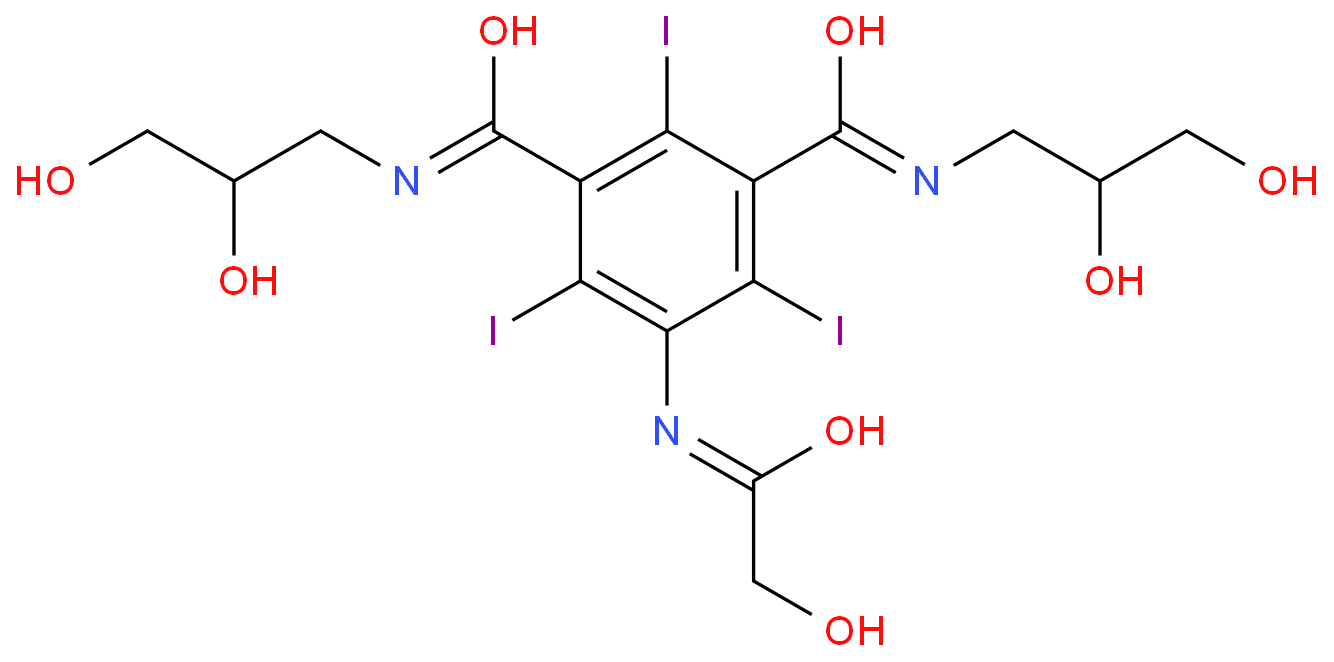
The molecule retains the fully substituted 2,4,6-tri-iodinated isophthalamide core of iomeprol with its pendant hydrophilic hydroxylated amide side chains, differing by replacement of one N-methyl group by N-H. That change adds a hydrogen-bond donor and shifts chromatographic retention enough to resolve it from the parent by reversed-phase HPLC. The compound is a high-molecular-weight, highly polar, water-soluble solid, strongly UV-absorbing through the aryl iodide chromophore and dense in iodine, which governs both its detection and its degradation behaviour.
- Formation Pathways and Why They Matter: N-Desmethyl species in this chemical class arise from incomplete N-alkylation during side-chain construction and from demethylation under the thermal and pH stress of the manufacturing sequence, particularly during the prolonged high-temperature steps used to install and solubilise the iodinated core. Because the compound differs from the active substance at a single nitrogen substituent, it is resolvable from the parent in a properly developed gradient method and is present at levels that must be individually specified rather than covered by a general limit. Knowing which step generates it lets a process team set an in-process control rather than rely on purge at final crystallisation.
- Iodine Speciation and Degradation Behaviour: The carbon-iodine bonds on an electron-rich, heavily substituted aromatic ring are the weak point of the whole class. Thermal stress, strong illumination and extremes of pH promote deiodination, releasing inorganic iodide and, under oxidising conditions, free iodine, which is why contrast-media specifications carry explicit limits for free iodide and ionic compounds. For the reference standard this means retest dating must be supported by iodide-growth data, not merely by HPLC purity, and light-protected refrigerated storage is a requirement rather than a preference.
2.2 Synthesis and Manufacturing Technologies
Material is produced in two distinct ways that serve different customers, and conflating them is the most common sourcing error. Campaign material for process-impurity studies is made by deliberate synthesis, generally by running the side-chain sequence with a protected or unmethylated amine so the desmethyl analogue is formed intentionally and then purified. Reference-standard material is more often isolated from a stressed or mother-liquor stream of the parent synthesis and then purified to a characterised, assigned purity. The route class determines the impurity fingerprint, so the certificate should identify which type is being supplied.
- Targeted Synthesis and Preparative Isolation: Deliberate preparation follows the parent route with a modified amine component, followed by preparative reversed-phase chromatography and desalting. Isolation from process streams uses the same chromatography on enriched mother liquors, which is cheaper but gives a broader co-eluting profile. In both cases the purification strategy is the product: the value lies not in making the molecule but in separating it from a family of near-identical, heavily iodinated analogues.
- Purity Assignment and Certification Practice: A usable certificate assigns content by mass balance, combining HPLC area normalisation with quantitative NMR against a certified internal standard, then correcting for water by Karl Fischer, residual solvent by headspace GC and non-volatile residue. The result is reported with an expanded measurement uncertainty and coverage factor, supported by homogeneity data across the fill series and stability data underpinning the retest date. This is the ISO 17034 framing buyers should demand, with ISO 17025 as the competence standard for the assigning laboratory.
2.3 Core Application Matrix
- Specified Impurity in Release and Stability Testing: The primary use is as the identified, quantified related substance in the active substance specification, with an acceptance criterion set against ICH Q3A thresholds and justified by batch data and, where applicable, by toxicological qualification. The standard supports release testing and stability-indicating studies tracking growth of the desmethyl species.
- Analytical Procedure Development and Validation: Under ICH Q2(R1) and the ICH Q14 analytical procedure development framework, the standard is required for specificity, response-factor determination, linearity, accuracy, quantitation-limit verification and robustness studies. Because an impurity standard is quantified against its own response rather than the parent's, an accurate assigned purity directly determines the accuracy of every reported impurity result.
- Process Understanding and Route Development: CDMO clients use the compound as a marker during route development and scale-up, tracking where the desmethyl species is generated and demonstrating purge across isolation steps. This is a service-intensive application in which the standard is one input to a larger method-development programme.
III. Global Market Supply-Demand Landscape and Export Trends
3.1 Demand Drivers and Market Shifts
Demand is derived entirely from contrast-media quality control and from generic development programmes, and it moves in steps rather than smoothly. Rising diagnostic imaging volumes sustain baseline consumption of iodinated contrast media; each new generic filing, specification revision and analytical-method modernisation generates a discrete pulse of demand for impurity standards. The structural shift since ICH Q14 has been towards more thoroughly characterised standards, because a lifecycle procedure requires a documented response factor and uncertainty.
3.2 Capacity Distribution and Export Flows
Supply is small, specialised and geographically dispersed. European producers in Italy, France and Germany sit closest to the innovator contrast-media industry and dominate high-end certified reference material. Indian and Chinese manufacturers in Hyderabad, Mumbai, Shanghai and Jiangsu supply campaign-scale impurity material and cost-competitive standards to generic developers. Because volumes are measured in grams, trade flows are dominated by air freight in temperature-controlled, light-protected packaging, with customs valuation complicated by very high value per kilogram.
3.3 Market Bifurcation and Pricing Dynamics
The market splits sharply between a simple impurity sample and a certified reference standard. A characterised but uncertified batch, supplied with HPLC purity and identity data, is priced as a fine chemical. The same molecule supplied as a certified reference material under ISO 17034, with assigned purity, expanded uncertainty, homogeneity and stability data, full spectroscopic documentation and a controlled change history, is priced at a substantial multiple, reflecting the cost of metrologically valid assignment and of maintaining the quality system. Buyers should decide which they need before requesting quotes, because the documentation gap between the two cannot be closed after purchase.
IV. In-depth Analysis of Global Compliance and Regulatory Barriers
Compliance here operates on two levels. As a chemical substance crossing borders it is subject to inventory and hazard-communication law; as a material used in pharmaceutical quality control it is subject to the data-integrity and reference-standard expectations of the receiving quality system. Most supply failures are of the second kind: an adequate sample arrives without the documentation a regulated laboratory needs.
4.1 European Market: REACH, CLP, and Sector-Specific Directives
- REACH Status and Low-Volume Exemptions: Impurity and reference-standard volumes are usually far below the one-tonne threshold, and material used for research and development may fall within the relevant exemption, but that exemption is conditional on the declared purpose and on the supplier holding supporting records. Buyers importing above threshold should obtain a registration number or an only-representative arrangement in writing rather than assume the exemption applies.
- CLP, SDS and Sector Expectations: Classification must be taken from the supplier's notified entry, and the safety data sheet must match the quantities and form supplied. Beyond chemical law, European contrast-media manufacturers apply their own reference-standard governance: documented provenance, a certificate with assigned purity and uncertainty, a defined storage and retest regime, and change-control notification if the assignment method or route changes.
4.2 North American Market: TSCA, EPA, and FDA Regulations
- TSCA Status and Import Certification: Commercial import into the United States requires an active TSCA inventory listing or an applicable exemption, with a certification held by the importer before entry. Because impurities of a listed substance are not automatically covered by the parent listing, suppliers should provide a specific written statement on the inventory status of this CAS number, refreshed when the route changes.
- FDA Expectations for Reference Standards: For a US filing, the impurity is controlled under ICH Q3A and Q3B, the method is validated under ICH Q2(R1) with Q14 lifecycle principles, and the reference standard must be of documented purity, either as an in-house primary standard with full structural evidence or as a purchased standard traceable to a competent laboratory. Supporting analytical data must meet data-integrity expectations, including audit trails and raw-data availability.
4.3 The Critical Hurdle: Quality Control and Safety Limits
Compliance Warning: Do not accept an impurity standard on HPLC area-normalisation alone. Require an assigned content determined by quantitative NMR or a full mass balance, reported with expanded uncertainty and coverage factor, plus water by Karl Fischer, residual solvents by headspace GC under ICH Q3C and non-volatile residue. Require identity confirmation by mass spectrometry and NMR, a stated iodide result, homogeneity data across the fill and stability data supporting the retest date. Confirm the producer's ISO 17034 scope and the ISO 17025 accreditation of the assigning laboratory, and require written notification of any change in route, assignment method or specification. Storage must be light-protected and refrigerated, with the container never opened at ambient humidity.
V. Green Trade Barriers and ESG in Manufacturing
For a material produced in gram quantities, the dominant environmental issue is not energy but iodine. Iodine is a geographically concentrated element whose price has been volatile, and every kilogram of iodinated intermediate that is discarded carries both a raw-material cost and a waste-treatment burden. ESG performance in this segment is therefore measured by solvent and iodine stewardship rather than by carbon intensity alone.
5.1 Carbon Footprint and Circular Economy
The measurable levers are chromatographic solvent consumption and iodine recovery. Preparative reversed-phase purification of highly polar iodinated compounds is solvent-hungry, so suppliers who recover acetonitrile and alcohol modifiers and minimise chromatographic passes reduce both cost and footprint. Iodine recovery from process liquors and deiodination streams, by oxidation and capture or ion-exchange concentration, converts a waste liability into recovered raw material. Waste streams containing organic iodine require documented destruction or recovery, not dilution.
5.2 Sustainable Sourcing and Traceability
Traceability has a hard and a soft dimension. The hard dimension is iodine provenance: commercial iodine comes overwhelmingly from caliche ore processing in Chile and from brine associated with gas production in Japan, and that concentration is a genuine sourcing risk for iodine-intensive materials. The soft dimension is documentation continuity: batch genealogy, instrument raw data, reference-lot cross-checks and change history, all needed to defend an impurity result years after purchase.
VI. Supply Chain Resilience and Export Logistics
Logistics determines whether a purchased standard arrives fit for use. The molecule is photochemically and thermally sensitive and hygroscopic to a degree that matters when assignment is by mass balance, and is shipped in quantities small enough that a single excursion can destroy the entire lot value. Packaging and transit discipline are therefore part of the product specification.
6.1 Packaging Standards and Moisture/Contamination Control
- Light Protection and Closed-System Filling: Amber glass vials with inert septa, filled under controlled humidity in a closed system and individually sealed, are the norm; bulkier campaign quantities use amber glass bottles inside a light-excluding outer pack. Because deiodination is promoted by light and heat, the outer packaging should be opaque rather than merely tinted and headspace minimised or inerted. Desiccant is used where the water specification is tight, provided it cannot shed particles into the vial.
- Labelling, Certificate and Retest Governance: Each vial should carry substance identity, CAS number, batch, assigned content with uncertainty, fill mass, storage condition and retest date, with tamper evidence and a unique container number. The certificate should restate the assignment method, uncertainty components, homogeneity result, iodide and water results and storage requirement. Retest intervals of 12 to 24 months should be extended only on real-time stability data.
6.2 Dangerous Goods Identification and Transit Protocols
Material of this type is not normally assigned a dangerous-goods class for transport, so IATA, IMDG and ADR classifications generally do not apply and air freight is the default given the value density. The operative protocol is temperature control at 2 to 8 degrees Celsius with a calibrated logger, opaque outer packaging and routing that avoids warehouse dwell. Customs handling is often the largest risk: high declared value per kilogram invites inspection, and inspection at ambient temperature defeats the cold chain, so shippers should use pre-cleared courier channels and declare the material clearly as an analytical reference standard.
VII. Enterprise Global Expansion Strategy Guide
For CDMOs and reference-material producers, three capabilities determine whether a buyer will qualify them at all.
- Build Metrological Credibility: Operate to ISO 17034 for reference-material production and ISO 17025 for the assigning laboratory, invest in quantitative NMR capability, and publish a real uncertainty budget. Buyers in this segment purchase the certificate, and metrological credibility is the only durable differentiator.
- Offer Method Development Alongside the Standard: The standard is an input to a larger problem. Suppliers who can develop and validate the related-substance method under ICH Q2(R1) and Q14, establish the relative response factor and support the customer's specification justification convert a one-off sale into a programme relationship.
- Restrict Distribution and Document It: Supply only to licensed pharmaceutical manufacturers, contract laboratories and analytical-service providers, with end-use declaration and Know-Your-Customer screening recorded on every order. Restricted distribution is expected in this segment and defends against diversion.
VIII. Conclusion
N-desmethyl iomeprol is a molecule whose commercial value lies almost entirely in the credibility of the paperwork that accompanies it. Separating and identifying a single N-demethylated analogue from a family of tri-iodinated isophthalamides is demanding but routine for a competent laboratory. What separates a usable reference standard from an expensive sample is assigned purity with defensible uncertainty, homogeneity and stability evidence, and a documented change history.
For buyers, the guidance is to specify the certificate before the price, confirm the producer's ISO 17034 scope, and treat cold-chain, light-protected logistics as part of the acceptance criteria. For suppliers, the opportunity in 2026 sits with those combining metrological competence with analytical-method service and documented end-use control.
IX. Industry Resource Connection and Supplier Ecosystem
Powered by Guidechem
This white paper is exclusively compiled by the Guidechem Intelligence Team based on global customs data, regulatory databases, and industry research. Guidechem is a leading global B2B chemical platform, dedicated to connecting global buyers with verified, high-quality manufacturers.
Relying on Guidechem's extensive global database, we have mapped the core participants in the current global N-Desmethyl iomeprol supply chain:
- Italy and European Contrast-Media Cluster: Italy, alongside France and Germany, sits at the centre of the non-ionic iodinated contrast-media industry, with innovator manufacturing and certified reference-material producers close to the customers who write the specifications. This ecosystem supplies the highest-specification material, with ISO 17034 framing, full spectroscopic documentation and mature change control.
- India Impurity and Analytical-Standard Ecosystem: Hyderabad, Mumbai and Bengaluru host impurity-synthesis specialists supplying generic developers and contract laboratories, combining preparative chromatography with ICH Q2(R1) and Q14 method-validation capability. Producers here compete on campaign-scale impurity material and increasingly offer ISO 17025-accredited assignment, though ISO 17034 scope remains less common than in Europe.
- China Fine-Chemical and CDMO Ecosystem: Shanghai, Jiangsu and Zhejiang supply iodinated intermediates and custom-synthesised impurity material at competitive cost, with growing strength in preparative HPLC and spectroscopic characterisation. The cluster is the practical source for process-development quantities and route-scouting work, while buyers needing certified reference materials typically pair it with European or Indian assignment.
Disclaimer: The content of this white paper is compiled based on public market data and regulatory information available as of 2026. Global chemical regulations are subject to dynamic adjustments. In actual export operations, enterprises must consult professional regulatory advisors or relevant competent authorities to obtain the latest compliance guidance.


 EN
 Agricultural News
 Food News
 Industrial News
 Cosmetic News
 Pharmaceutical News
 Science News


 14YRS


