-
We detected your language preference as English. Would you like to switch to the English version for a better experience?
Switch to English
Stay here


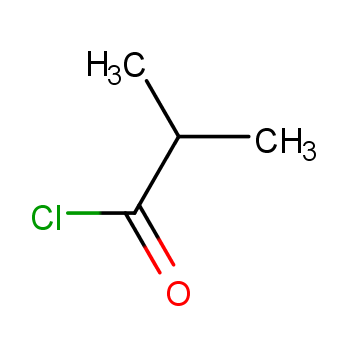
Isobutyryl chloride (2-methylpropanoyl chloride, CAS 79-30-1) is a short-chain aliphatic acyl chloride of formula C4H7ClO and molar mass 106.55 g/mol, supplied as a clear, colourless to slightly yellow, fuming liquid with a boiling point near 92 °C and a density around 1.02 g/cm3 at 20 °C. It functions industrially as a compact, highly reactive acylating agent that installs the isobutyryl group into alcohols, amines and aromatic rings, and it is consumed almost entirely as a captive or toll-manufactured intermediate rather than as a traded commodity.
Production is a classic carboxylic acid chlorination: isobutyric acid is treated with thionyl chloride, phosphorus chlorides or, at larger scale, phosgene/catalytic routes, followed by fractional distillation under anhydrous conditions. Process economics therefore hinge on chlorinating-agent cost, hydrogen chloride and sulfur dioxide off-gas management, corrosion-resistant reactor metallurgy and the ability to hold free acid and residual chloride impurities within tight limits, because both directly reduce acylation yield and generate difficult impurities downstream.
For B2B buyers and CDMO partners, the decisive factors in 2026 are specification control (assay, free isobutyric acid, hydrolysable chloride, phosphorus or sulfur residues), anhydrous packaging under dry nitrogen, and dual-hazard logistics combining flammability with corrosivity. Because the material reacts violently with water, releasing isobutyric acid and hydrogen chloride, every element of the supply chain — from reactor vent scrubber to container closure — must be engineered around moisture exclusion.
The reactivity of isobutyryl chloride follows from the strongly electron-withdrawing chlorine attached to a carbonyl already activated by the adjacent carbonyl carbon's partial positive charge. Nucleophilic acyl substitution proceeds through a tetrahedral intermediate in which chloride is the leaving group; alcohols give isobutyrate esters, amines give isobutyramides, and under Lewis acid catalysis aromatics undergo Friedel-Crafts acylation to aryl isobutyl ketones. The alpha-branched methyl groups provide steric bulk that moderates reaction rate and improves selectivity relative to unbranched acyl chlorides.
At the route-class level, isobutyryl chloride is manufactured by chlorinating isobutyric acid with an inorganic acid chloride. Thionyl chloride is favoured in multipurpose fine-chemical plants because the by-products (hydrogen chloride and sulfur dioxide) are gaseous and leave a clean crude; phosphorus trichloride or phosphorus pentachloride routes suit phosphorus-tolerant processes; phosgene-based routes are used where scale and integration with existing phosgenation infrastructure justify the containment investment.
Demand is derived and project-specific, tracking pharmaceutical and agrochemical pipelines rather than macro consumption. Growth is concentrated in custom-synthesis and toll-manufacturing volume, as innovator companies outsource reactive, corrosive acyl chloride chemistry to specialist CDMOs rather than investing in dedicated chlorination assets. Radiation-curable coatings and inks provide a smaller but steady pull through photoinitiator intermediates, while generic agrochemical production in Asia sustains baseline commodity-grade demand.
Capacity is distributed close to downstream synthesis rather than to feedstock: China and India host the largest number of multipurpose acid chloride units serving agrochemical, dye and generic API chains; Western Europe and the United States retain high-containment, pharma-qualified capacity supporting innovator projects and regulated GMP intermediates. Because shelf life and transport risk are significant, most volume moves regionally, with intercontinental trade concentrated in documented, stabilised drum shipments rather than bulk.
The market bifurcates between technical grade traded on assay and price for agrochemical and dye use, and pharma-grade material sold under quality agreements with documented impurity profiles, change-control commitments and audit rights. Cost is driven by isobutyric acid, chlorinating-agent pricing (thionyl chloride and phosphorus chlorides both track chlorine and energy markets), and the rising cost of hazardous waste and off-gas treatment, so buyers should expect quotes to carry explicit environmental-compliance components and to move with chlorine and energy indices.
As a corrosive, water-reactive, flammable intermediate, isobutyryl chloride is regulated through substance registration, hazard classification and transport law, with additional expectations imposed by pharmaceutical and agrochemical customers on solvent residues, elemental impurities and process-safety documentation. Exporters must be able to satisfy both the statutory layer and the customer quality layer, since the latter usually determines award.
Acyl chloride manufacture is energy-, chlorine- and waste-intensive, and ESG scrutiny now focuses on the fate of hydrogen chloride and sulfur dioxide streams, on chlorinated organic residues in effluent, and on the carbon intensity of distillation. Buyers in regulated industries increasingly evaluate suppliers on abatement performance and on the credibility of their process-safety culture as much as on unit price.
The dominant contributors are reactor heating, vacuum distillation energy and the upstream chlorine/chlorinating-agent chain. Credible reduction levers include heat integration and mechanical vapour recompression in rectification, recovery and reuse of excess thionyl chloride, conversion of captured hydrogen chloride into saleable hydrochloric acid or into downstream chlorination feedstock, and low-carbon steam and electricity supply supported by ISO 14001 and ISO 50001 certified management systems.
Traceability requirements focus on the origin and purity of isobutyric acid, on documented absence of unwanted halogenated by-products, and on responsible management of chlorinated waste streams. Suppliers should provide batch-level traceability, waste-disclosure summaries, EcoVadis or equivalent sustainability assessment results, and — for pharmaceutical customers — a written statement of route, solvent list and elemental-impurity risk assessment so the buyer's own Scope 3 and regulatory reporting can be completed without repeated audits.
Isobutyryl chloride is a dual-hazard material whose logistics risk is dominated by moisture ingress and container compatibility rather than by distance or transit time. Export practice therefore centres on verified dry packaging, inert-gas blanketing, conservative fill ratios to allow for thermal expansion, and documented emergency response for acid-gas release.
Shipments typically require dual hazard labelling for a flammable liquid with corrosive subsidiary risk (or the reverse, depending on the classification adopted), usually at packing group II, and must be declared under IMDG for sea, ADR/RID for European road and rail, 49 CFR for US domestic transport and IATA DGR where air freight is unavoidable. Required practice includes UN-specification packaging, flame-arresting and acid-resistant venting where fitted, segregation from water-reactive-incompatible classes, emergency response information referencing dry-powder extinguishing media and acid-gas exposure control, and pre-shipment verification that containers are externally dry and closure-tight.
Acyl chloride exports are won on reliability and documentation, not on headline price, because the cost of a failed drum for a pharmaceutical or agrochemical campaign far exceeds the unit price. The following priorities reflect how regulated customers select reactive-intermediate suppliers.
Isobutyryl chloride will remain a small but strategically indispensable intermediate wherever the isobutyryl group must be installed efficiently. Its commercial future lies with suppliers who treat free-acid control, anhydrous packaging and off-gas abatement as core competencies rather than as compliance overhead, and who can document that competence to pharmaceutical and agrochemical customers.
For buyers, the practical rule is to purchase the specification and the logistics system, not the molecule in isolation: free acid, hydrolysable chloride and container dryness determine downstream yield, while correct dual-hazard classification and UN-specification packaging determine whether the material arrives at all. Supplied strictly as an industrial chemical intermediate, it is not a finished product and carries no end-use authorisation.
Powered by Guidechem
This white paper is exclusively compiled by the Guidechem Intelligence Team based on global customs data, regulatory databases, and industry research. Guidechem is a leading global B2B chemical platform, dedicated to connecting global buyers with verified, high-quality manufacturers.
Relying on Guidechem's extensive global database, we have mapped the core participants in the current global Isobutyryl chloride supply chain:
Disclaimer: The content of this white paper is compiled based on public market data and regulatory information available as of 2026. Global chemical regulations are subject to dynamic adjustments. In actual export operations, enterprises must consult professional regulatory advisors or relevant competent authorities to obtain the latest compliance guidance.
|
 |
 |
 |
 EN
 Agricultural News
 Food News
 Industrial News
 Cosmetic News
 Pharmaceutical News
 Science News


 1YR

