
I. Executive Summary
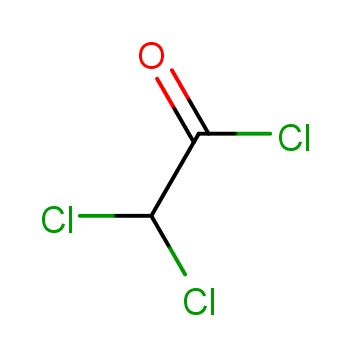
Dichloroacetyl chloride (CAS 79-36-7), CHCl2COCl, is a small but highly reactive acid chloride of molecular weight 147.39 g/mol. It is supplied as a colourless to pale yellow fuming liquid with a boiling point near 107 °C and a density around 1.53 g/cm³, and it is characterised by two properties that define every downstream decision: it is a powerful acylating agent for introducing the dichloroacetyl group, and it hydrolyses violently on contact with moisture to give dichloroacetic acid and hydrogen chloride gas. Those same properties make it a class 8 corrosive material with acute toxicity by inhalation and oral exposure under GHS.
Commercially, the molecule sits at the intersection of pharmaceutical and agrochemical intermediate chemistry. In pharmaceuticals it installs the dichloroacetamide group found in the amphenicol antibiotic family, including chloramphenicol-type and fluorinated thiamphenicol-type structures, and it serves generally as a dichloromethylating acyl donor. In crop protection it is the key acylating reagent for dichloroacetamide herbicide safeners such as dichlormid, a class of compounds used to protect maize and other cereals from herbicide injury, alongside dye and fine-chemical acylation chemistry.
This paper addresses the route-class chemistry and purification strategy that governs assay and impurity profile, the free-chlorine and hydrogen-chloride specification that determines downstream yield, the corrosive and acute-toxic classification and transport regime, anhydrous nitrogen-sealed and lined packaging practice, and the REACH, TSCA and pharmaceutical-quality obligations that buyers now impose. Because the material is both corrosive and moisture-sensitive, purchasing decisions should weigh packaging integrity, scrubbing capability and documentation as heavily as price.
II. Product Deep Dive: Molecular Mechanisms and Production Evolution
2.1 Physicochemical Properties and Mechanisms
Reactivity follows from the two alpha chlorines. Their inductive withdrawal makes the carbonyl carbon strongly electrophilic, so amines and alcohols acylate rapidly and exothermically, and it makes the alpha protons acidic enough to support further base-mediated chemistry on the dichloroacetyl group once installed. The corresponding reaction with water is not merely fast but violent: hydrolysis releases hydrogen chloride, and the resulting dichloroacetic acid is itself corrosive, so moisture exclusion is the single most important operating discipline across production, packaging and use.
- Acylating power and the dichloroacetyl pharmacophore: Introducing CHCl2CO– onto an amine or alcohol delivers a group that is metabolically distinctive and sterically compact, which is why it persists in established active structures rather than appearing as a generic protecting group. From a process standpoint, acylation is rapid at low temperature, gives hydrogen chloride as the only stoichiometric by-product, and requires efficient gas removal and scrubbing rather than complex work-up.
- Hydrolysis, hydrogen chloride release and materials compatibility: Any water ingress produces hydrogen chloride, raising pressure in closed containers, corroding steel, and degrading assay to dichloroacetic acid. Materials of construction must therefore be chosen for wet-chloride service: glass-lined steel, Hastelloy, tantalum, PTFE and PVDF linings are standard, while carbon steel, aluminium and many elastomers are unsuitable, and vent systems must be routed to alkaline scrubbing rather than to atmosphere or to a shared acid header.
2.2 Synthesis and Manufacturing Technologies
At route-class level, industrial supply is produced by two families of chemistry. The first is oxidation-chlorination of trichloroethylene, in which the chlorinated olefin is converted under oxidative chlorinating conditions to the acid chloride. The second is conversion of dichloroacetic acid to its acid chloride using conventional acid-chlorinating reagents such as thionyl chloride, phosphorus chlorides or phosgene-type reagents. In both cases the product is isolated and purified by fractional distillation under anhydrous conditions, because the impurity set is dominated by close-boiling chlorinated species.
- Fractionation and the chlorinated impurity family: Crude product contains hydrogen chloride, dissolved chlorine, dichloroacetic acid, and the neighbouring chloroacetyl and trichloroacetyl chlorides, all of which acylate competitively and therefore contaminate the downstream amide or ester. Efficient fractionation under dry inert gas, with corrosion-resistant column internals and HCl-resistant condensers, is what converts a reaction mass into a sellable reagent, and it is the main capital barrier to entry in this molecule.
- Free chlorine and hydrogen chloride control: Release specification centres on assay by GC or argentometric titration after derivatisation, free chlorine, dissolved hydrogen chloride, dichloroacetic acid, related chloroacetyl chlorides, colour and boiling range. Buyers should require batch-specific numbers for free chlorine and acid chloride hydrolysis products, because these two parameters drive both stoichiometric efficiency in acylation and the corrosion load on the customer's own plant.
2.3 Core Application Matrix
- Pharmaceutical intermediates: Dichloroacetyl chloride is the classical means of installing the dichloroacetamide moiety of the amphenicol antibiotic family, and it is used more broadly to prepare dichloroacetylated intermediates and esters in regulated synthesis. Customers in this segment buy under GMP-aligned quality systems with ICH Q7 expectations, documented impurity profiles and, for reactive chloroacetyl-type species, ICH M7 genotoxic-impurity assessment.
- Agrochemical safeners and intermediates: The dichloroacetamide herbicide safener class, typified by dichlormid and related N,N-dialkyl and cyclic analogues, is built by acylating the appropriate amine with this acid chloride. Demand is tied to maize and cereal herbicide programmes and is contract-driven, with buyers requiring change-control notification and consistent assay because amide yield and by-product profile are directly specification-sensitive.
- Dyes, pigments and general organic synthesis: As a compact electrophilic acyl donor it serves dye and pigment intermediate manufacture and exploratory synthesis, including preparation of dichloroacetates and heterocyclic intermediates. Volumes per customer are smaller and more opportunistic, and this segment is often the first to feel supply tightness when chlorinated-intermediate capacity is curtailed for environmental reasons.
III. Global Market Supply-Demand Landscape and Export Trends
3.1 Demand Drivers and Market Shifts
Demand is derived demand, tied to the production plans of a handful of antibiotic and safener programmes plus a long tail of fine-chemical users. Two structural trends matter: continued reliance on established generic antibiotic and crop-protection chemistries in emerging markets, which sustains baseline volume; and the migration of regulated-market intermediate manufacture toward audited suppliers, which concentrates export volume among fewer, better-documented producers. Environmental curtailment of chlorinated chemistry in China periodically tightens supply and produces sharp spot-price moves.
3.2 Capacity Distribution and Export Flows
Capacity is concentrated among chlorinated-intermediate specialists: Chinese producers in Shandong, Jiangsu and Zhejiang with integrated chlor-alkali and chlorination assets; Indian fine-chemical and agrochemical-intermediate manufacturers in Gujarat, Maharashtra and Hyderabad serving both domestic formulation and export synthesis; and European producers in Germany, Switzerland and Italy supplying regulated pharmaceutical customers. Export flows move in lined drums and ISO tanks from China and India to Asian, European and Latin American formulators, and from European plants to pharmaceutical sites under quality agreements.
3.3 Market Bifurcation and Pricing Dynamics
The market divides into technical grade bought on assay for dye and general acylation, and high-purity, documentation-heavy grade for pharmaceutical and safener synthesis, where free chlorine and related acid chlorides are tightly limited. Pricing tracks chlorine and chlorinated-feedstock cost, energy for distillation, and the rising cost of compliant halogenated waste disposal; because the product is a class 8 corrosive, freight, packaging and insurance represent a materially larger share of landed cost than for a neutral intermediate of similar value.
IV. In-depth Analysis of Global Compliance and Regulatory Barriers
Compliance for dichloroacetyl chloride has two layers: chemical-control obligations for the substance itself, and pharmaceutical or agrochemical quality expectations imposed by the customer's own registration. Suppliers serving regulated markets must be able to support both, and should expect their impurity and change-control documentation to be audited by the customer's regulatory affairs function rather than by purchasing alone.
4.1 European Market: REACH, CLP, and Sector-Specific Directives
- REACH registration and CLP corrosive/acute-toxic classification: The substance is registered under REACH for the relevant tonnage band and must be classified and labelled for severe skin corrosion and serious eye damage together with acute toxicity by the relevant exposure routes, with the water-reactivity supplementary statement that drives handling and emergency provisions. Importers must confirm their own tonnage is covered and that the SDS explicitly addresses hydrogen chloride evolution, since downstream risk assessment depends on it.
- Seveso, industrial emissions and halogenated waste: Large inventories of corrosive and acutely toxic substances can bring installations within major-accident-prevention regimes requiring safety reports and emergency planning. Separately, chlorinated organic waste and adsorbable organic halogen discharges are tightly controlled in Europe: producers and users must demonstrate solvent recovery, destruction or incineration with hydrogen chloride capture, and treatment of scrubber brine rather than discharge.
4.2 North American Market: TSCA, EPA, and FDA Regulations
- TSCA inventory, import certification and EPA obligations: Confirm the substance on the TSCA Inventory, retain the section 13 import certification, and check for any applicable significant new use rule before shipment. Facilities handling corrosive, water-reactive acid chlorides must also satisfy risk-management and emergency-planning requirements, and control hydrogen chloride emissions and halogenated waste under applicable air and effluent programmes.
- Pharmaceutical quality expectations for the customer's filing: Where the reagent feeds an active pharmaceutical ingredient, the customer's regulatory obligations determine the supplier's documentation burden: ICH Q7 GMP expectations for the intermediate, ICH Q11 development and lifecycle description, drug master file support where used, ICH Q3C residual solvent control, and ICH M7 assessment of reactive chlorinated impurities with defined acceptable intakes.
4.3 The Critical Hurdle: Quality Control and Safety Limits
Compliance Warning: Water, free chlorine and residual hydrogen chloride are the three parameters that decide whether a shipment is safe and usable. Never allow water or aqueous media into a dichloroacetyl chloride system: hydrolysis is violent and evolves hydrogen chloride. Require batch-specific free chlorine, hydrogen chloride and dichloroacetic acid results with the analytical method named, keep all handling under dry inert gas with alkaline scrubbing of vents, and confirm packaging is lined and nitrogen-sealed with UN-approved corrosive packaging and compatible closures.
V. Green Trade Barriers and ESG in Manufacturing
Chlorinated acid chlorides attract scrutiny on two fronts: the chlorine value chain's energy and mercury or membrane-cell footprint, and the persistence and treatment cost of halogenated waste. Buyers with scope 3 reporting and supplier codes of conduct now ask for waste-treatment routes, solvent-recovery rates and hydrogen-chloride capture efficiency as standard qualification questions, not as optional extras.
5.1 Carbon Footprint and Circular Economy
The dominant cradle-to-gate burdens are chlorine and chlorinated-feedstock production and the steam duty of fractional distillation, so product carbon footprint per kilogram is highly sensitive to electricity source and to distillation energy integration. The most credible circular-economy claims in this chemistry are solvent recovery by distillation, capture and reuse or neutralisation of hydrogen chloride, and heat integration across the fractionation train, all of which reduce both emissions and the halogenated-waste volume sent for destruction.
5.2 Sustainable Sourcing and Traceability
Traceability covers chlorine and trichloroethylene or dichloroacetic acid origin, solvent supply, waste contractor licensing and disposal manifests. Customers request ISO 9001, ISO 14001 and ISO 45001 certification, REACH SVHC-free declarations, documented halogenated-waste recovery or destruction with AOX monitoring where discharge occurs, and increasingly product carbon footprint data and third-party sustainability ratings, particularly when the reagent enters a regulated pharmaceutical supply chain.
VI. Supply Chain Resilience and Export Logistics
Logistics for this product are governed by corrosion and water reactivity. Every element of the chain — filling, closure, gasket, valve, drum lining, container, warehouse and receiving plant — must be dry and compatible with wet hydrogen chloride, and consignments must be segregated from water, alcohols, amines, bases and oxidisers. Buyers should plan lead times around the limited number of carriers and forwarders willing to handle class 8 acid chlorides.
6.1 Packaging Standards and Moisture/Contamination Control
- Anhydrous, nitrogen-sealed, lined packaging: Containers are dried and filled under dry nitrogen, closed with PTFE or PVDF-compatible gaskets and tamper-evident seals, and typically supplied in lined steel drums, composite packaging with appropriate inner receptacles, or dedicated lined ISO tanks for bulk. Headspace blanketing and positive-pressure closure checks before dispatch are standard, and receiving sites should verify seal integrity and drum condition before transferring into dry storage.
- Segregation, dry storage and spill response: Product must be stored cool, dry and ventilated, separated from water, aqueous formulations, alcohols, amines, alkali and oxidisers, with acid-resistant bunding and alkaline neutralisation material to hand. Spill response must avoid water: dry inert absorbent, controlled transfer to a compatible closed container and disposal as halogenated waste, with hydrogen chloride vapour controlled by scrubbing rather than by water spraying.
6.2 Dangerous Goods Identification and Transit Protocols
Dichloroacetyl chloride is transported as a class 8 corrosive under its dedicated UN 1765 entry, generally in packing group II, with corrosive labelling, UN-approved packaging and segregation from incompatible classes; buyers must nonetheless confirm the UN number, class, packing group and any special provisions against the supplier's current SDS and dangerous-goods declaration for the exact grade. Shipments move under IMDG, ADR and IATA DGR with trained shippers, documented emergency response and approved routes, and drums should be transported upright, temperature-moderate and never exposed to water ingress in transit.
VII. Enterprise Global Expansion Strategy Guide
Suppliers that build durable export positions in corrosive acid chlorides win on reliability and documentation. The three priorities below reflect how pharmaceutical and agrochemical buyers actually qualify a reagent of this hazard profile.
- Engineer and evidence the water-exclusion regime: Demonstrate dried containers, nitrogen blanketing, compatible linings and gaskets, alkaline vent scrubbing with measured hydrogen chloride capture, dry-room or dry-bay filling, and spill procedures that never introduce water. Present this as an auditable package with training records and incident history; for a water-reactive corrosive it is the strongest available differentiator and the first thing a customer's safety team asks about.
- Sell specification depth into regulated synthesis: Offer batch-specific free chlorine, hydrogen chloride, dichloroacetic acid and related acid chloride results with named methods, ICH Q7-aligned manufacture, ICH Q11 development rationale, ICH Q3C solvent statements and ICH M7 assessment of reactive chlorinated impurities. Supporting the customer's filing converts a reagent sale into a long-term position inside a registered supply chain.
- Close the chlorine and halogen loop: Invest in solvent recovery by distillation, hydrogen chloride capture and reuse or neutralisation, and licensed halogenated-waste destruction with manifested records and AOX monitoring. Pair that with REACH and UK REACH coverage, TSCA inventory confirmation, GHS-aligned destination-language SDS, ISO 9001/14001/45001 certification and product carbon footprint data.
VIII. Conclusion
Dichloroacetyl chloride is a mature reagent whose demand will follow the antibiotic and safener programmes it serves, and whose supply will remain concentrated among producers able to run chlorination, anhydrous fractionation and hydrogen chloride management safely. Its commercial risk is not substitution but concentration: environmental curtailment of chlorinated chemistry, freight restrictions on class 8 corrosives, and rising halogenated-waste cost all compress the qualified supplier base and favour producers with auditable environmental and safety systems.
Buyers should qualify on water-exclusion practice and specification depth rather than on assay and price alone: require batch-specific free chlorine, hydrogen chloride and dichloroacetic acid data, verify UN 1765 classification and UN-approved packaging on the current declaration, confirm dry nitrogen-sealed lined containers, and audit the supplier's scrubbing and halogenated-waste routes. Those checks determine whether a reagent arrives at specification and whether it can be used without an incident.
IX. Industry Resource Connection and Supplier Ecosystem
Powered by Guidechem
This white paper is exclusively compiled by the Guidechem Intelligence Team based on global customs data, regulatory databases, and industry research. Guidechem is a leading global B2B chemical platform, dedicated to connecting global buyers with verified, high-quality manufacturers.
Relying on Guidechem's extensive global database, we have mapped the core participants in the current global Dichloroacetyl chloride supply chain:
- China — integrated chlorination cluster: Shandong, Jiangsu and Zhejiang host producers with chlor-alkali, trichloroethylene and dichloroacetic acid integration, giving cost advantage and the ability to run dedicated acid-chloride campaigns. Export-oriented members invest in lined and nitrogen-sealed packing, English SDS and technical dossiers, and in solvent recovery and halogenated-waste treatment as environmental inspection tightens.
- India — agrochemical and pharmaceutical intermediate hub: Gujarat, Maharashtra and Hyderabad host fine-chemical manufacturers that both consume and export dichloroacetyl chloride, supplying safener and antibiotic intermediate programmes under contract. Their strength is route development, ICH-aligned documentation and regulatory support for export dossiers, and they are the ecosystem most active in converting spot enquiries into annual contracts.
- European Union — regulated pharmaceutical supply and compliance gatekeeping: German, Swiss and Italian fine-chemical producers serve regulated pharmaceutical customers with GMP-aligned campaigns, REACH registrations, robust corrosive-goods logistics and audited halogenated-waste routes. This ecosystem sets the documentation and handling expectations that buyers then impose on lower-cost sources, and it remains the reference standard for qualification.
Disclaimer: The content of this white paper is compiled based on public market data and regulatory information available as of 2026. Global chemical regulations are subject to dynamic adjustments. In actual export operations, enterprises must consult professional regulatory advisors or relevant competent authorities to obtain the latest compliance guidance.


 EN
 Agricultural News
 Food News
 Industrial News
 Cosmetic News
 Pharmaceutical News
 Science News


 1YR

