
I. Executive Summary
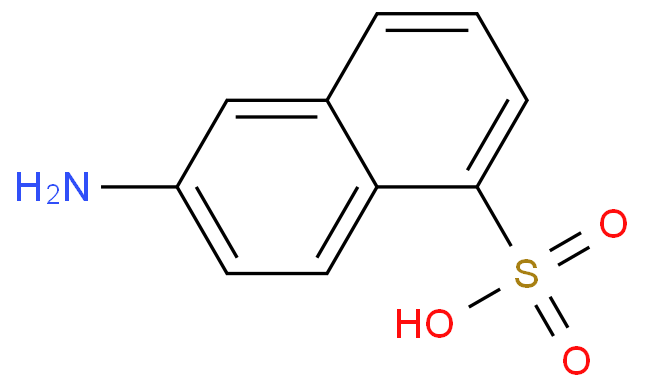
6-Amino-1-naphthalenesulfonic acid (CAS 81-05-0, C10H9NO3S, molecular weight 223.25 g/mol) is an amino-naphthalenesulfonic intermediate whose dual functionality anchors much of the world's azo colourant chemistry. The primary aromatic amine supplies the diazonium handle used to build the chromophore; the sulfonate delivers the water solubility and fibre substantivity required in the finished dye. Traded as technical press cake, aqueous concentrate or dried sodium salt, its demand tracks dyehouse throughput in textiles, leather, paper and ink-jet.
By 2026 competition has shifted from tonnage to documentation. Volume consolidates inside integrated Chinese and Indian complexes that consume most output domestically, while European and North American buyers take smaller lots under stricter terms: declared isomer content, non-detectable residual beta-naphthylamine, controlled iron and inorganic salt figures, and a complete REACH or TSCA dossier. Headline price per kilogram now ranks well below documented impurity profile and shade reproducibility.
This paper addresses sourcing managers, regulatory affairs teams and technical buyers who qualify intermediates rather than simply negotiate them. It sets out the physicochemical behaviour of the molecule, contrasts the two route classes now operated at scale, maps the application matrix, then analyses capacity geography, export flows and the widening gap between commodity technical grades and low-salt specification grades. Later sections treat compliance, sustainability, packaging and transit as practical trade constraints.
II. Product Deep Dive: Molecular Mechanisms and Production Evolution
2.1 Physicochemical Properties and Mechanisms
Commercial behaviour is dictated less by the sum of two functional groups than by their interplay across the naphthalene core. That interaction explains why the material trades as wet paste in some markets and dry powder in others, why warehouse humidity drives caking complaints, and why diazotisation yields differ between lots of identical nominal assay.
- Zwitterionic Structure and Solid-State Behaviour: The strongly acidic sulfonic group and the weakly basic amine mean the isolated solid exists as an intramolecular ammonium sulfonate zwitterion. That explains decomposition above 300 degrees Celsius in place of a true melting point, poor solubility of the free acid in cold water, and near-insolubility in toluene and xylene. Neutralisation to the sodium salt raises apparent solubility by orders of magnitude, which is why deliveries arrive as solutions or neutralised press cake.
- Auxochromic Function and Chromophore Construction: The amine is a strong electron-donating auxochrome; once diazotised and coupled onto a naphthol, pyrazolone or acetoacetanilide component, the resulting azo bridge gives orange, red and bordeaux shades of high tinctorial strength, while the sulfonate places the dye in the anionic direct-acid class and governs exhaustion on polyamide and protein fibres. Residual nitro homologues consume sodium nitrite and depress diazo value, so informed buyers specify nitrite uptake rather than nominal assay.
2.2 Synthesis and Manufacturing Technologies
Two route families dominate industrial supply. Both begin from coal-tar-derived naphthalene and both are technically mature, but they differ sharply in waste profile, capital intensity and achievable isomer purity, and that difference separates qualification-ready producers from commodity peddlers.
- Sulfonation, Nitration and Reduction Sequence: The classical sequence sulfonates naphthalene with oleum, exploits the kinetic alpha and thermodynamic beta preferences to set the substitution pattern, nitrates with mixed acid, then reduces the nitro group. Older plants still use the Béchamp iron-acid process, generating several tonnes of iron oxide sludge per tonne and burdening every downstream iron specification. The critical operation is isomer separation: these steps yield mixtures of the 1,5-, 1,6- and 2,6-disubstituted isomers, resolved by fractional crystallisation exploiting differential solubility of their sodium, magnesium or calcium salts, with mother liquors recycled to extinction.
- Cleaner Reduction and Process Intensification: Modern plants replace Béchamp reduction with catalytic hydrogenation over supported nickel or palladium, eliminating iron sludge and sharply lowering the iron and manganese figures that pigment makers scrutinise. Continuous falling-film sulfonation substitutes for batch oleum addition, spent acid is recovered by evaporation or diffusion dialysis, and nanofiltration or electrodialysis splits the salt load instead of discharging brine.
2.3 Core Application Matrix
- Azo Dyes and Reactive Colourants: The dominant outlet. The amine is diazotised and coupled into acid, direct and mordant dyes for wool, silk, polyamide and leather, or condensed with cyanuric chloride to install a fibre-reactive triazine anchor. Lot-to-lot diazo value determines reproducible shade depth.
- Organic Pigments: Serves as diazo component for laked azo pigments and higher-performance condensation pigments for coatings, inks and plastics, where the sulfonate is retained as a metal lacquer site or removed later. Residual amines and heavy metals govern acceptance.
- Whitening Agents and Functional Sulfonates: Also built into stilbene-triazine fluorescent brighteners for paper and detergents and into naphthalene-sulfonate dispersants and superplasticiser precursors, where colour body and chloride content matter more than diazo value.
III. Global Market Supply-Demand Landscape and Export Trends
3.1 Demand Drivers and Market Shifts
Aggregate consumption is roughly flat in tonnage yet steadily re-mixing by grade. Apparel-linked volume has migrated to Asia along with dye capacity, leaving Western pull concentrated in paper brighteners, leather finishing, ink-jet colorants and specialty coatings able to absorb compliance overhead. Buyers are thinning vendor lists, because brand restricted substance lists require disclosure of aromatic amine precursors.
3.2 Capacity Distribution and Export Flows
Capacity concentrates in China, with integrated complexes in Zhejiang, Jiangsu and Shandong combining naphthalene sulfonation with captive azo pigment lines, and in India, where the Gujarat corridor around Vapi, Sachin and Ankleshwar serves domestic formulators and exporters. European nameplate survives mainly as repurposed multipurpose assets run campaign-style or as blending sites, while Japanese and Korean output stays largely captive. Flows run east to west out of Shanghai, Ningbo, Hazira and Nhava Sheva under Chapter 29 headings for sulfonated aromatic amines, entering Europe through Rotterdam and Antwerp.
3.3 Market Bifurcation and Pricing Dynamics
The market has split in two. The commodity tier trades press cake and technical concentrate on naphthalene feedstock economics, exposed to coal-tar pricing, sulphur and mixed-acid costs and freight. The specification tier sells standardised dry powder with declared assay, isomer ratio, iron figure and amine panel, and its premium is durable because qualifying an alternate source costs a Western formulator more than the differential. Currency and Indian export incentives set short-term floors.
IV. In-depth Analysis of Global Compliance and Regulatory Barriers
Aromatic amines attract regulatory attention disproportionate to their tonnage, because the concern attaches less to the intermediate itself than to the trace compounds accompanying it and to the cleavable amines a finished colourant may release. Serious exporters therefore maintain standing dossiers, and that cost is structural.
4.1 European Market: REACH, CLP, and Sector-Specific Directives
- REACH Registration and SVHC Screening: A party placing one tonne per year or more on the EU market must hold a registration under Regulation (EC) No 1907/2006, directly or through an Only Representative, covering the identity profile, data set and chemical safety report. Importers verify that the registered tonnage band actually covers supply and that the substance has been screened against the Candidate List, including carcinogenic, mutagenic and reprotoxic endpoints. Because several amino-naphthalene family members carry harmonised CMR classifications, credible suppliers run read-across assessments on structural analogues.
- REACH Annex XVII Entry 43 and CLP Notification: Entry 43 restricts azo dyes capable of releasing listed aromatic amines above 30 milligrams per kilogram by reductive cleavage in textile and leather articles contacting skin or the mouth. Beta-naphthylamine is on that list and is precisely the historical impurity risk here, so European formulators require non-detectable levels by a validated EN 14362-type method. Alongside this, Classification, Labelling and Packaging duties under Regulation (EC) No 1272/2008 require notification to the C and L Inventory, commonly covering acute oral toxicity, skin and eye irritation and aquatic chronic hazard.
4.2 North American Market: TSCA, EPA, and FDA Regulations
- TSCA Inventory Status and Data Reporting: Supply into the United States requires listing on the Toxic Substances Control Act Inventory with active rather than inactive designation following the reset, since importing an inactive substance without a restoration request is a compliance failure irrespective of end use. Importers above the threshold must also file Chemical Data Reporting returns each cycle, disclosing volume, processing operations and use codes.
- Downstream Chains, Proposition 65 and Brand RSLs: Because the intermediate feeds consumer-adjacent articles, importers overlay obligations drawn from California Proposition 65 listings of carcinogenic aromatic amines, from Consumer Product Safety Commission requirements for children's products, and from private brand restricted substance lists maintained by apparel and footwear consortia. In practice exporters are asked for a full trace amine panel rather than merely a certificate of analysis.
4.3 The Critical Hurdle: Quality Control and Safety Limits
Compliance Warning: The binding non-tariff barrier is the impurity signature rather than the named substance. A shipment meeting its nominal assay can still be rejected if residual beta-naphthylamine appears above the customer's non-detect threshold, if iron or chloride breaches the pigment maker's limit, or if inorganic salt depresses diazo value below contractual shade-strength tolerance. Specify by impurity panel, require accredited results from validated methods on every lot, audit the producer's reduction technology rather than trusting its brochure, and confirm that the safety data sheet matches the imported grade.
V. Green Trade Barriers and ESG in Manufacturing
Sulfonation, nitration and reduction rank among the most emission-intensive operations in dye intermediate chemistry, so environmental performance has become a commercial selection criterion. European and Japanese buyers expect verified data rather than policy statements and exclude suppliers without it from tenders.
5.1 Carbon Footprint and Circular Economy
The dominant abatement lever is replacing Béchamp iron reduction with catalytic hydrogenation, removing tonnes of iron oxide sludge per tonne while improving the iron specification that determines market tier. Best-practice plants also run continuous sulfonation to cut steam demand, recover and reconcentrate spent sulfuric acid, treat nitration off-gas for nitrogen oxides, and use diffusion dialysis or membrane splitting to manage salt. Credible reporting quantifies Scope 1 process emissions, Scope 2 grid power and material Scope 3 items such as naphthalene feedstock, backed by ISO 14001 certification.
5.2 Sustainable Sourcing and Traceability
Traceability arrives through the dyehouse rather than the regulator: ZDHC restricted substance list conformance and wastewater limits are audited at textile mills, then pushed back upstream. Compliance means batch-level genealogy linking every drum to its sulfonation campaign and reduction method, documented naphthalene chain of custody, third-party rather than internal prohibited-amine testing, and formal declarations against customer restricted substance lists.
VI. Supply Chain Resilience and Export Logistics
Logistics are deceptively simple. The material is a non-volatile, non-flammable solid or aqueous concentrate needing no temperature control, yet performance turns entirely on excluding moisture, oxidation and foreign-ion contamination between reactor and dissolving vessel.
6.1 Packaging Standards and Moisture/Contamination Control
- Dry Powder Packaging and Caking Control: Dried sodium salt is hygroscopic and cakes under warehouse load, so standard practice is 25 kilogram multiwall kraft bags with a polyethylene liner or 500 to 1000 kilogram antistatic flexible intermediate bulk containers on fumigation-free pallets. Containerised shipments add desiccant sized to the voyage, since tropical port humidity produces bridging that slows discharge.
- Segregation, Cleanliness and Oxidation Protection: Trace iron, copper and manganese catalyse oxidation and shift shade, so concentrate moves in dedicated or validated-clean stainless vessels and lined tankers, and powder from dedicated bagging lines. Shared equipment requires cleaning verification by swab and rinse criteria, closures are sealed tightly for long voyages, and each unit carries a label tying lot number to certificate of analysis.
6.2 Dangerous Goods Identification and Transit Protocols
Classification for transport must be set against measured data rather than assumed. Most suppliers consign the material as non-regulated general cargo under IMDG, ADR and IATA, since the substance carries no dedicated UN number and organic dust of this particle size fails the flammability criteria; where a grade tests corrosive, shippers must assign Class 8 packing under the appropriate corrosive solid, acidic, organic entry with correct packing group and issue a dangerous goods declaration. Ocean transit is ambient full container load, with no cold chain, though bulk bookings avoid prolonged top-of-container exposure on high-summer Gulf and Red Sea routes. Discharge demands local exhaust ventilation, dust respirators and eye protection, contained spill cleanup to keep coloured run-off from drains, and port segregation where applicable.
VII. Enterprise Global Expansion Strategy Guide
Exporters moving from commodity trading into the specification tier usually fail on documentation rather than chemistry. The measures below are ordered by return on effort.
- Own Registration and Build the Dossier First: Appoint an Only Representative and complete full registration rather than relying on your buyer's coverage, since discovery that supplied tonnage exceeds the registered band ends the relationship. Assemble the hazard data set, refresh safety data sheets to the current jurisdictional format, and keep ISO 9001 and ISO 14001 certificates ready for first contact.
- Invest in Clean Reduction and Publish Data: Convert from iron reduction to catalytic hydrogenation where volume justifies it, then market the asset by publishing accredited results for prohibited amines, iron, chloride, sulfate ash and diazo value against declared rather than typical limits. Pair this with an accredited or customer-audited laboratory and validation against the customer's own diazotisation protocol.
- Hedge Geography and Structure Contracts: Dual-source from Indian and Chinese plants on harmonised specifications to absorb any single-site environmental shutdown, and add a European toll partner whose just-in-time blending converts bulk import into local delivery. Use frame contracts indexed to a transparent naphthalene benchmark, since spot-only quoting loses accounts when feedstock volatility forces unilateral price reopeners.
VIII. Conclusion
This is a mature, structurally standardised intermediate whose trajectory is governed less by chemistry than by how well each producer manages two impurities and one document set. Tonnage keeps drifting toward Asian integrated dye complexes, yet export profitability belongs to whoever demonstrates non-detectable listed amines, reproducible diazo value, low metal figures and an auditable footprint. That combination is slow to replicate, which is why the specification premium persists.
For buyers, qualification is a technical programme rather than a purchasing transaction: audit the reduction route, contractually lock the impurity panel, require accredited analytics per lot, and keep a qualified alternate site in a second jurisdiction. For producers, the route into that tier runs through hydrogenation investment, registration ownership and transparency rather than lower quotations.
IX. Industry Resource Connection and Supplier Ecosystem
Powered by Guidechem
This white paper is exclusively compiled by the Guidechem Intelligence Team based on global customs data, regulatory databases, and industry research. Guidechem is a leading global B2B chemical platform, dedicated to connecting global buyers with verified, high-quality manufacturers.
Relying on Guidechem's extensive global database, we have mapped the core participants in the current global 6-Amino-1-naphthalenesulfonic acid supply chain:
- China Integrated Naphthalene Cluster: The volume centre of gravity, integrating coal-tar naphthalene sulfonation with captive azo pigment and reactive dye lines across Zhejiang, Jiangsu and Shandong. It offers the widest grade range from press cake to low-salt specification powder, increasingly with hydrogenation installed, quoting out of Shanghai and Ningbo.
- India Gujarat Dye-Intermediate Corridor: The principal export alternative, centred on Vapi, Sachin, Ankleshwar and Ahmedabad inside vertically integrated dye groups that serve domestic formulators and ship through Hazira and Nhava Sheva. These producers compete on regulatory documentation, Only Representative support and links to European toll blenders.
- EU Specification and Distribution Network: Little primary sulfonation capacity remains, but the network across Germany, Switzerland, Belgium and the Netherlands retains campaign multipurpose assets, blending houses, independent ISO 17025 laboratories and Only Representative services. Buyers pay a premium for just-in-time delivery, small-lot repacking, local azo-cleavage testing and dispute resolution.
Disclaimer: The content of this white paper is compiled based on public market data and regulatory information available as of 2026. Global chemical regulations are subject to dynamic adjustments. In actual export operations, enterprises must consult professional regulatory advisors or relevant competent authorities to obtain the latest compliance guidance.


 EN
 Agricultural News
 Food News
 Industrial News
 Cosmetic News
 Pharmaceutical News
 Science News


 5YRS

