-
We detected your language preference as English. Would you like to switch to the English version for a better experience?
Switch to English
Stay here


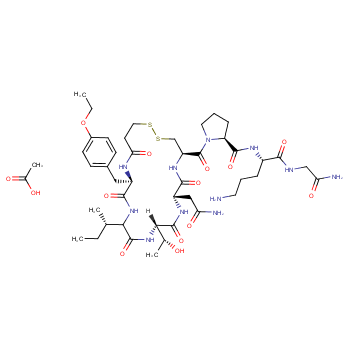
Atosiban acetate (CAS 914453-95-5) is the acetate salt of atosiban, a synthetic cyclic nonapeptide antagonist of the oxytocin receptor with additional vasopressin V1a affinity. Its backbone is Mpa-D-Tyr(Et)-Ile-Thr-Asn-Cys-Pro-Orn-Gly-NH2, with a 3-mercaptopropionyl residue at position 1 joined by a disulfide bridge to Cys6; the free peptide (C43H67N11O12S2, Mr about 994.19) plus acetic acid gives roughly 1054.24. Atosiban is an approved prescription medicine in the European Union and several other markets, so the buying frame is licensed finished-dose manufacture: GMP active substance, a dossier and a validated cold chain.
Supply is therefore a peptide CDMO proposition rather than a catalogue purchase. The material is assembled by Fmoc solid-phase synthesis, incorporating three non-natural elements — the mercaptopropionyl residue, O-ethyl-D-tyrosine and ornithine — before cleavage, oxidative folding, preparative purification, exchange into acetate and lyophilisation. Value per gram is high, and yield is dominated by folding and purification. What separates suppliers is not nominal purity but control of the impurity profile: deletion sequences, epimers, disulfide variants, oxidation products, residual trifluoroacetate, acetic acid, water and peptide content.
This paper sets out the structural and stability characteristics that drive the specification; the solid-phase, folding and salt-formation steps where campaigns succeed or fail; the analytical package regulators expect; the market and capacity picture for GMP peptide suites; the European and United States instruments that apply; the solvent and carbon footprint of solid-phase chemistry; and the cold chain that protects a lyophilised peptide in transit. It is written for sourcing, quality and regulatory professionals at licensed manufacturers and their CDMO partners, and is not medical advice.
Atosiban acts as a competitive antagonist at the oxytocin receptor, blocking the calcium mobilisation and prostaglandin release that drive uterine contraction. The design logic is visible in the sequence: the disulfide ring fixes a turn geometry compatible with receptor binding, the D-configured O-ethyl tyrosine and deaminated mercaptopropionyl residues blunt aminopeptidase attack, and ornithine with a C-terminal amide completes the pharmacophore. The active substance is a hydrophilic lyophilised powder, which is why commercial presentations are parenteral.
Industrial manufacture is Fmoc/tert-butyl solid-phase synthesis on a resin that generates the C-terminal amide, followed by cleavage, oxidation to close the ring, chromatographic purification, counter-ion exchange and lyophilisation. Development concentrates on four problems: near-quantitative coupling on an aggregation-prone sequence, introducing the non-natural residues without racemisation, folding at a dilution and redox potential that suppress oligomers and scrambled isomers, and converting the trifluoroacetate salt from purification into a defined acetate with reproducible acetic acid content.
Demand follows the installed base of approved tocolytic therapy and hospital procurement cycles, supplemented by generic entry in Asia and development activity in markets where the product is not authorised. Because alternatives include calcium-channel blockers and other tocolytics, volume is sensitive to national guidelines as well as price. The more important shift for suppliers is that loss of exclusivity and second-source policies have converted a single-source product into a competitive GMP peptide opportunity.
Capacity is defined by GMP peptide suites rather than by reactors, and is concentrated in Europe, China and India. Solid-phase campaigns are bounded by resin loading and column diameter, so commercial batches typically run at hundreds of grams to a few kilograms, with multi-batch pooling to meet annual demand. Lead times are governed as much by custom Fmoc amino acids, resins and columns as by synthesis time.
Pricing is tiered by development stage and documentation. Gram-scale development material is quoted per project with a heavy analytical component; GMP validation batches carry a premium because they absorb process validation, stability set-down and full release testing; commercial campaigns are priced per gram against a forecast. The dominant cost drivers are the custom non-natural amino acids, solvent and resin consumption, purification yield, the release package, cold-chain freight and inspected GMP status.
Because atosiban is an approved medicine, the regulatory burden sits on the active-substance manufacturer in a specific way. ICH Q7 governs GMP for the active substance, ICH Q11 its development and manufacture, and the applicant must reference a certificate of suitability, an active substance master file or a United States drug master file. Peptide-specific expectations — characterisation of related substances, justified thresholds, solvent and reagent control, immunogenicity risk assessment — are what regulators probe at assessment and inspection.
Solid-phase peptide synthesis is among the most solvent-intensive operations in pharmaceutical manufacturing, and its environmental profile is now a qualification topic rather than an internal matter. Buyers with published Scope 3 targets ask how much solvent is consumed per gram of peptide, whether restricted solvents remain in use, how trifluoroacetic acid is recovered or destroyed, and whether site energy use is documented.
Process mass intensity in solid-phase synthesis is typically in the thousands, dominated by washing solvents, deprotection base and cleavage acid, with lyophilisation and cold storage adding electrical load. Reduction levers include solvent substitution toward permitted systems, washing optimisation and in-line monitoring, recovery of acetonitrile and trifluoroacetic acid, continuous chromatography, and renewable electricity for freeze-drying.
Traceability starts with the amino acids. Fermentation-derived L-amino acids and, critically, the custom O-ethyl-D-tyrosine and protected mercaptopropionyl building blocks must come from qualified suppliers with documented routes, because their impurity profiles propagate into the peptide. Sites should hold an animal-derived-material-free position supported by supplier statements, maintain ISO 9001 and ISO 14001 systems, and provide Scope 1 and 2 data with a Scope 3 narrative covering solvents and cold-chain freight.
Atosiban acetate is a lyophilised, moisture-sensitive peptide normally stored frozen and protected from light, so its logistics are governed by stability rather than hazard class. The active substance is typically not classified as a dangerous good, but its packaging is regulated: dry ice is Class 9, and a temperature excursion destroys value long before a customs issue does. Cold-chain qualification, logger evidence and excursion governance belong in the supplier audit.
The peptide is normally consigned as non-hazardous cargo, while dry ice used as refrigerant is UN 1845, Class 9, shipped under IATA packing instruction 954 with correct marking and declaration; gel-pack systems avoid the dangerous-goods dimension but shorten the qualified transit window. Air freight with controlled handling is preferred, customs documentation should name the substance by CAS number and peptide identity, and every shipment should carry a defined excursion protocol with pre-agreed disposition rules and insurance.
Peptide CDMOs competing for this work win on three axes: the credibility of the analytical package, the yield economics of folding and purification, and the security of the non-natural building-block supply.
Atosiban acetate is a demanding but well-defined GMP peptide opportunity. Its difficulty lies not in assembling nine residues but in proving the material is what it claims to be, batch after batch: correct disulfide pairing, correct stereochemistry at the D-residue, a characterised and qualified impurity profile, defined acetate and trifluoroacetate levels, and a cold chain that preserves all of it. Suppliers who internalise that compete on demonstrated control; those who treat the molecule as a commodity lose at first inspection.
For buyers, the guidance is to qualify the analytical package before the price, require impurity reference standards and a justified specification, audit folding, purification and cold-chain qualification rather than only the synthesiser, and hold a second source wherever the product is a single-source authorised medicine. This paper is written for licensed manufacturers and their CDMO partners; it is not medical advice, it contains no dosing or administration guidance, and regulatory positions must be confirmed against current official texts.
Powered by Guidechem
This white paper is exclusively compiled by the Guidechem Intelligence Team based on global customs data, regulatory databases, and industry research. Guidechem is a leading global B2B chemical platform, dedicated to connecting global buyers with verified, high-quality manufacturers.
Relying on Guidechem's extensive global database, we have mapped the core participants in the current global Atosiban acetate supply chain:
Disclaimer: The content of this white paper is compiled based on public market data and regulatory information available as of 2026. Global chemical regulations are subject to dynamic adjustments. In actual export operations, enterprises must consult professional regulatory advisors or relevant competent authorities to obtain the latest compliance guidance.
|
 |
 |
|
 EN
 Agricultural News
 Food News
 Industrial News
 Cosmetic News
 Pharmaceutical News
 Science News


 2YRS


